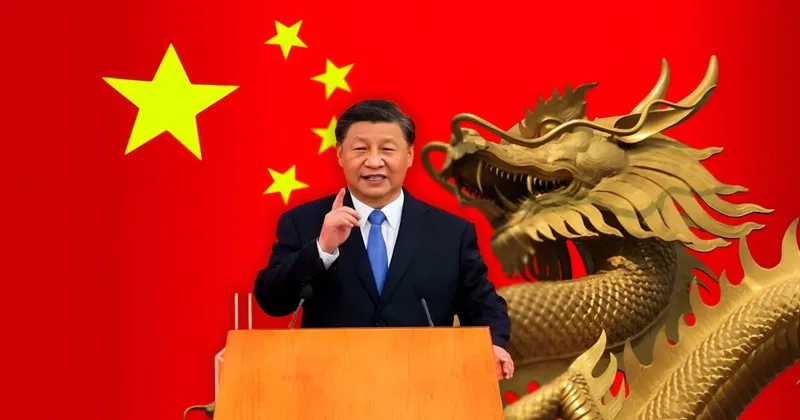
As China’s economic slowdown continues and pressures within the Chinese Communist Party (CCP) intensify, Beijing has introduced a new ideological framework known as “Xi Jinping Thought on Party Building,” signalling a further concentration of political authority around Chinese leader Xi Jinping and the Communist Party.
The doctrine was formally unveiled on June 15 during a national Party-building conference in Beijing. The date attracted attention because it coincided with Xi Jinping’s 73rd birthday. While Chinese leaders have traditionally avoided public celebrations of personal milestones, state media gave unusual prominence both to the anniversary and to Xi’s role as the central figure of the Party.
Senior CCP leaders used the conference to reinforce a message that has increasingly defined Xi’s rule that the Communist Party stands above all other institutions and must exercise leadership over every sphere of Chinese society. The event was attended by Politburo Standing Committee member Cai Qi, one of Xi’s closest political allies and the Party official responsible for ideology and propaganda, as well as Li Xi, head of the CCP’s powerful anti-corruption apparatus.
During the gathering, Party officials declared that “Xi Jinping Thought on Party Building” had officially taken shape and should become a guiding framework for Party organisations across the country. Cai Qi instructed Party committees and cadres to begin a fresh round of ideological study sessions, directing members to “study the original works, learn the original texts, and understand the principles” associated with Xi’s teachings.
He also emphasised adherence to the political slogan known as the “Two Upholds,” which requires officials to safeguard Xi Jinping’s position as the Party’s core leader and uphold the authority of the CCP Central Committee.
A new ideological campaign
The latest doctrine adds another layer to the growing collection of ideological frameworks bearing Xi Jinping’s name. Since taking power, Xi has steadily expanded the role of political education, ideological campaigns and Party supervision throughout China’s government institutions, universities, businesses and civil society.
The newly launched initiative places particular emphasis on Party discipline, organisational loyalty and the principle that “the Party leads everything.” While these themes have long existed within CCP doctrine, their formal consolidation into a dedicated “Party Building Thought” marks another step in institutionalising Xi’s political vision.
State news agency Xinhua described the doctrine as a “major original contribution” to Marxist party-building theory. The language reflects the Party’s broader effort to elevate Xi’s ideological status within the CCP’s official canon and place his political thought alongside the doctrines associated with previous Chinese leaders.
The campaign arrives at a sensitive moment. China continues to face sluggish economic growth, a prolonged property-sector crisis, weak consumer confidence and demographic challenges. Against that backdrop, Beijing has intensified efforts to promote political unity and ideological discipline within Party ranks.
The conference message left little ambiguity regarding priorities. Loyalty to the Party and loyalty to Xi Jinping were presented as inseparable political requirements.
Reform-era legacy faces a new direction
The introduction of “Xi Jinping Thought on Party Building” has also renewed debate about the direction of China’s political system. For decades after the late 1970s, China’s reform-and-opening-up period under Deng Xiaoping focused on moving the country away from the turbulence associated with the Cultural Revolution, the political movement launched by Mao Zedong that lasted from 1966 to 1976 and resulted in widespread social, political and economic disruption.
That reform era sought to reduce the dominance of revolutionary politics and create institutions capable of supporting economic modernisation. Under Xi Jinping, however, Party authority has steadily expanded across virtually every sector of Chinese life.
The new doctrine reinforces that trend. Rather than emphasising institutional separation or administrative autonomy, it places the CCP at the centre of governance, policymaking and social organisation. The core message remains that all institutions ultimately derive authority from the Party.
This year marks the 60th anniversary of the launch of the Cultural Revolution, adding symbolic significance to the timing of the new ideological campaign. The doctrine’s emphasis on political study, ideological loyalty and Party supremacy has drawn comparisons with earlier periods when political conformity occupied a central place in public life.
The framework effectively elevates Party-building from an organisational task into a comprehensive political mission. It presents Party leadership not merely as an administrative necessity but as the defining principle of governance.
Xi’s Name at the centre of the system
The CCP has increasingly incorporated Xi Jinping’s name into official doctrines, educational materials and Party regulations. The latest addition further strengthens a political structure in which Xi’s personal authority is closely intertwined with the authority of the Party itself.
State broadcaster China Central Television (CCTV) reinforced that message on June 15 by releasing a six-minute video titled “Communist Party Member Xi Jinping.” The programme was prominently promoted across major Chinese media platforms.
The video emphasised that Xi’s “primary identity is a Communist Party member” and that his “first responsibility is to work for the Party.” The messaging underscored a recurring theme of Xi’s leadership that the Party comes before all other institutions and political considerations.
Throughout the campaign, Party members have been instructed to deepen their study of Xi’s writings and integrate them into daily political work. The requirement extends across government agencies, local Party organisations and state institutions.
The doctrine also arrives as attention turns toward China’s political future beyond 2027, when another major CCP leadership transition point is expected. By further embedding Xi’s thought into Party structures and ideological education, Beijing is reinforcing a political framework centred on continuity of leadership and organisational loyalty.
For Party officials, the message accompanying the new doctrine is direct. Participation in ideological study is not optional but a political obligation. The campaign seeks to ensure that Party cadres demonstrate alignment with Xi’s leadership and the CCP’s central authority.
As Beijing pushes forward with this latest ideological initiative, the central theme remains unchanged that the Communist Party stands above the state, above society and above all other institutions. “Xi Jinping Thought on Party Building” transforms that principle into a formal doctrine, deepening the Party-centred political model that has increasingly defined China under Xi Jinping’s rule.