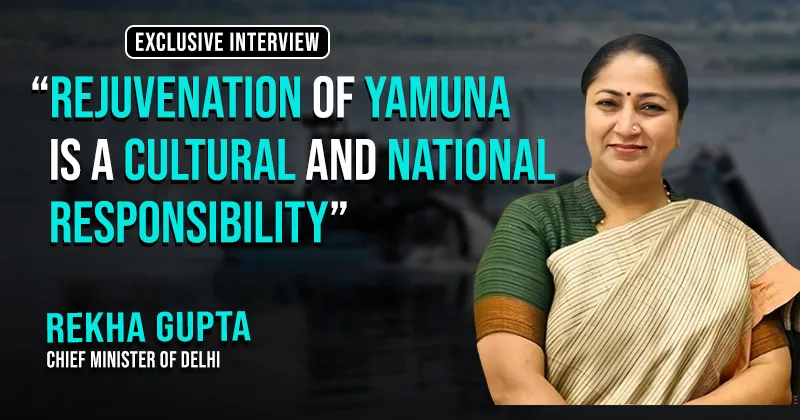
On June 14, Paryavaran Sanrakshan Gatividhi of RSS and the Delhi Government jointly organised a massive Yamuna cleanliness drive across 14 ghats in the national capital. Thousands of citizens from diverse back grounds participated in the campaign. On the sidelines of the initiative, Delhi Chief Minister Rekha Gupta spoke to Organiser Sub-Editor Yatharth Sikka about the Government’s plans for Yamuna rejuvenation and the broader vision for a cleaner and greener Delhi. Excerpts:
Delhi is the capital of India, yet for decades the Yamuna has remained one of the most polluted rivers in the country. The BJP promised Yamuna rejuvenation in its election manifesto, and citizens regularly witness cleanliness drives such as this one. Do you believe such drives alone are enough? Can the Yamuna realistically be cleaned, and what measurable progress has your government achieved so far?
At the outset, let me recall that in his very first victory speech after the Delhi Assembly Elections 2025, PM Narendra Modi reiterated his commitment to cleaning the Yamuna River, and since then, the double engine Government under his leadership has placed it at the top of policy priorities. At the same time, let me also remind you how the gentleman who used to call himself ‘Delhi Ka Maalik’ accepted his failure during the election campaign and confessed that there were a lot of unkept promises, and among them, the commitment to clean the River Yamuna. For us, the Yamuna is a sacred symbol of India’s civilisational consciousness. In the Bharatiya worldview, rivers are mothers, not drains. Therefore, Yamuna rejuvenation is also a cultural and national responsibility.
Our government has adopted a comprehensive strategy involving drain interception, sewage treatment, desilting, floodplain restoration, technology-based monitoring and inter-agency coordination. Pollution indicators have begun improving, sewage treatment efficiency has increased, and the number of major drains directly polluting the river has reduced significantly. The Yamuna is showing signs of recovery because governance is finally being matched by execution. I firmly believe that the Yamuna can be cleaned. If nations across the world can revive polluted rivers, India can certainly restore a river that is central to our faith, culture and ecology.
Experts often argue that the real challenge is not visible garbage but untreated sewage flowing into the river. What structural reforms has your government undertaken to address the root causes of Yamuna pollution?
That assessment is absolutely correct. Floating waste is visible, but untreated sewage is the real challenge. The previous government focused on optics while ignoring structural reforms. Several sewage treatment projects remained incomplete or underutilized for years. We are correcting those failures. We are addressing both. Visible garbage removal is important from an aesthetic point of view. Given our emphasis on attracting high-spending tourists, we have to ensure the city is clean and elegant. We are addressing the invisible garbage issue in Delhi and doing permanent structural reforms instead of temporary cosmetic fixes.
We are addressing both. Visible garbage removal is important from an aesthetic point of view. Given our emphasis on attracting high-spending tourists, we have to ensure the city is clean and elegant. We are addressing the invisible garbage issue in Delhi and doing permanent structural reforms instead of temporary cosmetic fixes. We have completed tapping and diversion of the major outfall drains (Najafgarh and Shahdara drains) to treatment facilities and have done capital allocation to extend sewer networks to previously uncovered unauthorized colonies, eliminating localized septage dumping. The government is also enforcing stricter biological oxygen demand (BOD) and total suspended solids (TSS) treatment standards across all active STPs.
Our government has accelerated pending STP projects, improved operational efficiency of existing plants, strengthened sewer connectivity, and introduced technology-driven monitoring systems. We are also integrating Yamuna rejuvenation with broader urban infrastructure reforms, including large-scale drain desilting and storm-water management.
Despite ongoing efforts, industrial discharge, encroachments, and untreated wastewater continue to enter the river. How is your government ensuring coordination among the various agencies responsible for the Yamuna, and how will the waste removed from the river be scientifically processed and disposed of?
For the last decade, Delhi’s progress was choked due to non-cooperative attitude of the previous government that led to bureaucratic friction between the MCD, the Delhi Government, and central agencies like the DDA. Because our administration is now aligned across all tiers of the government, a Unified Yamuna Action Committee has been formed to eliminate red tape.
Industrial discharge is being monitored more rigorously, illegal dumping is being identified through technology and field inspections, and enforcement mechanisms have been strengthened.
Delhi has witnessed a noticeable improvement in air quality in recent months. To what extent would you attribute this improvement to government policies rather than favourable weather conditions? More importantly, can Delhi sustain this improvement during winter?
Weather may influence air quality temporarily, but sustainable improvement comes only through policy and execution. Within a year, we have launched Delhi’s most comprehensive anti-pollution strategy. More than 326 mist sprayers, 388 anti-smog guns, 270 water sprinklers and 75 mechanical road sweepers are operating across the city. We have introduced six new air-quality monitoring stations and launched a dedicated Air Pollution Mitigation Action Plan. We are addressing dust, traffic congestion, construction pollution, industrial emissions and vehicular pollution simultaneously.
Most importantly, we are not waiting for winter to arrive before taking action. Earlier governments became active only when pollution peaked. We are identifying hotspots months in advance, undertaking dust-control measures, improving traffic management and enforcing pollution norms throughout the year. Moreover, we are not waiting for either winter to act. Our Advanced Winter Action Plan is already operational. This includes proactive micro-level monitoring of 13 primary pollution hotspots and close coordination with neighbouring states to deploy bio-decomposers to mitigate stubble burning at the source. One commendable example that I would like to quote here is the “Metro Monday” initiative, launched as part of the Mera Bharat, Mera Yogdan campaign inspired by Prime Minister Shri Narendra Modi Ji’s call for responsible living and energy conservation, we are encouraging every Delhiite to use public transport at least once a week. I have personally travelled by Metro and DTC buses to lead this effort by example, and all our MLAs have been directed to participate and promote the campaign in their constituencies.
Your government has initiated trials of new air-cleaning technologies to combat pollution. What technologies are being tested, and how effective do you expect them to be under Delhi’s real-world conditions?
Our approach is holistic and evidence-based. If a technology works, we will scale it. If it does not deliver measurable outcomes, we will not waste public money. We are doing a trial of advanced dust-suppressant chemical sprays, localized mobile anti-smog drones for high-altitude misting, and HEPA-grade indoor-outdoor air purification corridors at high-traffic intersections. We view these technologies as hyper-local tactical tools to protect citizens at critical congestion points, rather than a silver-bullet solution for the entire airshed. Real-world trials show a notable reduction in PM2.5 and PM10 levels in immediate micro-environments.
We are also currently testing multiple technologies under scientific supervision by institutions such as NPL and ICAT. These include EV-mounted anti-smog systems, filter-free outdoor air purification units, roadside pollution-capture devices and vehicle-mounted particulate filters.
Ghazipur, Bhalswa, and Okhla landfill sites have long affected the image of the National Capital. By when can Delhi realistically become free from these landfill mountains?
The landfill mountains are perhaps the most visible symbol of years of administrative neglect. For years, divided political control slowed down legacy waste management. Now, with a synchronized MCD and State Government, the ‘Triple Engine’ Government has doubled the daily processing capacity of biomining trommel machines at all three sites. Significant portions of the legacy waste have already been remediated. We are on track to make these sites completely free of legacy waste mountains ahead of schedule. The segregated combustible material is fuelling waste-to-energy plants, while inert materials are being utilized by the NHAI for highway embankment construction.
Significant land has already been reclaimed at Bhalswa, Ghazipur and Okhla. Simultaneously, we are strengthening waste segregation, recycling infrastructure and scientific waste management to ensure that new landfill mountains do not emerge. Our end goal is to permanently transform Delhi into a circular-economy city where waste becomes a resource. Citizens will see visible and measurable progress during this term itself.
Residents living near these landfill sites often complain of health problems, foul odours, and recurring fire hazards. What relief measures are being provided?
Every citizen, irrespective of where they live, deserves clean air, a healthy environment and dignity of life. That is the principle guiding our efforts. The health and dignity of communities living near landfills are top priorities. We have deployed dedicated mobile health clinics offering free respiratory check-ups and medicines. To control foul odors and prevent recurring methane fires, we have implemented continuous automated water-spraying systems and slope-stabilization techniques. However, the only permanent solution is the total remediation of these sites, which will eventually be transformed into green eco-parks for the local communities.
We have intensified bio-mining operations, strengthened fire-prevention systems, improved waste handling mechanisms and enhanced environmental monitoring around landfill sites. As landfill volumes reduce, odour, methane emissions and fire risks will decline substantially. However, we are not limiting ourselves to short-term relief. The permanent solution lies in eliminating the landfill mountains themselves while ensuring modern scientific waste management across Delhi.
The RSS has included environmental protection among its Panch Parivartan initiatives, and Paryavaran Gatividhi regularly organises such cleanliness campaigns. How do you view these efforts?
The RSS through its Paryavaran Gatividhi has consistently emphasised that environmental protection cannot be separated from societal well-being. Inspired by that holistic vision, our objective is not simply to remove pollution but to restore ecological balance for future generations.
We highly commend the environmental focus of the RSS’s Panch Parivartan initiative and the ground-level work of Paryavaran Gatividhi. Environmental protection is deeply rooted in our cultural ethos, not just legislative books. Government can build infrastructure, but society must sustain it. Without public participation and a collective shift in how we treat our natural resources, structural reforms cannot achieve their full potential and this is where the organizations like Paryavaran Gatividhi would be very helpful. The Yamuna cannot be cleaned by government departments alone. Citizens must participate by reducing waste, protecting water bodies and adopting environmentally responsible lifestyles. Prime Minister Narendra Modi Ji’s call for Jan Bhagidari has transformed governance across sectors. Environmental protection too must become a people’s movement. The RSS has played a significant role in nurturing this consciousness.
Your government has completed more than a year in office. Looking back, what would you consider the three biggest achievements of your administration?
First, we have restored faith in governance. Whether it is the Yamuna, pollution control, infrastructure development or civic services, people can see visible action replacing political theatrics.
Second, we have placed environmental sustainability at the centre of Delhi’s development model. Delhi’s first Green Budget, large-scale afforestation, expansion of reserved forests, Oxygen Parks, rooftop solar expansion, anti-pollution initiatives and Yamuna rejuvenation collectively reflect a new vision of sustainable urban development.
Third, we have strengthened the foundations of Viksit Delhi. Infrastructure upgrades, better coordination among agencies, technology-driven governance and citizen-centric administration are creating a model that aligns with Prime Minister Narendra Modi Ji’s vision of Viksit Bharat by 2047.