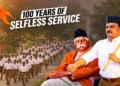
Recent remarks by Minister Priyank Kharge, suggesting that the Rashtriya Swayamsevak Sangh (RSS) is a “mysterious organization” because it is not formally registered anywhere, are not merely political rhetoric. They reveal a deeper misunderstanding of the fundamental rights enshrined in the Constitution of India and a lack of appreciation for Bharat’s civilizational and institutional traditions. Attempting to judge a century-old national movement, rooted in virtually every village of the country, solely on the basis of the absence of a registration certificate reflects a colonial mindset that equates legitimacy with bureaucratic recognition.
Constitutional Legitimacy
Those who seek to lecture others on constitutional values must first read the Constitution carefully. Article 19(1)(c) of the Constitution guarantees every citizen the fundamental right to form associations or unions. In constitutional jurisprudence, the existence of an association does not depend upon government registration. Registration under the Societies Registration Act or Trust Act is primarily an administrative mechanism designed to facilitate activities such as opening bank accounts, acquiring property, receiving grants, or obtaining tax exemptions. It is not the ultimate test of constitutional legitimacy.
Any association that does not threaten public order, national sovereignty, or constitutional governance is fully entitled to function under the protection of the Constitution, whether registered or not. To describe the RSS as a “secretive” or “illegitimate” organization merely because it lacks a centralized registration certificate demonstrates a misunderstanding of the very constitutional freedoms that protect civil society in a democracy.
The Colonial Standard of Registration
From a sociological perspective, the insistence that every social institution must derive legitimacy from formal registration is itself a legacy of colonial governance. Bharatiya civilization has historically evolved through decentralized, community-based, and self-regulating institutions.
Ancient monasteries, traditional mutts, Vedic pathashalas, village bhajan mandalis, community trusts, and local festival committees have often functioned effectively for generations without deriving their legitimacy from colonial legal frameworks. Their authority has rested upon social trust, shared values, and community participation. The RSS represents a continuation of this indigenous organizational tradition. To evaluate such a social movement solely through the lens of bureaucratic registration is to misunderstand the organic nature of Bharat’s civilizational institutions.
Transparency and Financial Self-Reliance
The allegation that the RSS operates outside the law or functions in secrecy is equally misleading. The RSS is fundamentally a socio-cultural movement and an ideological organization. Wherever legal and financial transactions are involved, established procedures are followed.
RSS offices and properties across the country are generally managed through legally registered trusts, which maintain accounts and comply with applicable laws. Furthermore, numerous organizations inspired by the RSS such as Vidya Bharati in the field of education, Bharatiya Mazdoor Sangh (BMS) in the labour sector, Seva Bharati in social service, and Vanvasi Kalyan Ashram in tribal development are duly registered entities functioning within the legal framework of the country.
Unlike many organizations that depend on government grants or foreign funding, the RSS primarily sustains itself through voluntary contributions known as Guru Dakshina, offered annually by its swayamsevaks. This model of financial self-reliance has enabled the organization to function independently while remaining accountable to its members and society. Several judicial judgments have also upheld this model.
The Emergency and the Defense of Democracy
Before portraying the RSS as anti-constitutional, one must revisit the pages of history. During the Emergency imposed in 1975, when democratic freedoms were suspended, civil liberties curtailed, and constitutional governance severely undermined, the RSS emerged as one of the principal forces resisting authoritarianism.
At a time when fundamental rights were effectively taken away, thousands of RSS volunteers were imprisoned, participated in underground resistance movements, and engaged in peaceful protests against the concentration of power. Many risked their careers, freedoms, and personal safety in the struggle to restore democracy. The role played by RSS volunteers in defending democratic institutions and contributing to the eventual restoration of constitutional rule is a documented chapter of modern Indian history. It is therefore ironic that political heirs of those associated with the Emergency now seek to question the constitutional commitment of an organization that actively participated in the movement to restore democratic freedoms.
The Need for Mature Public Discourse
A mature understanding of the Constitution requires more than a literal reading of legal provisions; it requires an appreciation of their underlying spirit. The worth of an organization cannot be determined merely by the existence of a certificate in a government office. Rather, it should be evaluated by its contribution to society, its service during times of crisis, and its role in nation-building.
Political disagreements are natural in a democracy. However, discussions concerning constitutional principles and historical realities should be conducted with intellectual seriousness and factual accuracy. Reducing such debates to superficial claims about registration certificates does little to strengthen democratic discourse.
Whether one agrees with the RSS or not, its century-long contribution to social service, national integration, and civic mobilization cannot be dismissed through administrative technicalities. Public representatives have a responsibility to elevate political debate rather than reduce it to unfounded allegations. A democracy flourishes when disagreements are informed by constitutional understanding, historical awareness, and intellectual integrity.