
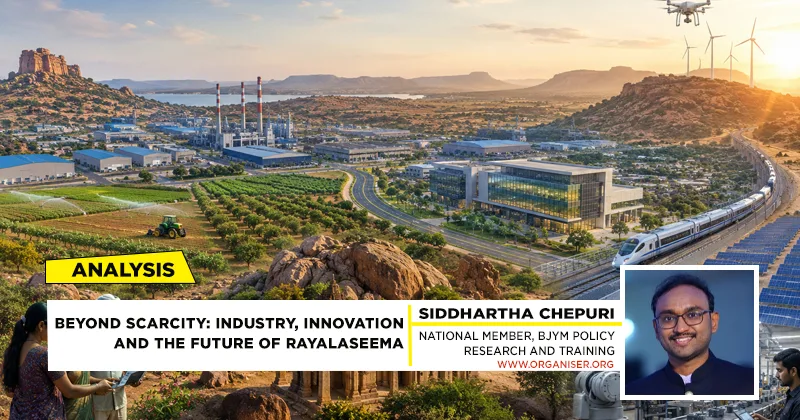
For decades, Rayalaseema has been defined by what it lacks. Conversations about the region
often begin with drought, migration and underdevelopment. These challenges are real, but they
have also obscured a larger reality. Few regions in India possess the combination of strategic
location, mineral resources, renewable energy potential, educational institutions and
entrepreneurial talent that Rayalaseema does.
This question of how the region can convert these strengths into sustainable growth was recently at the centre of the Rising Rayalaseema Symposium organised in Kadapa by the SAMARTH Research and Resurgence Foundation, led by BJP Andhra Pradesh President and SAMARTH Founder P.V.N. Madhav. The broader
takeaway from that discussion is that Rayalaseema’s future will depend not on the resources it
possesses alone, but on its ability to create value from them.
Geography offers one of the region’s strongest advantages. Located between Bengaluru,
Hyderabad, Chennai and Amaravati, Rayalaseema sits at the intersection of some of South
India’s most important economic centres. Three of India’s eleven economic corridors pass
through the region, providing connectivity to major markets and industrial clusters.
Economic history shows that regions with strong transport networks attract investment, talent and
enterprise. As infrastructure continues to improve, Rayalaseema has an opportunity to emerge
as a manufacturing and logistics hub serving multiple southern markets. Its location, often
overlooked in discussions about the region, may well become one of its greatest economic
assets.
Rayalaseema’s Mineral Wealth
The region’s mineral wealth presents another major opportunity. Rayalaseema possesses
substantial reserves of barytes, limestone, dolomite, iron ore, granite and quartz, while also
gaining relevance in the context of critical minerals required for clean energy technologies,
electronics and advanced manufacturing. Yet mining alone rarely creates broad based
prosperity. The larger opportunity lies in moving up the value chain through mineral processing,
advanced materials and downstream manufacturing.
At a time when countries are seeking resilient supply chains for strategic industries, regions capable of combining resource availability with industrial capacity stand to gain significantly. For Rayalaseema, the challenge is to
transform geological wealth into industrial growth rather than remain merely a supplier of raw
materials.
The same principle applies to renewable energy. Rayalaseema has emerged as one of Andhra
Pradesh’s most promising destinations for solar, wind and pumped storage projects and already
contributes around 5 per cent of India’s green energy output. Across the world, reliable and
affordable energy has often served as the foundation for industrial expansion. The region’s
renewable energy advantage can support investments in battery technologies, energy storage
systems, solar equipment and other industries linked to the clean energy transition.
If supported by suitable infrastructure and policy frameworks, Rayalaseema can position itself as an
important contributor to India’s emerging green economy while attracting energy intensive
industries that seek long term sustainability.
Agriculture remains central to the region’s economy and offers considerable scope for value
creation. Nearly 19.5 lakh acres in Rayalaseema are under horticulture cultivation, producing
bananas, sweet lime, mangoes, turmeric and several other crops. Yet much of the economic
value associated with these products is generated after harvest through processing, packaging,
branding and distribution.
How Farmers Can Get Good Returns?
Expanding food processing industries, strengthening cold chain infrastructure and improving market linkages can help farmers secure better returns while creating employment opportunities across the value chain. The challenge remains significant, particularly because only about 30 per cent of agricultural land currently has access to assured irrigation. Addressing water management and agricultural productivity will therefore remain
critical to the region’s long term growth strategy.
Industrial diversification will also be essential. The planned Advanced Medium Combat Aircraft,
or AMCA, testing and integration ecosystem in Sri Sathya Sai district has the potential to attract
a network of suppliers, startups and advanced engineering firms. Alongside defence
manufacturing, MSME development can become a major source of employment.
Traditional industries built around Geographical Indication products such as Dharmavaram silk sarees,
Venkatagiri sarees and Tholu Bommalata already possess strong brand recognition. With better
infrastructure, digital commerce, export support and access to finance, these enterprises can
generate jobs while helping local businesses move up the value chain. Such industries may not
attract the same attention as large investments, but they often create more distributed and
sustainable economic opportunities.
Perhaps the most significant long-term asset available to Rayalaseema is its expanding
knowledge ecosystem. Institutions such as IIT Tirupati, IISER Tirupati, the Central University of
Andhra Pradesh, Sri Venkateswara University and Yogi Vemana University provide a foundation
for innovation driven growth.
Research Underway
Research underway in areas such as precision agriculture, energy storage, drones, autonomous systems, smart mobility and green hydrogen aligns closely with sectors expected to shape India’s future economy. Successful regions around the world have demonstrated that universities become powerful growth engines when research translates into entrepreneurship, technology transfer and industry partnerships. Rayalaseema has the
opportunity to build exactly such a model.
Economic transformation cannot be measured solely by investment announcements or
industrial output. Its success will be judged by whether it creates opportunities for people. For
decades, many young men and women from Rayalaseema have migrated elsewhere in search
of education and employment.
Reversing that trend requires a development strategy that connects the region’s advantages, its geography, resources, energy potential, agriculture, MSMEs and educational institutions, into a coherent economic vision. For too long, Rayalaseema’s story has been told through the language of scarcity. The coming decades present an opportunity to tell a different story, one centred on industry, innovation and opportunity. The strengths already exist. The task now is to convert them into lasting prosperity