“He who never bowed his head in battle,
Who upheld courage even in adversity,
By keeping the flame of freedom alive,
He earned immortality in history.”
The golden pages of Indian history are adorned with the tales of countless heroes and great personalities, yet Maharana Pratap occupies a uniquely distinguished and glorious place among them. He was not merely the ruler of Mewar; he was a living symbol of Indian self-respect, freedom, and patriotism. His entire life stands as an unparalleled example of struggle, sacrifice, courage, and dignity. Every moment of his life was devoted to the protection of his motherland and the preservation of its independence. Even today, the very mention of his name evokes images of valour, heroism, and unwavering determination.
Maharana Pratap was born on May 9, 1540, at the Kumbhalgarh Fort in present-day Rajasthan. His father was Maharana Udai Singh II of Mewar, and his mother was Maharani Jaiwanta Bai. From an early age, Pratap displayed exceptional talent, bravery, and leadership qualities. He was raised in an environment steeped in Rajput traditions, patriotism, and devotion to duty. Through rigorous training in warfare, horsemanship, weaponry, and administration, he developed into an ideal warrior and ruler.
In 1572, following the death of Maharana Udai Singh, Pratap ascended the throne of Mewar. At that time, much of India was under the rule of the Mughal Emperor Akbar. Akbar sought to bring Mewar under his authority, but for Maharana Pratap, freedom was non-negotiable. He made it clear that under no circumstances would he compromise the independence of his homeland. Despite repeated diplomatic efforts and proposals from Akbar, Pratap steadfastly refused to submit. His decision reflected his unwavering self-respect and deep commitment to sovereignty.
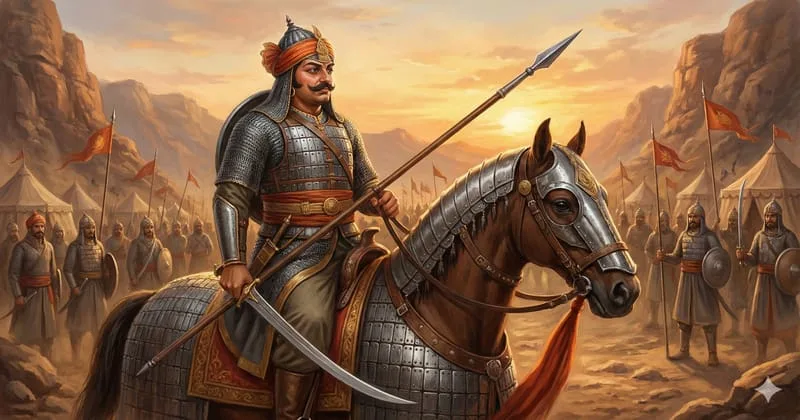
On June 18, 1576, the historic Battle of Haldighati took place. This battle has become a symbol of courage and resilience in Indian history. On one side stood the vast Mughal army led by Raja Man Singh of Amber, while on the other was Maharana Pratap’s comparatively small force. Despite being outnumbered and lacking resources, Pratap displayed extraordinary valour. During the battle, his loyal horse Chetak demonstrated remarkable devotion and bravery. Though severely wounded, Chetak carried his master to safety before succumbing to his injuries. The loyalty of Chetak and the heroism of Maharana Pratap remain immortal in Indian folklore and history.
Although the Battle of Haldighati did not result in a decisive victory, it was far from a defeat. It conveyed a powerful message to the nation—that the struggle for freedom is never futile. After the battle, Maharana Pratap faced immense hardships. He spent years living in forests, mountains, and remote regions while continuing his resistance. The ruler who once lived in royal palaces was forced to survive on grass bread along with his family. Yet he never surrendered to Mughal authority. His life stands as a testament to the truth that great causes demand sacrifice and perseverance.
During these difficult years, his trusted associate Bhamashah stood firmly by his side. Bhamashah donated his entire wealth to support Maharana Pratap’s cause and help rebuild his army. This contribution infused new strength into the struggle for Mewar’s independence. The friendship between Bhamashah and Maharana Pratap remains one of the finest examples of sacrifice and dedication to the nation.
Maharana Pratap never accepted defeat. Adopting guerrilla warfare tactics, he gradually reclaimed much of Mewar from Mughal control. Establishing Chavand as his new capital, he strengthened administration and undertook various measures for the welfare of his people. He was not only a great warrior but also a visionary and compassionate ruler. His governance was founded on justice, security, and public welfare.
His life was enriched with numerous noble qualities. His sense of self-respect was so profound that he never accepted subjugation. Patriotism was the guiding principle of his life. Courage and perseverance were his defining characteristics. Even in the most challenging circumstances, he never allowed despair to overcome him. His leadership inspired his soldiers and subjects to continue the struggle despite limited resources. He treated the joys and sorrows of his people as his own and remained devoted to their welfare.
On January 19, 1597, Maharana Pratap passed away at Chavand. Yet his life and ideals continue to inspire millions of Indians. He proved that true strength lies not in vast armies or material wealth, but in determination, self-confidence, and devotion to one’s nation.
For today’s youth, Maharana Pratap’s life serves as a beacon of inspiration. He teaches us that self-respect is a person’s greatest asset. No matter how difficult the circumstances, one should never compromise on principles and values. National interest must always take precedence over personal gain. Challenges should be confronted with courage rather than avoided. We should take pride in our history, culture, and traditions while actively contributing to nation-building.
At a time when material success is often regarded as the ultimate goal of life, Maharana Pratap’s legacy reminds us of the importance of character, duty, sacrifice, and patriotism. If the younger generation embraces his ideals, they will not only achieve personal success but also contribute meaningfully to society and the nation.
Maharana Pratap was not merely a great king of history; he was a symbol of the Indian spirit itself. His life teaches us that any struggle undertaken for freedom, dignity, and truth is never in vain. Whenever courage, patriotism, and sacrifice are celebrated in India, Maharana Pratap’s name will be remembered with pride and reverence. For generations to come, he will remain an eternal source of inspiration, strength, and self-respect.
“Freedom was his resolve, self-respect his identity;
The life of Maharana Pratap is the glorious pride of India.”