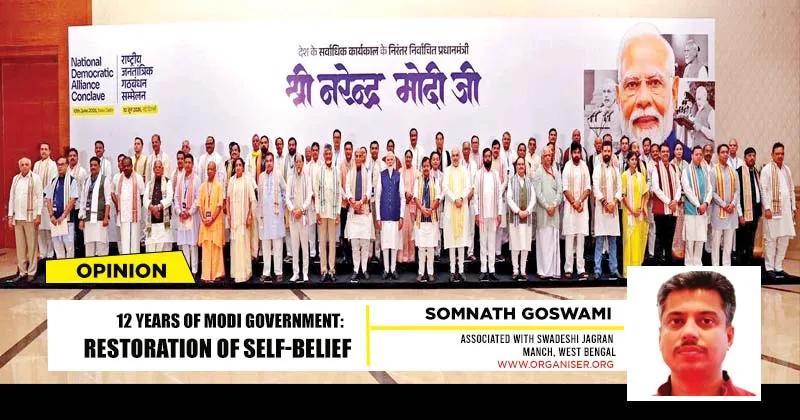
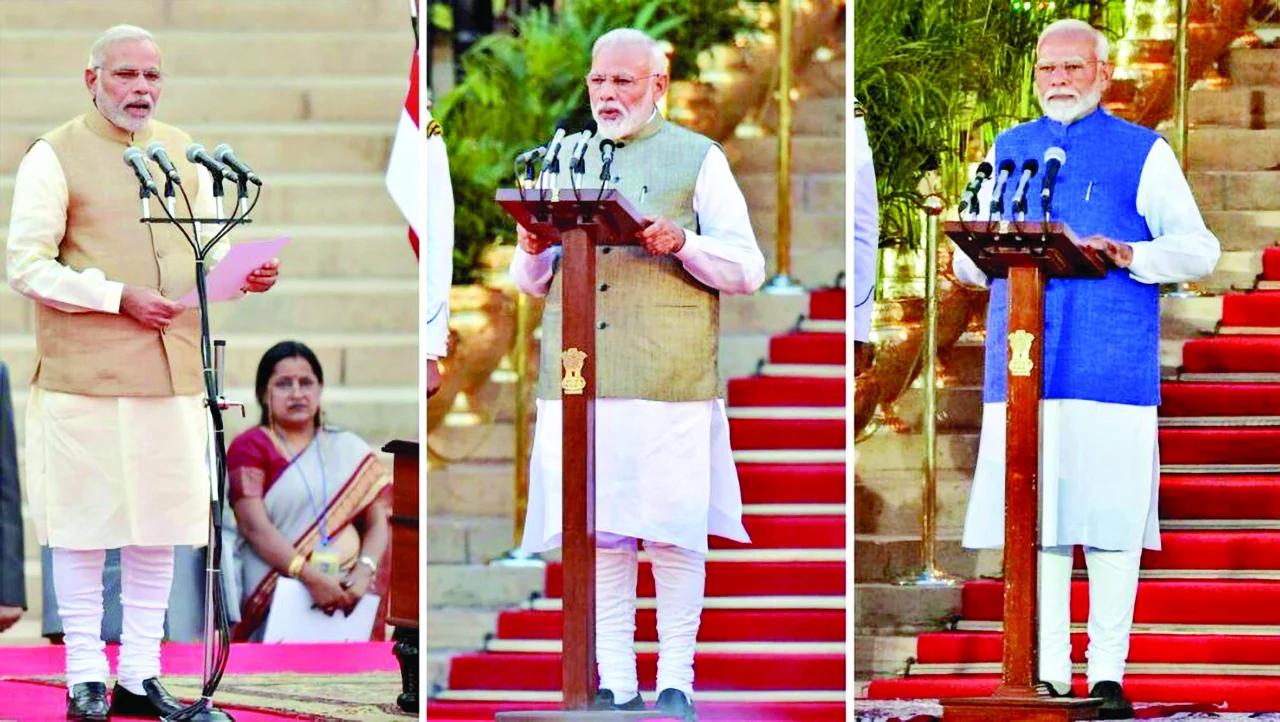
Twelve years ago, when Narendra Modi took oath of office, India stood at an important crossroad. The country was already recognised as a large democracy, a growing economy and a responsible international actor. Yet it remained constrained by a certain psychological hesitation about its own place in the world.
India often spoke of its civilisational heritage and strategic importance, but its actions frequently reflected the mindset of a country managing limitations rather than pursuing possibilities. Foreign policy was largely reactive, economic ambitions were often incremental, and national confidence rarely matched national potential. Looking back after twelve years, future political commentators may conclude that the most consequential achievement of the Modi era was not a particular scheme, infrastructure project or diplomatic initiative. It was the restoration of India’s belief that it could shape global events rather than merely adapt to them. The transformation of roads, railways, airports, digital systems and welfare delivery has been important, but these are ultimately manifestations of a deeper shift—the return of national ambition as a governing principle.
Gap between Potential & Performance
The significance of this change is best understood in historical context. Independent India inherited extraordinary civilisational assets: a strategic location, a vast population, democratic institutions and one of the world’s oldest cultural traditions. Yet for much of the post-Independence era, India’s global role remained smaller than its inherent strengths warranted. The Cold War, economic constraints and domestic developmental challenges encouraged caution. Strategic autonomy often became synonymous with strategic restraint. India sought moral influence but lacked the economic and military weight necessary to translate influence into power. The result was a persistent gap between potential and performance. The Modi years have sought to close that gap by pursuing a simple but transformative proposition: that India should think and act like a leading power rather than a perpetual emerging power. This shift has influenced decisions across domains ranging from economic policy and national security to diplomacy and technology.
Economic strength has been the foundation of this project. History demonstrates that no nation has achieved enduring geopolitical influence without first building a strong economic base.
Modernisation & Digital Transformation
The last decade has, therefore, witnessed an unprecedented emphasis on infrastructure creation, manufacturing capacity, logistics modernisation and digital transformation. Airports have expanded dramatically, metro systems have spread across major cities, expressways and freight corridors have accelerated connectivity, and public capital expenditure has reached levels unimaginable a generation ago. Simultaneously, India has emerged as one of the world’s most dynamic startup ecosystems while attracting investment into sectors ranging from electronics and semiconductors to renewable energy and defence manufacturing. These developments are often discussed as domestic economic achievements, but their significance extends far beyond growth statistics. They represent an effort to create material foundations of national power. A country that seeks strategic autonomy must possess the productive capacity, technological competence and economic resilience necessary to sustain it.
Emergence of Digital Public Infrastructure
Among the most remarkable achievements of this period has been the emergence of Digital Public Infrastructure as a new instrument of national influence. The combination of Aadhaar, Jan Dhan accounts and the Unified Payments Interface has created a governance architecture of unprecedented scale. Hundreds of millions of citizens have been integrated into formal financial systems while welfare transfers have become more transparent and efficient. Yet the larger significance lies elsewhere. For decades India imported developmental models from advanced economies. Today, policymakers from Asia, Africa and Latin America increasingly study Indian digital governance systems as potential templates for their own countries. In a century, where technological standards and digital ecosystems will shape geopolitical influence, India’s ability to export governance solutions may prove as consequential as its ability to export goods and services. The country is no longer merely participating in global innovation; it is beginning to shape it.
The transformation has been equally visible in the sphere of national security. One of the defining characteristics of the Modi era has been abandonment of strategic ambiguity regarding defence of national interests. For many years, India’s responses to cross-border terrorism and external provocations were often perceived as restrained to the point of predictability. The surgical strikes and the Balakot operation signalled a departure from that pattern. Their importance lies not only in their operational outcomes but in the message they conveyed about India’s willingness to impose costs on those who challenge its sovereignty. In international politics, perceptions often matter as much as capabilities. A nation that is seen as unwilling to act invites pressure; a nation that demonstrates resolve alters the calculations of adversaries. The Modi government’s approach has sought to ensure that India’s growing economic strength is matched by a credible willingness to defend its interests.
At the same time, India has preserved and, in many respects, strengthened its tradition of strategic autonomy. The defining diplomatic challenge of the current era has been the fragmentation of the international system into competing centres of power. The Russia-Ukraine conflict illustrated the complexity of this environment. While many countries were compelled to choose sides, India maintained engagement with all major actors while protecting its own national interests. This approach has often been misunderstood abroad. It is neither neutrality nor opportunism. Rather, it reflects a mature understanding that the interests of a rising power cannot be permanently subordinated to the preferences of any external bloc. India today enjoys deep partnerships with the United States, strong defence ties with France and Israel, longstanding relations with Russia, growing engagement with the Gulf and an increasingly influential role within the Global South. Few countries possess the diplomatic flexibility to operate effectively across such diverse platforms. That flexibility itself has become a strategic asset.
Another defining feature of the last twelve years has been the re-emergence of civilisational confidence as a component of statecraft. Modern India is not merely a nation-state created in 1947; it is also the inheritor of a civilisation that has endured for millennia. For decades, however, Indian diplomacy often hesitated to draw upon this civilisational identity. Under Modi, the country has increasingly projected itself as a civilisation-state whose historical experience offers unique perspectives on global challenges. International Yoga Day, the promotion of traditional knowledge systems, the restoration of cultural heritage sites and the renewed emphasis on India’s civilisational narrative are all part of a broader effort to align national identity with national ambition. Critics may debate the methods, but the larger trend is unmistakable. India has become more comfortable presenting itself to the world on its own cultural terms rather than through borrowed frameworks. This growing confidence found perhaps its most visible expression during India’s G20 presidency. The successful inclusion of the African Union as a permanent member reflected India’s long-standing commitment to a more representative global order. More broadly, the presidency demonstrated India’s ability to bridge competing geopolitical camps at a time of extraordinary international tension. For many developing nations, India increasingly represents a model of growth that combines democratic governance, technological innovation and developmental ambition. The aspiration to serve as a leading voice of the Global South is not merely a diplomatic slogan; it is an attempt to position India as a bridge between established powers and emerging economies. Whether this ambition is fully realised will depend on sustained economic and institutional strength, but the direction of travel is clear.
The next stage of India’s rise will depend less on symbolism and more on execution. The country must deepen its manufacturing base, strengthen research and development capabilities, build globally competitive universities and create innovation ecosystems capable of leading the technologies of the future. Semiconductors, artificial intelligence, clean energy, biotechnology and advanced defence systems will shape the hierarchy of nations in the coming decades. India’s success in these fields will determine whether its current momentum becomes a permanent feature of the international system.
The challenge is particularly important because demographic advantage alone guarantees nothing. India possesses one of the world’s youngest populations, but demographic potential becomes a demographic dividend only when supported by skills, productivity and employment opportunities. Infrastructure must translate into competitiveness, investment must translate into innovation and growth must translate into prosperity. The next phase of national transformation must therefore focus on human capital with the same intensity that the previous phase focused on physical capital. Great powers are built not only through highways and airports but also through laboratories, universities and research institutions.
As political commentators eventually assess the Modi years, they will undoubtedly debate individual policies, economic outcomes and political decisions. Such debates are natural and necessary in a democracy. Yet beyond those debates lies a broader historical reality. The defining contribution of this period may be the restoration of national self-belief. For decades, India’s discourse was dominated by questions about its limitations—what it lacked, where it fell behind and why its potential remained unrealised. Today the conversation has shifted toward questions of capability, influence and leadership. That shift, while intangible, may prove more consequential than any individual project or programme.
For the first time in generations, India is not merely asking how it can secure a place within the existing international order. It is asking how it can help shape the order itself. Whether that ambition ultimately succeeds will depend on choices made over the next two decades. But the psychological barrier has already been crossed. The India of 2026 is more confident, more visible and more ambitious than the India of 2014. The country’s challenge now is not to discover its potential, but to realise it. If the 20th century was defined by India’s struggle for political freedom and the early twenty-first century by its quest for economic development, the coming decades may well be remembered as the period when India sought to reclaim its place as one of the world’s leading civilisational powers. That, more than any statistic or slogan, may be the enduring legacy of the Modi Doctrine.