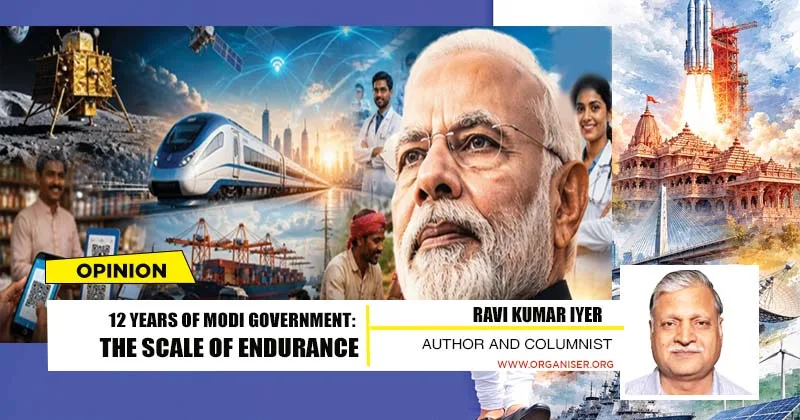
12 years of Modi government: The scale of endurance
June 15, 2026
  • Read Ecopy
  • Circulation
  • Advertise
  • Careers
  • About Us
  • Contact Us
Android AppiPhone AppArattai
Organiser
  • ‌
  • Bharat
    • Assam
    • Bihar
    • Chhattisgarh
    • Jharkhand
    • Maharashtra
    • View All States
  • World
    • Asia
    • Europe
    • North America
    • South America
    • Africa
    • Australia
  • Editorial
  • International
  • Opinion
  • RSS @ 100
  • More
    • Op Sindoor
    • Analysis
    • Sports
    • Defence
    • Politics
    • Business
    • Economy
    • Culture
    • Special Report
    • Sci & Tech
    • Entertainment
    • G20
    • Azadi Ka Amrit Mahotsav
    • Vocal4Local
    • Web Stories
    • Education
    • Employment
    • Books
    • Interviews
    • Travel
    • Law
    • Health
    • Obituary
  • Subscribe
    • Subscribe Print Edition
    • Subscribe Ecopy
    • Read Ecopy
  • ‌
  • Bharat
    • Assam
    • Bihar
    • Chhattisgarh
    • Jharkhand
    • Maharashtra
    • View All States
  • World
    • Asia
    • Europe
    • North America
    • South America
    • Africa
    • Australia
  • Editorial
  • International
  • Opinion
  • RSS @ 100
  • More
    • Op Sindoor
    • Analysis
    • Sports
    • Defence
    • Politics
    • Business
    • Economy
    • Culture
    • Special Report
    • Sci & Tech
    • Entertainment
    • G20
    • Azadi Ka Amrit Mahotsav
    • Vocal4Local
    • Web Stories
    • Education
    • Employment
    • Books
    • Interviews
    • Travel
    • Law
    • Health
    • Obituary
  • Subscribe
    • Subscribe Print Edition
    • Subscribe Ecopy
    • Read Ecopy
Organiser
  • Home
  • Bharat
  • World
  • Operation Sindoor
  • Editorial
  • Analysis
  • Opinion
  • Culture
  • Defence
  • International Edition
  • RSS @ 100
  • Magazine
  • Read Ecopy
Home Bharat

12 years of Modi government: The scale of endurance

Records in politics are measured not only by time but by the complexity of the nation being governed. Narendra Modi's twelve years in office place him among the most enduring democratic leaders of the modern era

Ravi Kumar IyerRavi Kumar Iyer
Jun 15, 2026, 07:30 pm IST
in Bharat, Opinion
Follow on Google News
FacebookTwitterWhatsAppTelegramEmail

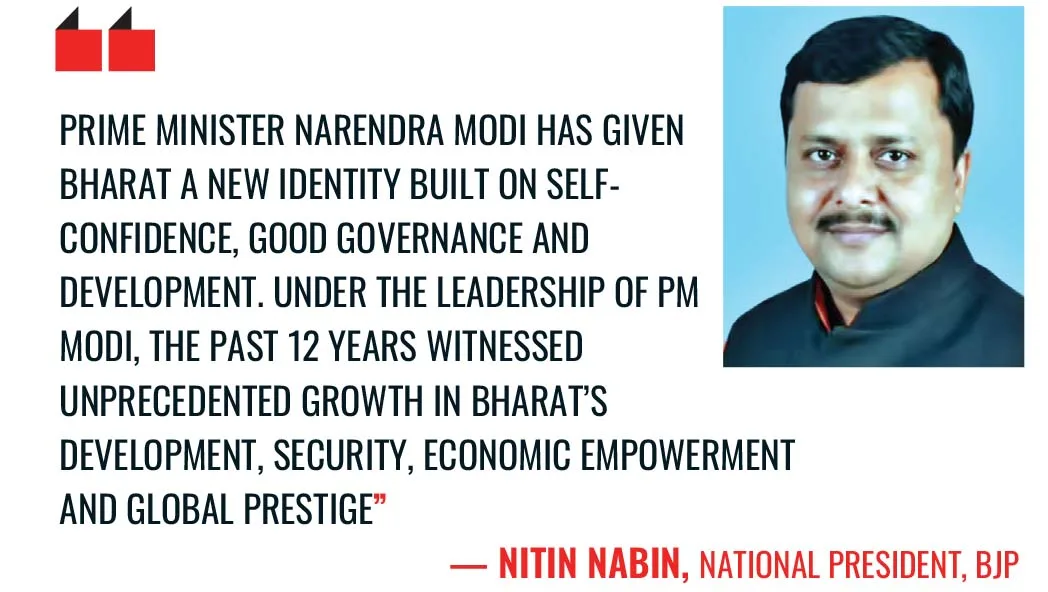
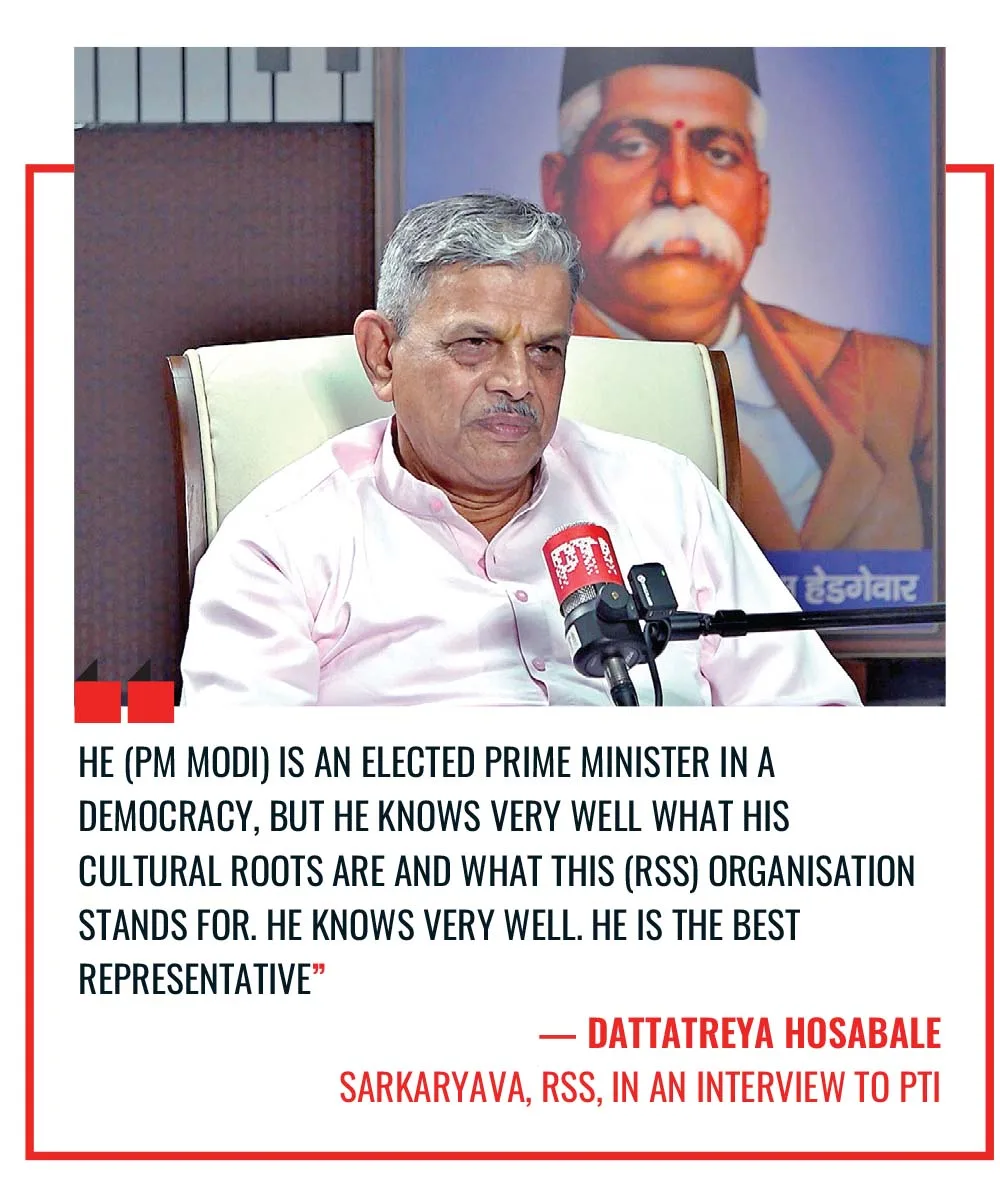
June 10, 2026, marks a watershed moment in the history of global democracy. Completing exactly 4,399 consecutive days in office, Prime Minister of Bharat Narendra Modi has officially become the longest-continuously serving elected Prime Minister in the nation’s history. In doing so, he surpasses a six-decade-old record held by Bharat’s foundational Prime Minister Jawaharlal Nehru, whose post-independence elected streak concluded at 4,398 days.

While political longevity is often calculated in simple mathematical tallies, evaluating leadership durability requires examining it alongside a critical geopolitical variable: the scale of the populace. When longevity is weighed against demographic weight, a stark reality emerges. Narendra Modi stands as the longest-serving democratically elected head of government of a large country anywhere in the world today.
Political history is replete with long-serving leaders, but context matters deeply. Lee Kuan Yew (Singapore) governed seamlessly for 31 consecutive years (1959–1990) as Prime Minister. Yet, during his foundational years, Singapore’s population hovered between 1.5 million and 3 million people—essentially a highly manageable, concentrated city-state. Sheikh Hasina (Bangladesh) commanded the legislative architecture of her country for over 20 cumulative years (including an uninterrupted run from 2009 until her resignation in August 2024). While navigating a highly complex country of 170 million, the administrative and geographic perimeter remained localised compared to a continental entity. Paul Biya (Cameroon) has served as President of 3 crore population since November 6, 1982. While Cameroon holds elections, his longevity in power is often described by political scientists as autocratic rather than strictly representative. Teodoro Obiang Nguema Mbasogo (Equatorial Guinea) has been the President since August 1979 for a small country of 18 lakhs.
To govern a highly centralised, ethnically homogeneous, or geographically compact state for decades is an exercise in elite administrative management. To do the same in a subcontinental nation of 1.46 billion people is an entirely different operational matrix.
The Math of Subcontinental Pluralism

Governing modern India is equivalent to administering the entire European Union, the United States, Russia, and South America combined — not just in raw numbers, but in sheer systemic friction. The Scale of present Indian Democratic Governance is a population of 1.46+ Billion with 960+ Million voters across 28 States and 8 UTs and 700+.
Active Political Parties which face continuous, 24/7 localised elections, unrestricted digital scrutiny, and deep pluralism.

Unlike single-party state models such as China under President Xi Jinping, whose tenure relies on an all-encompassing party apparatus, Bharat’s system is a hyper-competitive, round-the-clock electoral cauldron. Since 2014, the current administration has had to navigate:
1. Continuous Electoral Volatility: Bharat is in a state of perpetual election cycles. A premier must win not just national mandates (such as the historic consecutive terms of 2014, 2019, and 2024), but also manage high-stakes state assembly elections occurring multiple times every single year.
2. Hyper-Fragmented Political Landscapes: Moving past the one-party dominance of the early post-independence era, modern India features over 700 active political parties, deep-seated regional assertions, and complex coalition arithmetic.
3. The Digital Panopticon: Unlike the legacy leaders of the twentieth century who governed without private television networks or instant digital communication, contemporary governance unfolds under the immediate, unfiltered gaze of over 800 million smartphone users and globalised social
media ecosystems.
Shift from Survival to Delivery

What makes this 12-year-and-15-day milestone textually significant to political scientists is that the survival of the executive has not resulted in policy paralysis. Frequently, long-serving leaders often become desperate to just hold onto power. This desperation typically causes them to ruin the economy, impose emergency, suspend civil rights, imprison opposition leaders and attack democratic institutions. However, Narendra Modi avoided that trap, maintaining a stable democracy while successfully passing major laws.

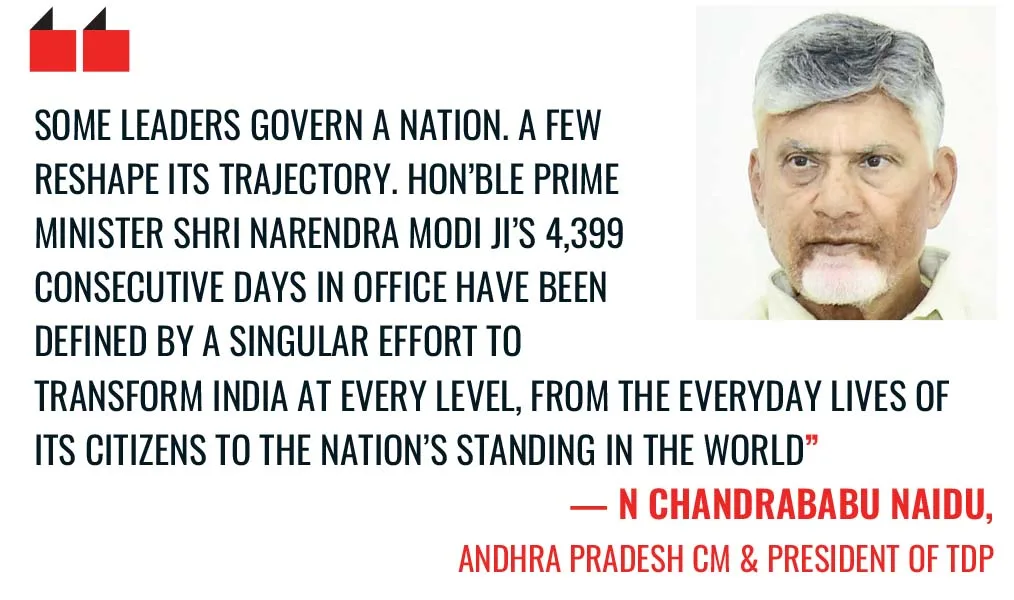
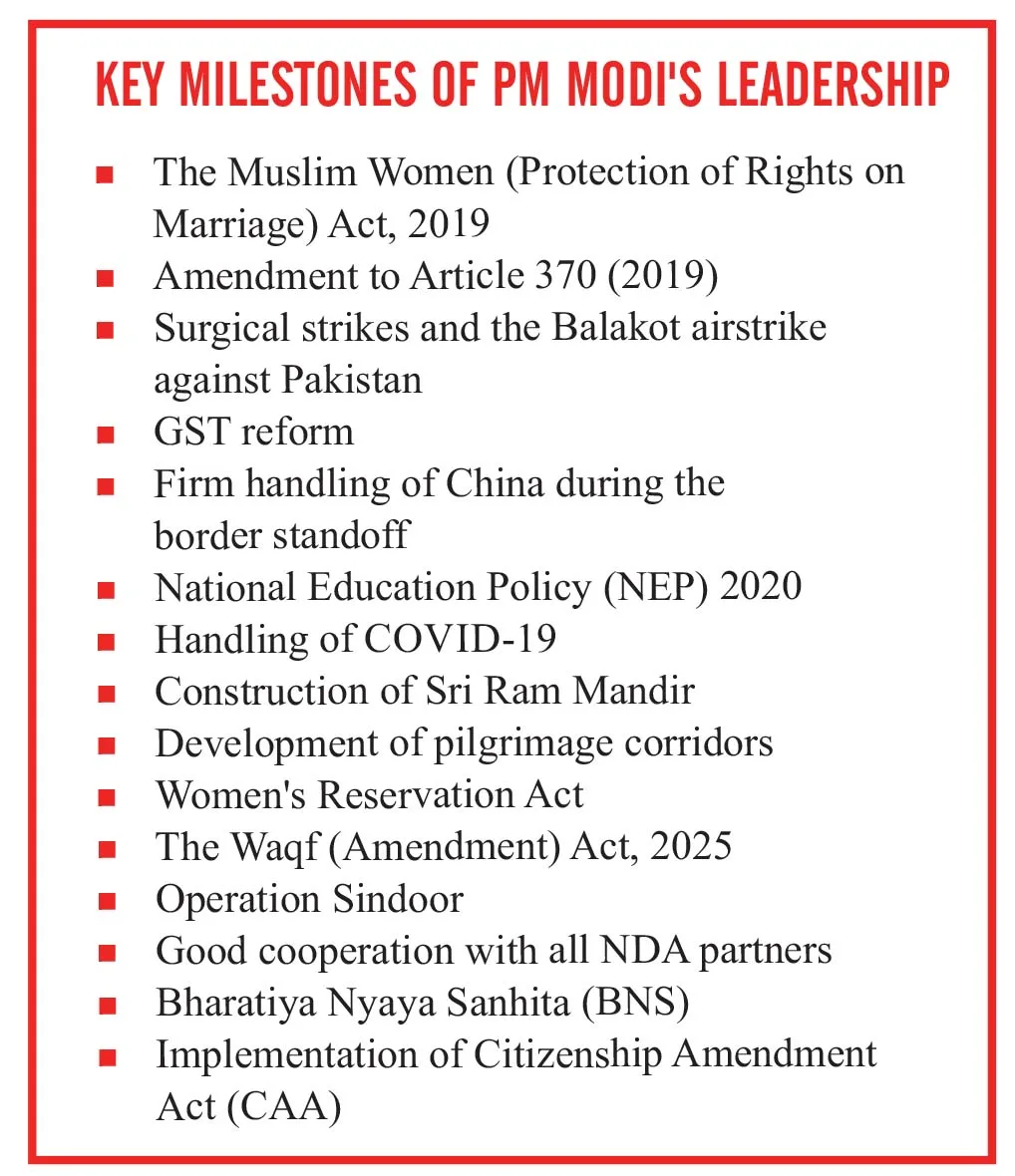
Over the last 4,399 days, Bharat has undergone a massive transformation through its Digital Public Infrastructure and targeted welfare, uplifting over 23 crore citizens from multidimensional poverty. Reforms like GST integrated the market, Direct Benefit Transfers reduced leakages, and Jan Dhan accounts brought half a billion unbanked citizens into the financial system. Globally, Prime Minister Modi championed the Global South by inducting 1.5 billion people of all the 55 member countries of the African Union into the G20 in Delhi and has received a record number of international awards.

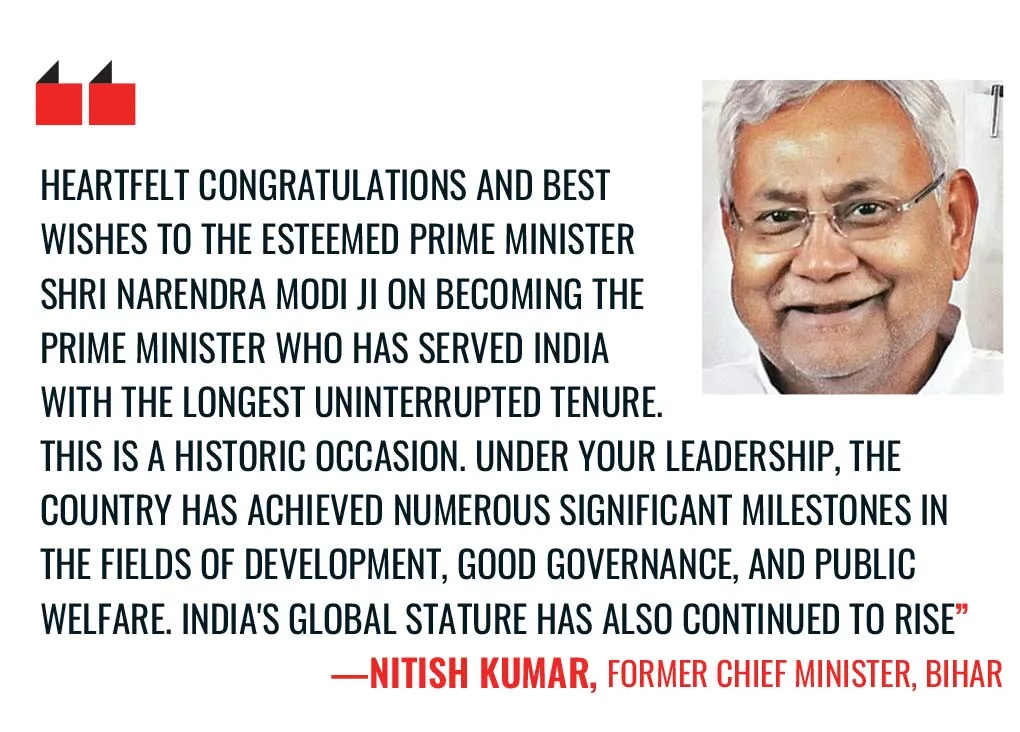
Every democracy features a natural shelf-life for its leadership; voter fatigue, anti-incumbency, and internal contradictions typically erode a leader’s political capital within a decade. As the National Democratic Alliance celebrates this milestone, the statistics serve as a reminder of an underlying truth: in the arena of global politics, surviving the democratic gauntlet of the world’s most populous nation for over twelve unbroken years is not merely a record of longevity. It is a testament to an unprecedented scale of sustained public trust.


Topics: GST integrated the marketDirect Benefit Transfers reduced leakagesNational Democratic Alliance celebratesPrime Minister of Bharat Narendra Modi
ShareTweetSendShareSend
✮ Subscribe Organiser YouTube Channel. ✮
✮ Join Organiser's WhatsApp channel for Nationalist views beyond the news. ✮
Previous News

The Fifty-Year Sabotage: How politicians are making delimitation meaningless

Next News

Janajati Samagam 2026: The indigenous quest to protect culture, tradition and the soul of Bharat

Related News

No Content Available
Load More

Latest News

Singapen Special Task Force (SSTF) unit in Tamil Nadu

Singapen, all-women police unit, force launched by TVK, but crimes against women remain a growing concern in Tamil Nadu

The National Democratic Alliance (NDA) on June 10 passed a resolution marking 12 years of the Narendra Modi-led Government, describing it as a defining phase of "people-centric development, participative democracy and performance-oriented governance"

12 years of Modi government:  Restoration of self-belief

More than a cultural gathering, the event reflected a collective resolve to protect indigenous traditions, strengthen community bonds and celebrate Bharat's enduring unity in diversity.

Janajati Samagam 2026: The indigenous quest to protect culture, tradition and the soul of Bharat

12 years of Modi government: The scale of endurance

Representative Imaeg

The Fifty-Year Sabotage: How politicians are making delimitation meaningless

Video of CM Bhagwant Mann sprinkling alcohol on Sikh Guru portraits is authentic: Akal Takht Jathedar Gargaj to Sangat

Delhi CM Rekha Gupta take spart in cleanliness drive of River Yamuna

Delhi witnesses massive Yamuna cleanup drive: 14 Ghats, 71 tonnes of waste removed

Remembering Shaheed Bhai Mani Singh: They cut him joint by joint, he lives in every Sikh prayer

Cache of arms and explosives recovered by Odisha Police from Rayagadha forest

Odisha: Major Maoist dump unearthed in Rayagada Forest; Arms, explosives and Maoist literature seized

Prime Minister Narendra Modi and his Slovakian counterpart Prime Minister Robert Fico

India-Slovakia elevate ties to Comprehensive Partnership; PM Modi hails cultural bond, Upanishads translation to Slovak

Load More
  • Privacy
  • Terms
  • Cookie Policy
  • Refund and Cancellation
  • Delivery and Shipping

© Bharat Prakashan (Delhi) Limited.
Tech-enabled by Ananthapuri Technologies

  • Home
  • Search Organiser
  • Bharat
    • Assam
    • Bihar
    • Chhattisgarh
    • Jharkhand
    • Maharashtra
    • View All States
  • World
    • Asia
    • Africa
    • North America
    • South America
    • Europe
    • Australia
  • Editorial
  • Operation Sindoor
  • Opinion
  • Analysis
  • Defence
  • Culture
  • Sports
  • Business
  • RSS @ 100
  • Entertainment
  • More ..
    • Sci & Tech
    • Vocal4Local
    • Special Report
    • Education
    • Employment
    • Books
    • Interviews
    • Travel
    • Health
    • Politics
    • Law
    • Economy
    • Obituary
  • Subscribe Magazine
  • Read Ecopy
  • Advertise
  • Circulation
  • Careers
  • About Us
  • Contact Us
  • Policies & Terms
    • Privacy Policy
    • Cookie Policy
    • Refund and Cancellation
    • Terms of Use

© Bharat Prakashan (Delhi) Limited.
Tech-enabled by Ananthapuri Technologies