
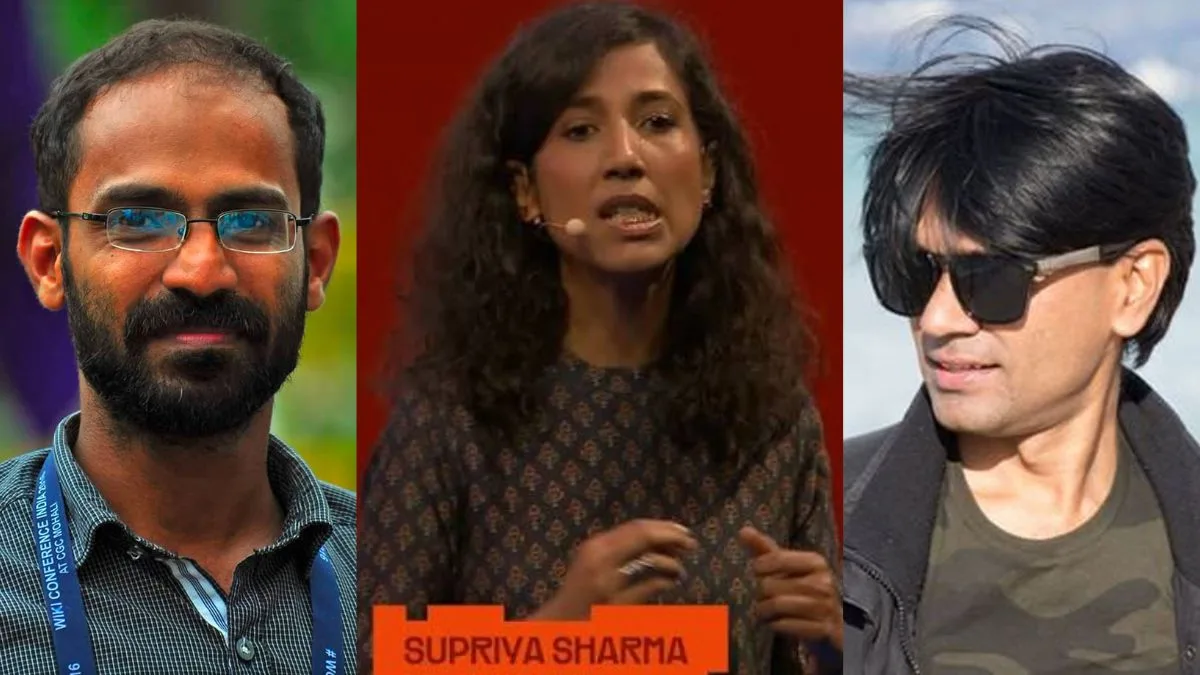
When Supriya Sharma, Executive Editor of Scroll.in, stepped onto the Oslo Freedom Forum stage this month, she was not merely giving a speech. She was packaging India — its courts, laws, journalists, and minorities — for an international audience capable of reshaping diplomatic reputations. Her talk, titled “In India, Prime Minister Modi has ensured media is on his side,” was sharp, polished, and, when compared to the documented legal record, selectively constructed.
Oslo Stage and Its Sponsors
The Oslo Freedom Forum is not a neutral venue. It is organized by the New York-based Human Rights Foundation (HRF), whose donors include the Thiel Foundation — funded by PayPal billionaire and Trump-aligned venture capitalist Peter Thiel — alongside the Royal Norwegian Ministry of Foreign Affairs, Fritt Ord, and the Brin Wojcicki Foundation. HRF specifically focuses its programming on what it defines as “authoritarian or hybrid authoritarian” regimes, a classification that shapes the nature of the testimonies it seeks.
A speaker invited to Oslo is not asked for nuanced policy analysis. They are asked to testify. The structural incentives favor brevity over depth, and grievances over context. India — a democracy of a billion people with an independent judiciary, free elections and a press that ranges from heavily pro-government to fiercely oppositional — does not easily fit that framework. Oslo makes it fit anyway.
Watch Video Here…
Your blood will boil after watching this 10-minute video.
Supriya Sharma, Executive Editor of Scroll, spoke at the Oslo Freedom Forum, organized by Human Rights Foundation in Norway from June 1-3.
She stood on foreign soil and peddled lies and fake news to demonize India and… pic.twitter.com/6vEEs6wNRG
— STAR Boy TARUN (@Starboy2079) June 10, 2026
Case File One: Siddique Kappan, PFI agent disguised as Journo
What Oslo Heard from Scroll
Siddique Kappan was a journalist arrested for trying to cover a gang-rape. He was held for nearly two years without bail. International organisations — CPJ, USCIRF, Amnesty International — labeled him a prisoner of conscience. His case was cited as emblematic of how Indian authorities use anti-terror law to silence reporters covering uncomfortable truths.
What the Legal Record Shows
Kappan was arrested alongside K.A. Rauf Sherif, national general secretary of the Campus Front of India (CFI), the student wing of the Popular Front of India (PFI). UP’s Special Task Force filed a 5,000-page chargesheet in April 2021, charging the group under UAPA Sections 17 and 18 — laws regarding funding of terrorist acts — alongside sedition and criminal conspiracy. K.A. Rauf Sherif is still in jail based on Kappan’s confession about their treason activities. He is still a convict in the case out on bail.
UP government affidavits before the Supreme Court alleged Kappan had a “close nexus and deep connection” with PFI’s top leadership and had written articles “at the directions of the top leadership of PFI aimed at spreading communal tensions.” Kappan’s own senior lawyer, Kapil Sibal, admitted before the court that Kappan had received Rs 40,000 from PFI — arguing only that PFI was not a banned organisation at that time.
PFI was designated as unlawful by the Indian government in September 2022, accused of ties to Al Qaeda-aligned networks. The Supreme Court granted bail in September 2022 — not as an acquittal — but noting that Kappan had been held for nearly two years and that charges were still being framed. In November 2024, the court further relaxed bail conditions, removing the requirement for weekly police reporting. Trial proceedings on the charges remain ongoing.
“The full picture shows a journalist with documented PFI associations arrested alongside PFI organizers, charged under terror-financing laws, and granted bail on procedural grounds — not factual exoneration.”
Case File Two: Mohammed Zubair
What Oslo Heard from Scroll
Zubair, co-founder of Alt News, was presented as a journalist persecuted for exposing right-wing hate speech. His June 2022 arrest — triggered by a 2018 tweet alleged to have offended religious sentiments — came weeks after he publicized BJP spokesperson Nupur Sharma’s inflammatory remarks about the Prophet Muhammad. The timing seemed retaliatory, and the Supreme Court agreed to some extent, granting bail and disbanding a multi-state SIT.
What the Legal Record Shows
In November 2024, Ghaziabad Police filed a new FIR against Zubair following a complaint that his social media post promoted religious hatred. In May 2025, the Allahabad High Court refused to quash this FIR — and made a pointed observation: the court questioned why Zubair shared alleged hate speech on social media instead of reporting it to authorities, warning such actions could escalate communal tensions.
Public records show that Zubair’s legal battles were far more extensive. He faced multiple FIRs across several districts, with authorities alleging a deliberate pattern of outraging religious feelings to incite communal tension. Furthermore, police investigated the funding structure of his organization.
The Supreme Court’s July 2022 intervention was a significant judicial rebuke and deserves recognition as such. However, the Zubair cases did not end there. The Allahabad High Court’s May 2025 observations — refusing to quash the FIR while extending arrest protection — complicate the simple “victim journalist” narrative that Sharma presented in Oslo. These were active, documented proceedings at the time of her speech. They did not make the cut.
The Ecosystem Behind the Narrative: Follow the Money
Scroll.in operates under Indian ownership and follows FCRA regulations that limit direct foreign funding of Indian media. However, it functions within a wider international ecosystem of citations, awards, fellowships, and conference invitations that provide strong structural support. Alt News, similarly, has received the Index on Censorship journalism award (2023), citations from CPJ, Amnesty International, and Front-Line Defenders — all funded by Western advocacy organisations.
This creates a self-reinforcing cycle: Indian journalists mentioned by CPJ receive Oslo invitations. Oslo speeches generate new CPJ citations. Reporters Without Borders and Freedom House include testimony-based data in press freedom rankings. India’s standings drop. Western governments use these rankings in diplomatic messaging. Denials from the Indian government are framed as confirmation of the problem. No single step in this process has to be dishonest for the overall conclusion to be systematically skewed.
The Facts That Didn’t Make It to Oslo
India held a general election from April to June 2024, in which the ruling BJP lost its majority and had to form a coalition government — an outcome that directly contradicts the authoritarian narrative. During this same period, India’s Supreme Court granted bail to Kappan against government objections, disbanded the state-level SIT investigating Zubair, and issued several rulings supporting free expression. Indian courts may be slow, overloaded, and sometimes under political pressure — but they are not merely instruments of executive control.
Freedom House’s 2025 Internet Freedom report does document real incidents: accounts on X withheld for The Wire, Maktoob Media, and Kashmir Times editor Anuradha Bhasin; government requests to remove over 3,400 URLs per RTI filings; arrests of journalists covering protests. These issues are legitimate and deserve examination.
Supriya’s Purposeful Omission: PFI Context Stripped, Allahabad HC’s Critical Observations Against Kappan and Zubair
The Kappan case stripped of its PFI context. The Zubair cases lacking the Allahabad High Court’s critical observations. India’s press environment portrayed without its opposition parties, its independent courts, and its free elections. The result is a distorted picture designed to satisfy a particular framework — one that serves Oslo’s ideological sponsors as much as it serves any honest accounting of press freedom in India.
Selective truth, packaged for the right audience, in the right forum, for the right international effect, is a form of narrative warfare. It deserves the same scrutiny we apply to the governments it targets.
“If you care for democracy, support us” – Funding Trail Behind Supriya Sharma’s Narrative
At the conclusion of her speech, Sharma issued a direct appeal to the international community: “Our second challenge is how to find the resources to do our work… If you care for democracy, support us”
The Broader Context: This appeal opens a critical window into the funding ecosystem of transnational advocacy. Many digital news portals and human rights NGOs operating in the Global South rely on international grants, Western philanthropic foundations, and foreign rights groups. Critics argue that this financial dependency inadvertently incentivizes local activists to tailor their reporting to fit Western anxieties about democratic backsliding. When international forums like the Oslo Freedom Forum platform these voices, they often amplify a curated “victimhood narrative” that secures continuous funding streams while ignoring India’s complex socio-political realities and the resilience of its democratic institutions.