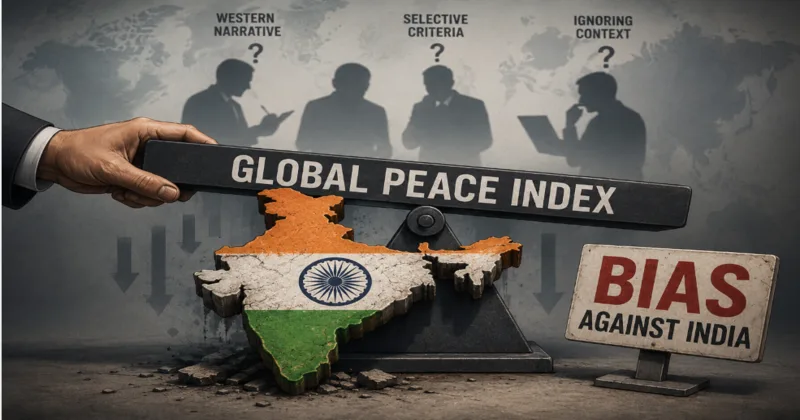
The Global Peace Index (GPI) 2026 has ranked India 127th. Meanwhile, several countries, whose populations are smaller than that of a single major Indian metropolis, have been declared far more peaceful than India. The release of the report has reignited suspicions that the experts compiling it conduct their comparative studies with a specific bias. Can India, the world’s largest democracy with a population of approximately 1.5 billion, truly be evaluated using the same yardstick applied to Iceland (population 300,000) or New Zealand (population 5 million)?
In reality, the issue goes beyond just India’s ranking. The question is whether the current global model for measuring peace is genuinely impartial, balanced and suited to the diverse circumstances of all nations. Let us briefly examine the Global Peace Index itself. It is published annually by the “Institute for Economics and Peace” and claims to evaluate 163 countries based on 23 indicators.
These indicators are categorized into three main areas: societal safety and security, the extent of domestic and international conflict and the level of militarization. While the model appears comprehensive in theory, many experts have argued since its inception that its structure inherently favors smaller nations.
According to the Global Peace Index 2026, the top 10 safest countries in the world are, in order- Iceland, New Zealand, Switzerland, Slovenia, Ireland, Austria, Portugal, Singapore, Finland, and Japan. When viewed in the context of India, the Global Peace Index (GPI) appears to have consistently targeted the country; India fails to make the list of the top 100 safest nations. Meanwhile, several Islamic countries, where violence, rape and atrocities are rampant, are ranked higher than India by this index.
The rankings of various global powers in the report have also drawn attention. Russia, a long-standing strategic ally of India, is ranked among the lowest-performing nations this time. It has been placed below conflict-ridden countries like Syria and Afghanistan. Alongside Russia, the list of the world’s least peaceful nations includes Sudan, the Democratic Republic of the Congo, Ukraine and Israel. Iran is ranked 144th, while the United States holds the 134th spot.
Among India’s neighbors in the subcontinent, Bhutan is the best performer, securing the 16th position this year. Surprisingly, however, Bangladesh, a country where minority Hindus and Christians face severe and ongoing atrocities, is deemed more peaceful than India by the GPI report’s compilers, ranking 117th. China is ranked 118th, Nepal 111th, Sri Lanka 67th and Malaysia 12th. Pakistan is ranked 152nd this year. A serious study of the GPI list reveals that several countries, whose situations are far worse than India’s in every respect, are ranked higher than India!
India vs. Iceland: Is the comparison fair?
India’s population in 2026 is estimated to be around 1.5 billion (150 crore), whereas Iceland’s population is approximately 400,000. In other words, India’s population is roughly 3,700 times larger than that of Iceland. It is worth noting that the renowned political scientist Samuel P. Huntington, in his book “Political Order in Changing Societies” (1968), wrote that order and stability in a society should be evaluated in the context of institutional capacity and population pressure.
If this principle is taken as a basis, maintaining peace in a country like India, with its vast and diverse population, is an extraordinary achievement in itself. Here, hundreds of languages, numerous beliefs, sects and religions, along with thousands of ethnic communities and diverse cultural groups, coexist within a democratic framework.
The Global Peace Index (GPI) includes several indicators that prioritize the absolute number of incidents. In a vast country like India, the number of incidents will naturally appear high. However, if incidents of crime, violence, or conflict were evaluated on a per-lakh-population basis, the results would differ significantly. This is why many social scientists believe that comparing countries solely based on absolute numbers can lead to misleading conclusions.
India: The world’s largest democracy
In India’s 2024 general elections, over 640 million voters cast their ballots. This marked the largest democratic exercise in world history. In his renowned book “Polyarchy” (1971), political scientist Robert A. Dahl identified democratic participation and political stability as crucial indicators of peace. Consequently, the presence of regular elections, an independent judiciary, an active media and a democratic mechanism for the transfer of power in a country should be recognized as a vital dimension of social peace, a view supported by Dahl’s work, yet the index in question remains completely silent on this aspect.
Structural advantages of small nations
Countries such as Iceland, New Zealand, Slovenia and Finland have small populations. In smaller nations, administrative oversight is easier, social inequalities are relatively lower and the maintenance of law and order is more effective. Relevant here is the book “Making Democracy Work: Civic Traditions in Modern Italy” (1993, Princeton University Press) by the distinguished Harvard scholar Robert D. Putnam, co-authored with Robert Leonardi and Raffaella Y. Nanetti.
The book discusses this subject in detail, identifying social trust and the bonds within small communities as key drivers of stable governance. It sheds significant light on the importance of social capital and civic engagement. Given this, weighing small nations against countries of continental proportions on the same scale naturally invites controversy and is entirely inappropriate.
Will the cost of combating terrorism lower India’s ranking?
This question becomes particularly significant given that India has been grappling with cross-border terrorism for decades. Security challenges have persisted in Jammu & Kashmir, the Northeast and Naxal-affected regions. Terrorism remains a reality in several areas today; yet, the Global Peace Index (GPI) treats militarization and security-related activities as negative indicators. Consequently, the rankings of countries that must allocate significant military resources for their security are affected.
The question arises here: should a nation fighting terrorism be viewed in the same light as a country that faces no external security challenges?
What could a more equitable model for India look like?
Several experts, such as Dr. Seema Singh (Law Professor and Social Scientist at Delhi University), Prof. Vimlesh Agarwal (Sociology, Jiwaji University/MP Government) and Dr. Vasudev Singh Jadoun (Associate Professor of Sociology)- believe that the following criteria should be incorporated when formulating future peace indices:
1. Population-adjusted Peace Index: Violence, crime and conflict should be evaluated based on rates per 100,000 people.
2. Democratic Stability Index: Greater emphasis should be placed on elections, the judiciary, press freedom and institutional strength.
3. Social Diversity Management: It is essential to measure the capacity to maintain peace amidst religious, linguistic and cultural diversity. When analyzing a country’s society, the assessment should specifically account for how social diversity is managed.
4. Counter-terrorism Capability: A distinct evaluation model is needed for countries affected by terrorism. In this context, international relations scholar John J. Mearsheimer writes in “The Tragedy of Great Power Politics” (2001) that the security challenges faced by major powers are far more complex than those faced by smaller nations. Similarly, Kenneth Waltz states in “Theory of International Politics” (1979) that a state’s behavior and security needs cannot be understood in isolation from its geopolitical environment.
5. Economic Opportunity and Social Mobility: These should serve as distinct assessment parameters, incorporating employment, education and social inclusion as components of peace. These views make it clear that a country like India- vast, nuclear-armed, and beset by numerous security challenges, requires evaluation within a specific context.
In this regard, economist Professor S.K. Singh observes that while the ‘Global Peace Index’ (GPI) should be viewed merely as an attempt to understand the global security landscape, comparing a vast, multicultural and complex nation like India with small countries such as Iceland, Slovenia, or New Zealand raises several serious questions.
He states, “Placing India at the 127th position does not prove that it is the 127th most unsafe country in the world. It simply indicates the score India received under the ‘Global Peace Index’ (GPI) current methodology; therefore, the debate should not focus on India’s ranking, but rather on the methodology itself, one that measures a democratic nation of 1.5 billion people against small countries with populations of just a few hundred thousand using the same yardstick.”
Prof SK Singh adds, “Perhaps the time has come to develop a new methodology for measuring global peace, one that does not rely solely on the number of incidents but also accords equal importance to factors such as a country’s population, diversity, democratic capacity and security challenges. Only then can true justice be ensured for nations like India.”