For years, relations between India and China have been defined by a mixture of economic engagement, strategic competition and recurring border tensions. From the Doklam standoff in 2017 to the Galwan clash in 2020, mutual distrust has shaped the trajectory of the relationship despite repeated diplomatic efforts to stabilise ties.
Against this backdrop, Beijing’s latest message to New Delhi stands out. Chinese Foreign Ministry spokesperson Lin Jian has called on India and China to view each other as “cooperative partners, not competitors and rivals” and as “opportunities, not threats” for each other’s development. The remarks came alongside China’s endorsement of greater cooperation among India, Russia and China under the Russia-India-China (RIC) framework and shortly after Russian President Vladimir Putin emphasised the importance of balanced ties with both Asian powers.
On the surface, the language signals a softer Chinese approach towards India. However, the timing of the statement, coming only weeks after New Delhi publicly criticised Beijing’s support for Pakistan during Operation Sindoor, raises an important question that is China genuinely seeking a reset with India, or is this a tactical adjustment driven by changing strategic realities?
A softer message amid hard realities
Lin Jian’s remarks were carefully crafted. He stated that the border situation between India and China is “generally stable” and that communication channels remain open. He urged both countries to handle differences from a “strategic height and long-term perspective”, strengthen mutual trust and expand cooperation.
The statement appears designed to project an image of responsible engagement at a time when Beijing faces multiple geopolitical pressures. China is navigating an increasingly complex international environment marked by strategic competition with the United States, economic headwinds at home and growing concerns among several neighbours regarding its regional ambitions.
For Beijing, reducing friction with India serves multiple purposes. India is the world’s fastest-growing major economy, an influential voice in the Global South and a key player in emerging multilateral frameworks such as BRICS and the Shanghai Cooperation Organisation (SCO). A prolonged confrontation with New Delhi risks undermining China’s broader diplomatic objectives in Asia.
China now wants a Russia-India-China strategic triangle. 🇮🇳🇨🇳🇷🇺
China's Foreign Ministry says it is ready to work with Russia and India to advance cooperation among the three countries.
After years of backing Pakistan and competing with India across Asia, Beijing is suddenly… pic.twitter.com/Qn1jDK9gxs
— Military Observer (@TheMilObserverr) June 8, 2026
At the same time, China is aware that India has steadily strengthened its strategic partnerships with countries including the United States, Japan, Australia and several European powers. While India maintains strategic autonomy, Beijing recognises that continued hostility could push New Delhi towards deeper security cooperation with countries seeking to balance Chinese influence in the Indo-Pacific. Viewed from this perspective, China’s latest rhetoric appears less like a sudden transformation and more like a calculated effort to stabilise an important relationship without making major strategic concessions.
The Pakistan factor continues to shadow relations
The biggest challenge confronting any China-India rapprochement remains Beijing’s enduring strategic partnership with Pakistan. Even as Lin Jian called for cooperation and mutual trust, he reiterated China’s familiar position on India-Pakistan relations, saying Beijing supports both sides in resolving differences through dialogue and consultation. However, recent developments have significantly complicated that narrative.
India’s Ministry of External Affairs strongly criticised China’s confirmed support to Pakistan during Operation Sindoor, describing such actions as damaging to the credibility of countries claiming to be responsible global powers. MEA spokesperson Randhir Jaiswal underscored that Operation Sindoor was a targeted counterterrorism response following the Pahalgam terror attack and was aimed at dismantling terrorist infrastructure operating from Pakistan and Pakistan-occupied Kashmir.
𝐖𝐞𝐞𝐤𝐥𝐲 𝐌𝐞𝐝𝐢𝐚 𝐁𝐫𝐢𝐞𝐟𝐢𝐧𝐠 ||
India reacts to China's support for Pakistan in May 2025:@MEAIndia 𝐎𝐟𝐟𝐢𝐜𝐢𝐚𝐥 𝐒𝐩𝐨𝐤𝐞𝐬𝐩𝐞𝐫𝐬𝐨𝐧 Randhir Jaiswal says, #OperationSindoor was a precise, targeted and calibrated response to the terrorist attack in Pahalgam.… pic.twitter.com/3vgxsRWXrj
— All India Radio News (@airnewsalerts) May 12, 2026
The controversy intensified after a Chinese state broadcaster aired an interview with Zhang Heng, an engineer associated with AVIC’s Chengdu Aircraft Design and Research Institute. In the interview, Zhang described providing on-ground technical support to Pakistan Air Force units operating Chinese-made J-10CE fighter aircraft during the four-day conflict.
The account marked the first public Chinese confirmation of direct operational involvement during the 2025 hostilities. For New Delhi, this reinforced long-standing concerns regarding the depth of Sino-Pakistani military cooperation. Operation Sindoor itself represented a significant moment in India’s security doctrine. Launched in May 2025 after Lashkar-linked terrorists killed 26 tourists in Pahalgam, the operation lasted exactly 88 hours and was presented by India as a precise and calibrated military response against state-supported terrorist networks.
Against this backdrop, Chinese appeals for trust face a credibility challenge. From the Indian perspective, meaningful trust cannot be built solely through diplomatic statements while Beijing continues to deepen military cooperation with Pakistan, particularly during periods of active conflict.
Putin’s balancing act and the revival of the RIC conversation
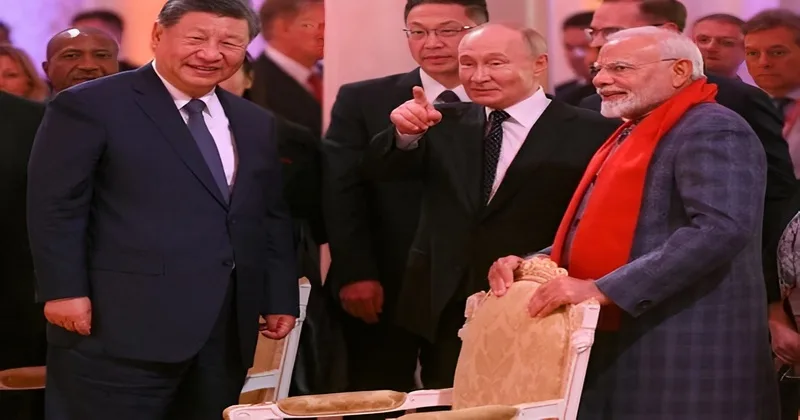
The immediate context for China’s remarks also includes renewed discussion around the Russia-India-China framework. During an interaction with heads of major international news agencies, including PTI, Russian President Vladimir Putin emphasised that Moscow’s relationships with New Delhi and Beijing have evolved independently and naturally over decades. Rejecting the notion that Russia must choose between its two Asian partners, Putin described both India and China as friends and cautioned against external interference in their relationship.
Significantly, Putin expressed confidence in the efforts of Prime Minister Narendra Modi and Chinese President Xi Jinping to address issues of mutual concern, including the border dispute. He portrayed Russia’s growing cooperation with India as not being directed against China and its strategic alignment with China as not coming at India’s expense.
China quickly echoed this position. Lin Jian stressed that China, Russia and India are all emerging economies whose stable relations contribute to regional and global peace, security and prosperity. He also confirmed Beijing’s willingness to maintain communication with both countries regarding trilateral cooperation. The revival of discussion around the RIC format reflects broader geopolitical changes. As the international system becomes increasingly multipolar, all three countries share an interest in preserving strategic flexibility and resisting rigid bloc politics.
Yet the reality remains that India’s relationship with Russia is fundamentally different from its relationship with China. New Delhi’s ties with Moscow are underpinned by decades of defence cooperation and political trust. India’s engagement with China, by contrast, continues to be constrained by unresolved border disputes, strategic competition and Beijing’s close partnership with Pakistan.
Why India is likely to remain cautious
While China’s latest messaging may create space for diplomatic engagement, New Delhi is unlikely to interpret it as evidence of a fundamental shift in Chinese policy. Indian policymakers tend to judge strategic intent through actions rather than rhetoric. The experience of the past decade has reinforced this approach. Even during periods of diplomatic engagement, tensions along the Line of Actual Control and China’s strategic support for Pakistan have repeatedly generated friction.
The recent revelation regarding Chinese technical assistance to Pakistan during Operation Sindoor is particularly significant because it transforms what was often viewed as indirect support into publicly acknowledged operational involvement. That development is likely to influence Indian strategic assessments for years to come.
Moreover, India has emerged from Operation Sindoor with greater confidence in its counterterrorism doctrine and military response framework. The operation demonstrated New Delhi’s willingness to impose costs on terrorist infrastructure while shaping a new deterrence against cross-border terrorism. Consequently, Beijing’s call for India to view China as an opportunity rather than a threat will be assessed against concrete actions. Progress on border stabilisation, greater transparency regarding military cooperation with Pakistan and a reduction in activities perceived as undermining India’s security interests would carry far greater weight than diplomatic assurances alone.
China’s new tone towards India is therefore best understood not as a dramatic strategic transformation but as an acknowledgement of changing geopolitical realities. Faced with global uncertainty, economic challenges and shifting power balances, Beijing has strong incentives to prevent relations with India from deteriorating further.