
“Although Bangladeshi illegal migrants have come into several States of India and they are more numerous in West Bengal than in Assam, they pose a much greater threat in Assam than in any other State. If not effectively checked, they may swamp the Assamese people and may sever the North East land mass from the rest of India. This will lead to disastrous strategic and economic results”- Lt Gen (Retd) SK Sinha, PVSM, Governor of Assam, in the report submitted to the Rashtrapati of Bharat on ILLEGAL MIGRATION INTO ASSAM, dated November 8, 1998
As per the announcement made by Prime Minister Narendra Modi in his Independence Day speech of 2025, on May 26, 2026, the Union Government officially notified the formation of a High-Level Committee to analyse and suggest remedial measures to address the unnatural population growth in certain areas, especially along the borders. On May 31, 2026, Japanese authorities ordered the demolition of an illegal mosque structure in Kawagoe City after the massive public outrage. The said structure was built on land classified as forest land under Japanese records. On June 2, 2026, the discussion over heart-wrenching testimonies of grooming gang victims in the UK, who were locked in dog cages and raped by 600-700 men in three years, reignited the debate over political correctness over race and migration issues. These three stories are from three distinct corners of the world, but they have one common factor – illegal migrants with radical orientation.
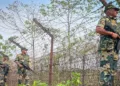
The discussion over illegal migration from both the parts of partitioned Bharat is not new. After the unnatural and unfortunate Partition with a colonial design, the country was divided on religious lines. Once, such a partition was accepted, then nation-states’ boundaries should be respected. Unfortunately, the Western part adopted cross-border terrorism as the foreign policy doctrine while the Eastern front opted for the silent infiltration in the name of economic or environmental causes. The communal politics of self-certified secular parties in Bharat gave the infiltrators a sense of entitlement and a sort of permit to occupy land, obtain voters’ rights, avail benefits from Government schemes and if any of these were questioned, resort to violent protest.
There have been multiple debates in the Parliament. In one such debate in August 2005, former CM of West Bengal, Mamata Banerjee, called the infiltration a ‘disaster’ for Bharat’s democracy. Unfortunately, she perpetuated the same menace after assuming power.Various courts in Bharat have made observations, issued estimates, and called for strict measures to deal with the problem. The World Migration Report 2010 stated that 1.7 crore undocumented Bangladeshi are in Bharat, which is a very conservative estimate. Thus, the problem has been well-known, however the will power to address it was missing. The formation of a High-Level Committee has provided an opportunity to address the demographic challenge, along with develop remedial measures.
The committee is expected to conduct a comprehensive and scientific assessment of the demographic changes that are taking place in various parts of Bharat due to abnormal reasons, including illegal migration. This committee would analyse the causes for such abnormal rise and recommend appropriate policy, legislative, and administrative measures. This is the first time that such a comprehensive exercise is being undertaken for the entire country. It will allow cross-departmental and inter-State coordination to address the issue. The presence of BJP-led NDA governments in most of the bordering areas on the Eastern front will prove to be beneficial in this process, as was the case in eradicating the armed Maoist activities.
The detection process would be a tedious task, but still possible with proper use of technology. Deletion of names from the voter’s list is also possible if ‘secular’ provocations are not used to communalise the issue. The real challenge will be deportation, as, under the international law, unilateral deportation in defiance of the views of the originating country is not permitted. From 1993 to 1998, Bharat could deport only 9,253 people and Bangladesh refused to accept 30493. Even if we can develop a comprehensive policy framework for detection and deletion, the deportation process will the evolve. Till then, at least we would know the number of foreign nationals who are working in Bharat without encroaching upon citizens’ rights.
The detection and deletion measures will certainly deter future infiltrators. Everybody knows that ‘Demographic Change’ is a serious problem linked to national sovereignty and security, having a direct bearing on law and order, social structures, and cultural composition. Therefore stopping all sorts of infiltration should be the ultimate objective. The High-Level committee is an opportunity to work together to form a comprehensive, realistic, and still humane framework to mitigate the deadly design of demographic shifts.