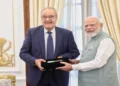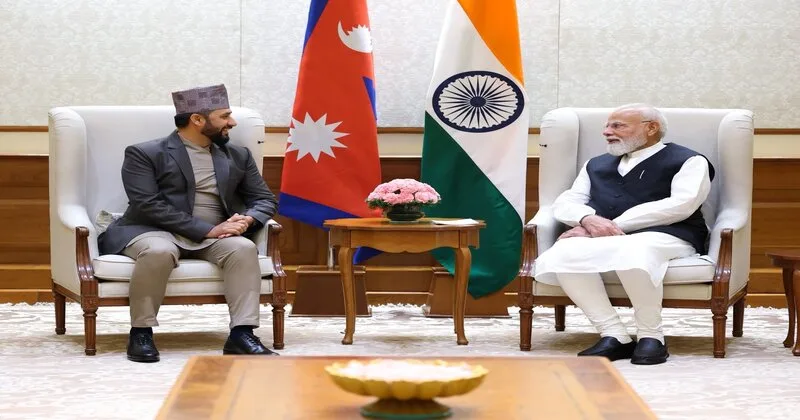
When Nepal’s ruling Rastriya Swatantra Party (RSP) President Rabi Lamichhane returned to Kathmandu after his five-day visit to India from June 1 to 5, he carried back more than diplomatic courtesies and political photographs. His engagements with Indian Prime Minister Narendra Modi, External Affairs Minister S. Jaishankar, Home Minister Amit Shah and the leadership of Bharatiya Janata Party (BJP) reflected a deeper strategic shift underway in Nepal’s political landscape. At a time when India-Nepal relations have been strained by renewed territorial disputes, anti-India rhetoric and attempts to internationalise bilateral issues, Lamichhane’s visit signalled the emergence of a new political approach in Kathmandu, one that prioritises development diplomacy over geopolitical posturing.
The visit also highlighted the growing success of India’s Neighbourhood First policy in engaging Nepal’s rising political generation. Unlike traditional Nepali political elites who often viewed relations with India through the prism of balancing New Delhi against Beijing, Nepal’s new political class appears increasingly focused on economic growth, institutional development, connectivity and governance. In many ways, Lamichhane’s India visit marked the most visible manifestation of this political reset.
A new generation looks South
The delegation accompanying Lamichhane included parliamentarians Bipin Kumar Acharya, Deepak Bohora, Nikita Paudel and Pradeep Acharya. Their engagements in New Delhi were not limited to diplomatic protocol. The visit was designed to build political, governmental and organisational linkages with India’s institutions.
The symbolism was important. Lamichhane is not a product of Nepal’s traditional political establishment. A former journalist who rose to prominence through anti-corruption and governance-focused politics, he represents a generation that came to power promising to break from the old ideological binaries that dominated Nepalese politics for nearly two decades.
It was indeed a great delight to engage in such a productive hour-long conversation with Hon. PM @narendramodi today. I share your vision for a future where Nepal and India transcend past constraints to embrace a new era of development diplomacy. By focusing on shared… https://t.co/PFQgJ8IJ5T
— Rabi Lamichhane (@hamrorabi) June 3, 2026
For much of the period following the abolition of the monarchy in 2008, Nepal’s mainstream political parties frequently leveraged the so-called “China card” in their dealings with India. Political leaders often portrayed closer ties with Beijing as a strategic counterweight to New Delhi, especially during periods of domestic political instability. Former Prime Minister K. P. Sharma Oli became the most prominent face of this approach. His governments repeatedly emphasised strategic partnerships with China and often adopted positions that generated friction with India. However, the political environment that enabled such politics is changing rapidly.
The rise of younger leaders, urban voters and governance-centric political movements has shifted public discourse towards employment, infrastructure, technology, education and economic opportunities. For these constituencies, geopolitical symbolism matters less than tangible development outcomes.
Lamichhane’s visit reflected precisely this transition.
From geopolitics to development diplomacy
Perhaps the most significant aspect of Lamichhane’s India outreach was the vision he articulated for future Nepal-India relations. In his editorial published in an Indian newspaper and in multiple public statements, Lamichhane consciously moved away from the traditional vocabulary of “pro-India” and “anti-India” politics. Instead, he advocated a framework centred on development diplomacy. His emphasis was clear that connect economies rather than merely borders. Lamichhane argued that Nepal should benefit from India’s economic transformation and institutional success stories.
He specifically highlighted the importance of learning from institutions such as the Indian Institutes of Technology (IIT) and All India Institute of Medical Sciences (AIIMS). For a country facing persistent youth migration and employment challenges, access to knowledge, skills and institutional expertise is increasingly viewed as a strategic asset. The RSP chairman also proposed elevating cooperation in hydropower, connectivity and digital infrastructure beyond political disagreements. This represents a notable departure from previous political narratives that frequently allowed bilateral disputes to overshadow areas of mutual economic benefit.
Rabi Lamichhane, chief of Nepal's ruling Rastriya Swatantra Party @party_swatantra, visited the Shri Ram Janmabhoomi Temple in Ayodhya this morning. He was accompanied by his wife, Nekita Poudel Lamichhane, and offered prayers at the Ram Lalla temple.
@hamrorabi pic.twitter.com/AsrRaNtGyE— Shalinder Wangu (@Wangu_News18) June 5, 2026
His message resonated strongly with India’s own regional vision. Prime Minister Modi described Nepal as a “priority partner” under India’s Neighbourhood First policy and expressed support for working together towards a shared and prosperous future. Lamichhane responded by endorsing a future built around shared civilisational bonds, digital corridors, seamless connectivity and mutual trust.
The language itself reflected a significant evolution. Rather than emphasising historical grievances, sovereignty disputes or geopolitical competition, the focus was on growth, connectivity and shared prosperity.
BJP-RSP engagement and the search for political learning
One of the most consequential but less discussed aspects of the visit was Lamichhane’s extensive interaction with the BJP leadership. At BJP headquarters in New Delhi, the RSP delegation received a warm welcome that included ceremonial honours, cultural performances and direct engagement with senior leaders. Lamichhane held discussions with BJP leader Nitin Nabin, who emphasised the deep civilisational, cultural and people-to-people ties connecting India and Nepal. The interaction went far beyond diplomatic niceties. According to statements issued by both sides, the RSP delegation showed considerable interest in understanding BJP’s organisational structure, membership model, candidate selection processes and grassroots outreach mechanisms. Nabin explained how BJP’s political machinery functions from the national level down to the booth level and highlighted the role of party workers in maintaining continuous engagement with citizens.
KNOW BJP पहलअन्तर्गत भाजपा मुख्यालयमा राष्ट्रिय स्वतन्त्र पार्टी (RSP) नेपालका सभापति श्री रवि लामिछानेज्यू तथा उहाँसँग आउनुभएको प्रतिनिधिमण्डललाई स्वागत गर्न पाउँदा र उहाँहरूसँग संवाद गर्न पाउँदा खुशी लागेको छ।
BJP–RSP बीच पार्टी-टु-पार्टी सम्बन्धलाई अझ सुदृढ बनाउने विषयमा… pic.twitter.com/gqag5ioz1k
— Nitin Nabin (@NitinNabin) June 2, 2026
For the RSP, which is still evolving as a relatively young political organisation, these discussions carried practical significance. The party sought insights into building sustainable grassroots networks, identifying local leadership and institutionalising public outreach.
The meeting also featured discussions on the role of Generation Z in politics and democratic participation. This focus was particularly relevant given that both RSP and leaders such as Prime Minister Balen Shah have drawn significant support from younger voters frustrated with traditional political structures.
The subsequent lunch interaction included Delhi Chief Minister Rekha Gupta along with leaders Manoj Tiwari, Praveen Khandelwal, Bansuri Swaraj, Harsh Malhotra and Ramvir Singh Bidhuri.
The RSP later described the engagement as an opportunity to exchange experiences regarding organisational strengthening, development-oriented governance, grassroots mobilisation and youth leadership. Such interactions indicate that Nepal’s emerging political forces increasingly view India not merely as a neighbour but also as a source of institutional and political learning.
India’s outreach amid diplomatic turbulence
The timing of Lamichhane’s visit was particularly significant. India-Nepal relations have experienced renewed turbulence in recent months over the long-running Kalapani-Lipulekh-Limpiyadhura territorial dispute. Tensions escalated following objections from Nepal regarding India’s use of the Lipulekh route for the Kailash Mansarovar Yatra. The situation became more sensitive after remarks by Nepal Prime Minister Balendra Shah regarding alleged border encroachments and references to engaging the United Kingdom and China on historical territorial issues originating during the British India period.
It was pleasure meeting with India’s Home Minister, Shri @AmitShah Ji, during my visit to New Delhi. We held a constructive dialogue on strengthening the Nepal-India relationship, enhancing security cooperation, and fostering greater collaboration between our parties to promote… pic.twitter.com/RgE6n43rSE
— Rabi Lamichhane (@hamrorabi) June 2, 2026
India responded firmly by reiterating that the boundary issue remains a strictly bilateral matter and rejecting any third-party involvement. Against this backdrop, New Delhi’s decision to engage directly with Nepal’s emerging political leadership demonstrated strategic foresight. Rather than allowing disagreements to dominate the relationship, India sought to broaden engagement with influential political actors who may shape Nepal’s future trajectory. Lamichhane’s meetings with External affairs minister Jaishankar and Home minister Amit Shah reflected this approach. His discussion with Jaishankar focused on the Nepal-India development partnership and multifaceted engagements between the two countries. Both sides emphasised people-to-people ties as a foundation for shared growth and prosperity.
The meeting with Amit Shah addressed a broader set of issues, including cross-border connectivity, transborder criminal activities and disaster management cooperation. Shah also congratulated Lamichhane on the RSP’s electoral success and conveyed India’s support for strengthening bilateral relations. These discussions demonstrated that despite occasional political disagreements, the bilateral agenda remains broad, substantive and forward-looking.
Why India’s Neighbourhood First Policy is finding new support
The strongest takeaway from Lamichhane’s visit is that India’s Neighbourhood First policy appears increasingly aligned with the aspirations of Nepal’s emerging political class. For years, India’s approach toward Nepal was often assessed through the lens of security concerns or geopolitical competition with China. Today, however, Nepal’s younger political leaders are confronting different realities. Their priorities include job creation, infrastructure expansion, digital transformation, educational opportunities, energy development and governance reform. India possesses significant advantages in each of these areas.
A pleasure to meet Nepal's Rastriya Swatantra Party Chairperson Rabi Lamichhane and his delegation today in Delhi.
Our discussions focused on the 🇮🇳🇳🇵development partnership and people-to-people ties. These have a crucial role in promoting growth and prosperity.@hamrorabi… pic.twitter.com/z9vzMOSkVu
— Dr. S. Jaishankar (@DrSJaishankar) June 2, 2026
Its rapidly growing economy offers market access and investment opportunities. Its educational institutions attract thousands of Nepali students. Its digital public infrastructure has become an internationally recognised model. Its expertise in hydropower partnerships, disaster management and connectivity projects provides practical benefits that resonate with Nepal’s development agenda. Lamichhane’s repeated emphasis on digital corridors, connectivity and institutional learning reflects this convergence of interests.
Equally important is the fact that India’s outreach is increasingly extending beyond governments to political parties, young leaders, civil society and emerging institutions. Such engagement helps create durable relationships that can withstand periodic diplomatic disagreements. The significance of the visit therefore extends beyond immediate policy outcomes. It illustrates how India is adapting its Nepal strategy to engage a changing political landscape while Nepal’s new leaders are reassessing the practical benefits of closer cooperation with India.
As Lamichhane concluded his India visit and returned to Kathmandu, he carried with him a message that would have been unusual in Nepalese politics just a few years ago, that the future of Nepal-India relations need not be defined by disputes, balancing strategies or geopolitical anxieties. Instead, it can be shaped by development diplomacy, institutional partnerships, connectivity and shared prosperity. That shift, from the politics of the China card to the politics of development, may ultimately become the defining feature of Nepal’s new political reset with India. And if current trends continue, it could also become one of the most successful outcomes of India’s Neighbourhood First policy in South Asia.