For months, the Cockroach Janta Party (CJP) has projected itself as the voice of India’s disillusioned youth, leveraging viral videos, influencer networks, Instagram campaigns and anti-establishment messaging to build what appeared to be one of the country’s largest digital communities. Its leaders repeatedly highlighted a follower base running into tens of millions and portrayed the movement as a grassroots uprising against systemic failures.
But on June 6, when the organisation stepped out of the digital world and into the political arena with its first major coordinated protest at Delhi’s Jantar Mantar, the results painted a very different picture.
The demonstration, organised around demands for accountability over examination controversies which are under investigation and a call for Union Education Minister Dharmendra Pradhan’s resignation, was intended to showcase the movement’s ability to transform online outrage into street-level action.
Instead, the gathering raised uncomfortable questions about whether the Cockroach Janta Party is a genuine mass movement or largely a phenomenon sustained by algorithms, influencers, viral content and online engagement.
The First Major Test of a Digital Movement
The significance of the protest extended beyond the immediate issue of examination irregularities.
The Cockroach Janta Party is not a conventional political outfit. It did not emerge from student unions, social organisations, trade groups or traditional grassroots networks. Rather, it grew almost entirely through social media platforms, particularly Instagram and YouTube, where its founders built enormous audiences among young Indians frustrated with competitive examinations, educational uncertainty and governance failures.
Its rise has been unprecedented in some respects. Never before has an organisation with virtually no traditional political structure claimed such massive digital reach before attempting a large-scale public mobilisation.
That is precisely why the June 6 protest was viewed as a litmus test.
Could millions of followers be converted into thousands of protesters?
Could social media influence become political influence?
Could viral engagement translate into sustained activism?
The answer, judging by the turnout, appeared far more complicated than the movement’s online projections suggested.
Digital Numbers Meet Ground Reality
Despite repeated online appeals and extensive promotion by influencers associated with the movement, the crowd at Jantar Mantar remained modest relative to the scale of support claimed online.
Many noted that the gathering was nowhere near what one would expect from an organisation claiming access to an audience of more than 22 million followers.
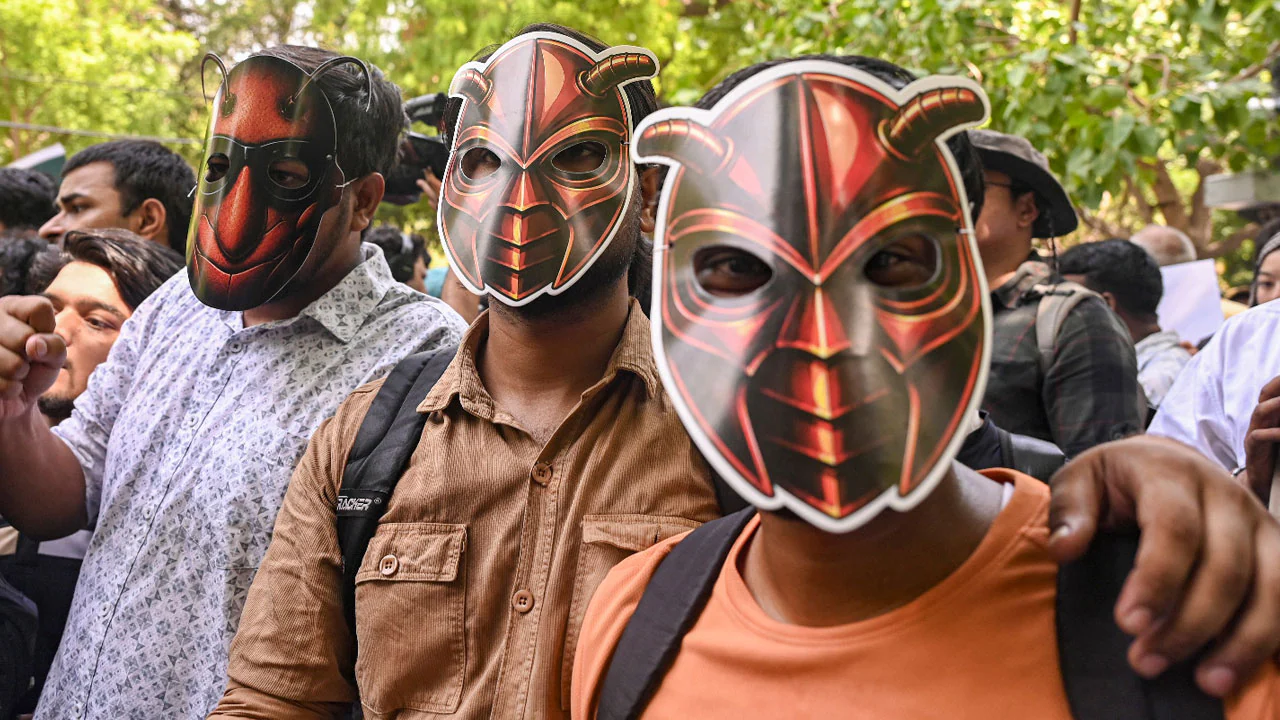
The protest site featured students, competitive examination aspirants, parents and supporters carrying symbolic cockroach masks and placards. However, a significant portion of the crowd also consisted of content creators, YouTubers and social media personalities documenting the event.
At times, the atmosphere resembled a large creator meet-up as much as a political demonstration.
Camera crews, vloggers and influencers were visible throughout the venue, recording videos, conducting interviews and producing content for online audiences.
The contrast between virtual popularity and physical mobilisation became impossible to ignore.
The Influencer Ecosystem Behind the Movement
One of the defining characteristics of the Cockroach Janta Party is its dependence on digital creators and influencer culture.
Unlike traditional student movements that rely on organisational networks within colleges, universities and local communities, CJP’s strength has largely come from content circulation and online engagement.
The Jantar Mantar gathering reflected this reality.
Many attendees appeared deeply familiar with the movement’s symbolism, slogans and online culture. Cockroach-themed artwork, masks, merchandise and social media references were common throughout the protest venue.
For some participants, the event seemed to serve as an opportunity to meet fellow supporters and online personalities whom they had previously followed only through social media.
This highlights a fundamental weakness in the movement’s structure.
While influencer networks can rapidly amplify messages and attract attention, converting online audiences into committed activists capable of sustaining long-term campaigns is a far more difficult challenge.
Students Voice Frustration, But Questions Remain
Many attendees who travelled to Jantar Mantar expressed concerns about the state of India’s education system.
Students spoke about recurring examination controversies, uncertainty surrounding competitive tests and concerns regarding transparency in recruitment and admissions processes.
Several participants emphasised that their attendance should not be interpreted as support for any political party but rather as an expression of frustration with systemic problems affecting students.
Yet even among supporters, there was recognition that online support does not necessarily translate into physical participation.
A number of students acknowledged that many of their peers preferred to express solidarity through likes, shares, comments and hashtags rather than attending a protest in person.
That distinction may prove crucial for the future of the movement.
Founder’s Controversial Past
The emergence of the Cockroach Janta Party is closely tied to its founder, Abhijit Dipke, a social media influencer whose rapid rise has often been accompanied by controversy. Dipke has shared platforms and maintained visible interactions with several opposition figures, including leaders associated with the Aam Aadmi Party, while positioning himself as an anti-establishment voice on social media.
Many have also questioned some of his engagements with foreign commentators and activists, including individuals from Pakistan, arguing that such interactions warrant greater public scrutiny given the political nature of his campaigns.
As the movement attempts to transition from an online phenomenon into a political force, questions surrounding its leadership, ideological direction, funding, networks, and long-term objectives are likely to attract increasing attention.
The Question of Leadership and Objectives
Another challenge facing the Cockroach Janta Party concerns the clarity of its political objectives.
At Jantar Mantar, the central demand remained the resignation of Union Education Minister Dharmendra Pradhan.
However, many questioned whether focusing on a single resignation adequately addresses the broader structural issues repeatedly highlighted by the movement.
The debate shows a larger dilemma confronting many modern protest movements.
Is symbolic accountability enough?
Or does meaningful reform require detailed policy proposals, institutional engagement and long-term organisational work?
The protest did not provide clear answers.
While slogans demanding accountability resonated with supporters, the broader roadmap for achieving systemic educational reform remained less visible.
Can a Social Media Movement Become a Political Force?
The June 6 protest may ultimately be remembered less for its immediate demands and more for what it revealed about the strengths and weaknesses of digital-age activism.
The Cockroach Janta Party has unquestionably demonstrated an ability to dominate online conversations, attract media attention and build a recognisable brand among younger audiences.
What remains uncertain is whether those achievements can evolve into sustained political influence.
History offers numerous examples of viral movements that captured public attention only to fade when faced with the organisational demands of real-world politics.
Street mobilisation, leadership development, grassroots expansion, coalition building and policy engagement require a different set of skills from those needed to accumulate followers on social media.
The Jantar Mantar protest highlighted that distinction.
A Reality Check for the Cockroach Janta Party
For the Cockroach Janta Party, June 6 represented a moment of reckoning.
The organisation succeeded in drawing attention, generating headlines and bringing together a section of concerned students and supporters. Yet the event also exposed the limitations of relying primarily on digital influence.
The contrast between millions of online followers and a comparatively modest physical turnout has become the defining takeaway from the protest.
Whether the movement can bridge that gap in the future remains to be seen.
For now, the first major experiment in converting social media popularity into street-level political mobilisation has delivered a sobering reality check: viral engagement and real-world political strength are not always the same thing.