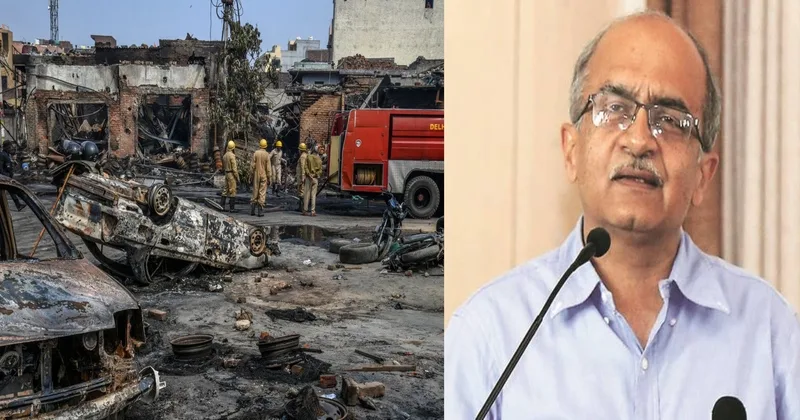
New Delhi: The violence that gripped Delhi on February 24 and 25, 2020, resulted from an organised conspiracy that began months earlier. According to the 2,700-page chargesheet filed by the Delhi Police under FIR 59/2020, approximately 700 pages are dedicated to tracing the timeline of this conspiracy. The investigation demonstrates that the February riots were directly linked to the initial wave of anti-CAA violence that erupted across Delhi and Uttar Pradesh in December 2019.
The conspiracy began to take shape immediately after the Citizenship Amendment Bill (CAB) was tabled in Parliament:
December 5, 2019: According to an OpIndia report, Sharjeel Imam created a WhatsApp group named “Muslim Students of JNU” (MSJ). Chargesheet records indicate that Imam was in regular communication with Arshad Warsi (a Jamia student later arrested in 2023 by the Delhi Special Cell in connection with a Pune ISIS terror module) and the radical group “Students of Jamia” (SOJ).
December 6, 2019: Members of the MSJ group distributed pamphlets authored by the Imam outside the Jama Masjid. The literature used highly provocative language, invoking the Supreme Court’s Ram Janmabhoomi verdict to incite resentment, and called for a mass mobilisation at a protest organised by the group ‘United Against Hate’ (UAH) at Jantar Mantar.
December 7, 2019: At the UAH protest, prominent figures, including Umar Khalid, Yogendra Yadav, Nadeem Khan, Sharjeel Imam, Ifat, and Sai Balaji, delivered speeches against the CAA.
Key Investigation Finding
Witnesses stated that during this event, Umar Khalid introduced Sharjeel Imam to Yogendra Yadav. Khalid had previously instructed Imam to form a core group of students from JNU, Jamia, and Delhi University (DU) to execute a “Chakka Jam” (traffic blockade).
Following discussions with Yadav, four strategic decisions were finalised:
Use social media platforms to mobilise the public for the Chakka Jam.
Launch targeted awareness campaigns in Muslim-majority areas.
Establish alliances with aligned organisations to expand the blockade.
Utilise mosques as focal points for launching the protests, engaging the cooperation of local Imams.
The December 8 Meeting at 6/6 Jangpura Extension
While initial coordination occurred online and at protest sites, the operational plan for the Chakka Jam was finalised during a pivotal meeting on December 8, 2019.
According to the chargesheet, this meeting took place in the basement of 6/6, Jangpura Extension, an address identified in public court documents and Supreme Court filings as the office of senior advocate Prashant Bhushan.
During this meeting, it was agreed that Sharjeel Imam would lead and organise student bodies across Delhi’s universities, while platforms like United Against Hate and Swarajya Abhiyaan would provide organisational backing. The same day, a coordinated WhatsApp group titled “CAB TEAM” was created, featuring Umar Khalid, Yogendra Yadav, Sharjeel Imam, and other co-accused to streamline operations.
Entities Operating from 6/6 Jangpura
The property at 6/6 Jangpura serves as the registered address or functional headquarters for several prominent activist groups:
Campaign for Judicial Accountability and Judicial Reform (CJAR)
Founded by Shanti Bhushan and Prashant Bhushan, CJAR has been involved in several high-profile campaigns challenging the judiciary. In 2017, the Supreme Court imposed a fine of Rs 25,00,000 on the organisation for filing a petition that levelled unsubstantiated bribery allegations against a sitting judge.
National Alliance for People’s Movements (NAPM)
Founded in 1996 by Medha Patkar, NAPM also operates out of this address. The organisation and its leadership have faced multiple legal investigations:
In 2022, an FIR was filed in Madhya Pradesh against Patkar and 11 others, alleging the misappropriation of over Rs 13 crore meant for the education of tribal children through the ‘Narmada Navnirman Abhiyan’ foundation.
The Enforcement Directorate (ED), the Department of Revenue Intelligence, and the Income Tax Department launched investigations into suspected money laundering connected to financial transfers received by the Narmada Bachao Andolan NGO.
NAPM has consistently released public statements supporting individuals prosecuted under anti-terror laws, including convicted Maoist collaborator GN Saibaba and The Kashmir Walla editor Fahad Shah, who was charged under the Unlawful Activities (Prevention) Act (UAPA).
NAPM’s Support During the Protests
Throughout the period of unrest from December 2019 to February 2020, NAPM actively supported the anti-CAA demonstrations. On December 15, 2019, following violent clashes at Jamia Millia Islamia, where police personnel were injured, and public property was damaged, NAPM issued statements backing the student protesters. The group has also consistently campaigned for the release of riot accused Umar Khalid.
Prashant Bhushan has also been a controversial figure for several of his public positions and legal interventions.
Kashmir & plebiscite remarks: He once suggested a possible referendum in Jammu & Kashmir to decide its future status. These comments were widely criticised as questioning India’s territorial integrity.
Defence of accused in security-related cases: He has supported or represented individuals in sensitive cases, including those linked to Maoist insurgency (GN Saibaba case) and petitions related to convicted terrorist Yakub Memon, which drew strong public criticism. Bhushan and his associated activist networks strongly campaigned against the conviction of GN Saibaba, a former Delhi University professor sentenced to life imprisonment in 2017 for his active links to the banned CPI (Maoist) and for inciting tribal populations to join armed Naxalite insurgencies.