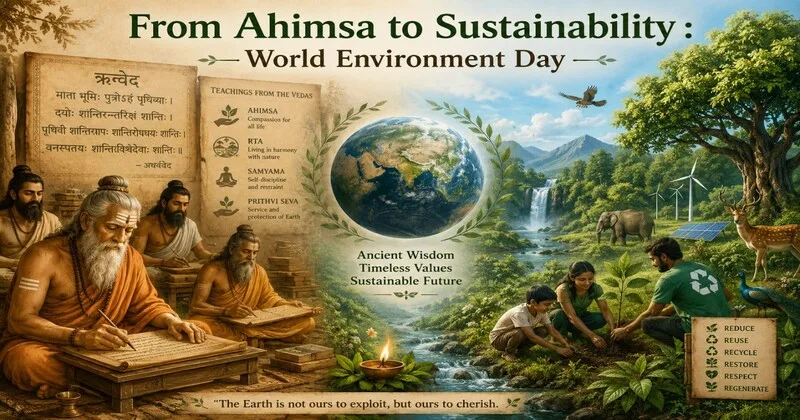
Three thousand years before the modern world coined the word “environment,” the sages of the Indian subcontinent were observing, contemplating and recording the natural world in the Vedas. The Vedic saints sang to nature in parts as well as in whole form and the surrounding hymns reveals an ecological imagination far wider than a single composition. Among their compositions stands what may be humanity’s oldest sustained meditation on the human debt to the planet: the Bhumi Sukta, also known as the Prithvi Sukta.
As the world marks World Environment Day, the modern ecological vocabulary like biodiversity, carbon sink and intergenerational responsibility arrives as a recent invention, a corrective measure of the West stumbled toward only after it had scorched its own rivers. The Indian subcontinent in the Vedic age, consider sustaining with environment not as policy but as prayer and kinship. The quoted line of the Bhumi Sukta captures the entire ethic in eight words:
माता भूमिः पुत्रो अहं पृथिव्याः
Mata bhumih putro aham prithivyah
“Earth is the mother, I am her son.”
Once the person consider Earth is mother rather than resource, the entire logic of extraction collapses. You do not over strip mines. You do not poison the body that feeds you.
What distinguishes the Bhumi Sukta from the rest of the Vedic corpus is its singular focus. The older Rigveda almost always addresses Earth in tandem with the Sky as a cosmic couple, Dyava-Prithivi. The Atharvaveda breaks Earth out on her own and gives her sixty-three verses of undivided attention, an independent theology of the planet that integrates cosmology, agriculture, ethics and governance in one sweep.
Scholars who have mapped the hymn find it falls into clear thematic clusters, almost as if the rishis were drafting a constitution. The opening verses ground Earth in rita the cosmic order, truth, discipline and sacrifice. Insisting that the planet is held together not by physical forces but by moral law. Middle sections turn to fertility and agriculture, praising soil, rivers, rain and cattle while warning that the Earth resists those who exploit her violently. Later verses celebrate human diversity, picturing the planet as a single great hall housing peoples of many languages, customs and laws. Then come the clusters on healing herbs and minerals, on just governance, and finally a long benediction for peace and stability. It is in effect a sustainability charter written in the idiom of devotion.
Not one hymn, but a source of knowledge
The Atharvaveda’s Apah Suktas, hymns to the waters treat rivers and waters as living, healing presences rather than supply, invoking them as bearers of medicine and purifiers of body and spirit. Its Bhaishajya hymns, the healing verses that later seeded the Ayurvedic tradition, catalogue named oshadhis: plants and herbs by their curative powers. Also embedding the idea that human health is drawn directly from a living botanical world that must therefore be protected. One striking line frames the planet itself as the custodian of this green wealth, earth as the keeper of creation, the container of forests, trees and herbs.
The wider Vedic corpus extends the knowledge about environment. The Rigveda’s Aranyani Sukta (10.146) is a hymn to the goddess of the forest by praising not only her gifts but her beauty and mystery, an early voice for the wild as something to be revered rather than cleared.
अरण्यान्यरण्यान्यसौ या प्रेव नश्यसि ।
कथा ग्रामं न पृच्छसि न त्वा भीरिव विन्दतीँ ॥
Araṇyāny araṇyāny asau yā preva naśyasi;
kathā grāmaṃ na pṛcchasi, na tvā bhīr iva vindatīm̐.
The Oshadhi Sukta (10.97) addresses the plants as mother: “Hundreds are your birthplaces and thousands are your shoots.” Read together with the Bhumi Sukta, these hymns form a layered environmental vision in which earth, water, forest and herb are each addressed as kin and notably, in which the destruction of forests is expressly discouraged.
या ओषधीः पूर्वा जाता देवेभ्यस्त्रियुगं पुरा ।
मनै नु बभ्रूणामहं शतं धामानि सप्त च ॥
Yā oṣadhīḥ pūrvā jātā devebhyas triyugaṃ purā;
manai nu babhrūṇām ahaṃ śataṃ dhāmāni sapta ca
Verses that anticipate the modern conscience
In the Bhumi Sukta’s cluster on non-violence (verses 23 to 34), the hymn pleads that human activity should not injure the Earth’s “vital organs” that tilling, digging and mining wound a living body and demand restraint. It even asks forgiveness for the harm cultivation inevitably causes. This is the precautionary principle and the ethic of ahimsa fused into one: the recognition, startling for its age, that human prosperity comes at an ecological cost that must be acknowledged and minimised rather than denied.
The hymn names Earth as the source of medicinal herbs and curative minerals (verses 35 to 43), framing health not as a matter of the body alone but as something entwined with ecological balance, a proto-public-health vision in which a poisoned environment means a sickened people. The governance verses (44 to 52) bind the legitimacy of rulers to dharma, casting the good ruler not as an owner of the land but as its steward, answerable to Earth herself as witness. And in a line that reads almost as prophecy, the closing cluster describes Earth as patient and beneficent yet fully capable of shaking off those who presume to dominate or exploit her. A civilisation watching glaciers retreat and coastlines drown might recognise the warning.
Why this matters on World Environment Day
Every year 5th June is to treat environmentalism as a borrowed conscience, a set of targets handed down by international bodies that India must scramble to meet. The Atharvaveda upends that posture. It establishes that the relational ethic now being rediscovered globally, Earth as a rights-bearing entity, sustainability as restraint rather than conquest. It was articulated here first in Bharat.
Comparative scholarship has made the parallels explicit. The Bhumi Sukta’s plea for forgiveness and replenishment maps onto the modern goal of responsible consumption. Its celebration of many peoples sharing one planet anticipates contemporary commitments to reducing inequality. Its insistence that just governance must mirror Earth’s own order echoes the modern demand for accountable institutions.
Ecuador and Bolivia have, in this century, written the rights of “Mother Earth” into their constitutions as a bold legal innovation. The Vedic seers granted Earth that status in verse, in an ages without parliaments.
This is not a claim that the Vedic age was an ecological utopia, nor that a hymn substitutes for emissions policy. It is a claim about lineage and self-knowledge. Where much of the industrialised world arrived at reverence for the planet only after exhausting the alternative, India carries an unbroken civilisational memory in which that reverence was the starting premise. Rivers are goddesses, forests are queens, herbs are mothers and the Earth is family.
The inheritance worth reclaiming
There is an available nation that does not need to import its environmental ethics. The Bhumi Sukta and its sister hymns are not museum pieces to be admired and shelved, its central insight that we are children of the Earth, not its conquerors is precisely the correction the present moment demands.
The rishis offered no carbon budgets and no treaties. What they offered was orientation, a way of standing in relation to the planet that makes exploitation feel not merely unwise but unnatural, a violation of kinship. Three thousand years on, with the modern world straining to legislate its way back to that posture, the older wisdom asks a simple question.
We have always known how to call the Earth our mother. World Environment Day is as good a moment as any to ask whether we still behave like her children.