
The controversy surrounding the Japan Jame Masjid Ramzan in Kawagoe—now facing demolition orders from Japanese authorities—has not only embarrassed Pakistan diplomatically but has also reignited long-standing concerns within Japanese society about demographic change, religious expansion, and the challenges of preserving social cohesion amid rising immigration
From Early Warnings on Religious Tensions to the Kawagoe Mosque Controversy, Japan’s Debate on Immigration and Integration Enters a New Phase
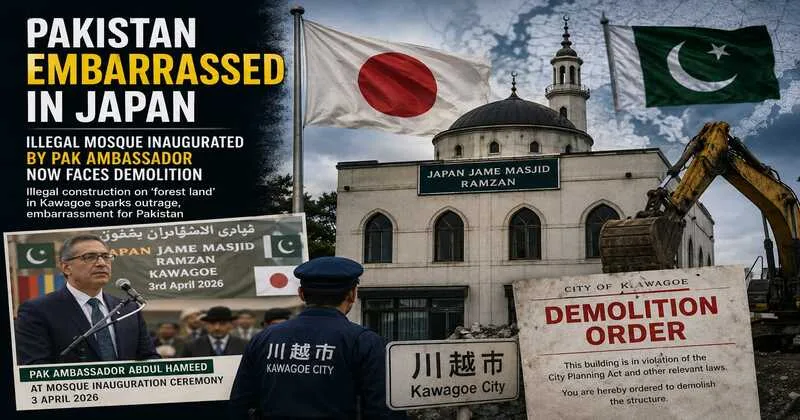
Pakistan has found itself in an embarrassing position in Japan after an illegally constructed mosque inaugurated in the presence of Pakistan’s Ambassador to Japan now faces demolition orders from Japanese authorities.
The controversy surrounding the Japan Jame Masjid Ramzan in Kawagoe, Saitama Prefecture, has not only triggered diplomatic embarrassment for Islamabad but has also reignited a larger debate within Japanese society about immigration, demographic change, cultural integration, and the future character of the Land of the Rising Sun.
In a statement issued on May 31, 2026, the Pakistan Embassy in Japan urged Pakistani nationals to comply with Japanese laws, particularly regarding mosque construction, and distanced itself from the controversial project. However, the damage had already been done.
Japanese authorities have since ruled that the structure was built illegally on protected forest land in an urbanisation-controlled zone and have ordered its demolition. The controversy has become a national talking point, raising questions not merely about one building but about the challenges accompanying rapid demographic and religious changes in Japanese society.
A Warning Raised Three Years Ago
For careful observers of Japan, the Kawagoe controversy did not emerge in isolation.
Nearly three years ago, writing in Organiser on June 14, 2023, this author examined the changing religious landscape of Japan in an article titled “Religious Tensions in Japan Grows Amidst Burgeoning Muslim Population in the Land of the Rising Sun.” The article highlighted the rapid growth of Japan’s Muslim population, the increasing number of mosques across the country, and the emerging tensions between Japan’s traditionally assimilative Shinto culture and more exclusivist religious worldviews.
At the time, it was noted that Japan’s Muslim population had grown dramatically—from approximately 20,000 in 2000 to nearly 200,000 within a generation. Likewise, mosques, once a rarity in Japan, had increased from merely 15 in 1999 to more than 113 by 2021. The article also documented growing public concerns after incidents involving attacks on Shinto religious symbols and the emergence of social media debates questioning whether certain religious doctrines could coexist with Japan’s unique cultural ethos.
While many dismissed these concerns as isolated incidents, the events in Kawagoe suggest that those anxieties have neither disappeared nor diminished. Instead, they appear to have become more pronounced as Japan grapples with unprecedented demographic pressures.
The Kawagoe Mosque Controversy
The mosque at the centre of the controversy was constructed in Kawagoe City, Saitama Prefecture, on land classified as forest land under Japanese records.
Residents reportedly began objecting to the construction in late 2024 after noticing the emergence of a large mosque structure in an area subject to strict building restrictions under Japan’s City Planning Act. Local authorities subsequently issued multiple stop-work notices. Yet construction allegedly continued despite official objections.
The controversy deepened when the mosque’s owners reportedly attempted to argue that the structure had existed previously and therefore should be regularised. Japanese authorities rejected this claim after examining official records and historical images, which reportedly showed no previous structure at the location.
The resulting demolition order has become a major embarrassment for Pakistan because the mosque’s inauguration done by the country’s ambassador, lending the project an aura of legitimacy before its legal status came under scrutiny.
Equally significant is the allegation that individuals associated with the mosque had links to Tablighi Jamaat, an organisation that has attracted scrutiny in several countries including Bharat. These allegations have intensified public debate and increased concerns among sections of Japanese society regarding the activities of foreign-funded religious networks.
A Different Story from Japan
The Kawagoe controversy stands in sharp contrast to another significant development that took place in Japan just a year earlier.
In March 2025, this author reported in Organiser on the unveiling of a statue of Chhatrapati Shivaji Maharaj in Japan. The article described the memorial as a remarkable example of transnational cultural synergy and civilisational friendship between Bharat and Japan.
The Shivaji Maharaj memorial symbolised something fundamentally different from the controversy unfolding today. It represented cultural exchange without confrontation, civilisational pride without exclusivism, and international cooperation grounded in respect for local laws and social sensitivities.
The memorial was welcomed as a bridge between two ancient civilisations that share deep respect for heritage, tradition, and national identity. Rather than generating tensions, it strengthened cultural ties and enhanced mutual understanding.
The contrast is revealing.
One development became a symbol of harmony and friendship. The other has become associated with allegations of illegal construction, disregard for local regulations, and diplomatic embarrassment.
Together, these two events illustrate that the question is not whether foreign communities or cultures should be present in Japan. The real question is whether those communities integrate respectfully into Japanese society or seek to operate outside its established legal and cultural framework.
Japan’s Demographic Dilemma
The backdrop to this debate is Japan’s worsening demographic crisis.
Japan’s fertility rate has fallen to among the lowest in the world. Births continue to decline year after year while the elderly population continues to grow. Labour shortages are becoming acute across several sectors of the economy.
Consequently, policymakers have increasingly turned toward immigration as one possible solution.
However, immigration is never merely an economic phenomenon. It also carries social, cultural, and civilisational implications.
Japan has historically maintained a strong sense of cultural continuity rooted in Shinto traditions, social discipline, community harmony, and respect for public order. The arrival of large immigrant communities inevitably raises questions about how these traditions will adapt to new realities.
The Kawagoe mosque controversy has become a focal point for these concerns because many Japanese citizens perceive the issue not as one of religious freedom but of legal compliance and social integration.
Shinto Civilisation and Cultural Cohesion
Japan’s religious culture differs significantly from many missionary traditions.
Shintoism, much like Sanatan civilisation, possesses an inherently accommodative character. It does not insist upon exclusivity and has historically coexisted with Buddhism and various other traditions. Japanese identity evolved around the principle of cultural harmony rather than religious competition.
This author’s, 2023 Organiser article had highlighted this distinction, noting that many Japanese commentators were increasingly debating whether certain exclusivist theological frameworks could comfortably coexist with Japan’s historically pluralistic outlook.
The Kawagoe episode has brought these discussions from the margins into the mainstream.
For many Japanese citizens, the issue is not directed against individual Muslims. Rather, it concerns whether immigrant communities are willing to adapt to Japanese norms or whether they expect Japanese society to adapt to them.
Lessons Beyond Japan
The demolition order against the Kawagoe mosque may concern a single structure, but the debate it has unleashed extends far beyond Kawagoe.
The progression is striking.
In 2023, concerns were raised about demographic change and emerging religious tensions.
In 2025, the unveiling of a Shivaji Maharaj memorial demonstrated how civilisational exchange can enrich a host society while respecting its traditions.
In 2026, the illegal mosque controversy has forced Pakistan itself to publicly urge its nationals to obey Japanese laws while distancing its embassy from a project inaugurated in the presence of its ambassador.
Taken together, these developments offer an important lesson for nations across the world. Immigration and multiculturalism can succeed only when newcomers respect the laws, traditions, and civilisational ethos of the societies they enter.
Japan’s challenge today extends beyond reversing demographic decline. It must also preserve the social cohesion, cultural confidence, and civilisational ethos that have long defined Japanese society, even as rising Muslim immigration raises new questions about integration, identity, and the future character of the Land of the Rising Sun. The controversy in Kawagoe has ensured that this conversation can no longer be avoided.