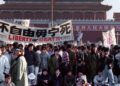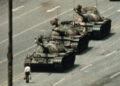
In the Lok Sabha on November 7, 1990, Vijay Kumar Malhotra said, “It was the same Communist Party [India] which supported Hitler and again, during our freedom struggle in 1942, they supported the cruel and repressive British Government. During Indo-China war in 1962, the Communist Party supported China and at Tiananmen Square in Beijing when tanks were used to crush the prodemocratic movement in which lakhs of youth were killed, the Communist Party supported the Chinese Government.”
In an article titled “Left stand on China conflicting”, published in The Times of India on June 16, 1989, V.R. Mani reported that when hundreds of thousands of students were peacefully protesting in Beijing’s Tiananmen Square in 1989 — demanding democracy, freedom of expression, and an end to corruption — the Chinese Communist government responded with extreme brutality, deploying tanks and guns against them. Thousands of people were killed in this crackdown, which the international community recognized as a brutal massacre. However, the response of Indian leftist parties — especially the CPI(M) and CPI — was contradictory and amounted to tacit support. These parties neither clearly condemned the massacre nor criticized the Chinese government. CPI(M) spokespersons attempted to dismiss the event by labeling it as “China’s internal matter,” and even justified the Chinese action by calling the students’ activities “politically destabilizing.”
An editorial titled “Subdued and Silent”, published in The Times of India on January 16, 1990, noted that the Communist Party of India (Marxist) had publicly defended the Tiananmen Square massacre.
The Communist Party of India (Marxist)’s official mouthpiece Deshabhimani (Malayalam) referred to the student protesters at Tiananmen Square as “troublemakers” and expressed support for the Chinese government’s military action.
Leftist Violence and Anti-Constitutional Acts in India
After independence, the Communist Party of India (CPI) rejected the legitimacy of the Constituent Assembly. The party declared, “The proposed Constituent Assembly as a fake and not a sovereign body, an imperialist trap beset with imperialist awards, which can therefore produce only a constitution of Indian slavery and division, and nothing else.”
In 1948, at its Second Congress held in Kolkata, the CPI harshly criticized the process of constitution-making in its famous “Calcutta Thesis.”
When the new Constitution of the Republic of India was enacted, B.T. Ranadive denounced it as a “slave constitution” and a “constitution of fascist tyranny.”
In 1958, Congress President U.N. Dhebar wrote a letter to the then Chief Minister of Keralam and Communist leader E.M.S. Namboodiripad, instructing that the Communist Party must adhere to the Indian Constitution. This letter came at a time when there was a nationwide debate on whether the Communist Party was functioning within the bounds of the Constitution. He wrote, “The Communist Party must realize that it is working under a constitution which has been adopted by the people of India themselves. Therefore, it is imperative that it fully adheres to the Constitution—not only to its letter but also to its spirit and objectives.”
Sitaram Goel writes, “Everyone remembers the Telangana episode of 1948–50. Countless innocent farmers were killed by the Communists.”
According to the Government of India, more than 12,000 people have been killed in Naxalite violence, including a large number of security personnel, and civilians. Major attacks include Dantewada (2010), Jhiram Ghati (2013), and Bijapur (2021), where hundreds of security forces were martyred.
In his book Communist Party of India, M.R. Masani writes that it has been clearly established that: (1) The Communist International was founded in 1919 with its headquarters in Moscow and is the supreme authority of all communist organizations worldwide. (2) Its primary objective is the establishment of workers’ republics in every country. (3) To achieve this, it has adopted the incitement of violent revolution in all countries as its fixed policy. (4) It has especially focused on India and resolved to launch a revolution aimed at overthrowing sovereignty in British India. (5) To this end, it conspired with individuals and bodies in Europe, India, and elsewhere to incite Indian workers and peasants to revolution. (6) These individuals and organizations, who may be called conspirators, formed a common plan of action under the direction of the Communist International. (7) This plan included the establishment of institutions such as the Communist Party of India and various Workers and Peasants Parties. (8) These parties’ immediate task was to organize the working class into unions, indoctrinate them with communist ideology, and train them through propaganda, education, and strikes. (9) Workers were to be trained for a general strike, following which the revolution would be launched. (10) Peasants were to be similarly organized to act as a strong reserve force for the proletariat and to carry out an agrarian revolution. (11) Following this agenda, the Communist Party of India and four Workers and Peasants Parties were established in Bombay, Bengal, Punjab, and the United Provinces. (12) These bodies received financial assistance from Moscow, and their policy was directed from Moscow—either directly or via secret and conspiratorial communication through England and continental Europe.