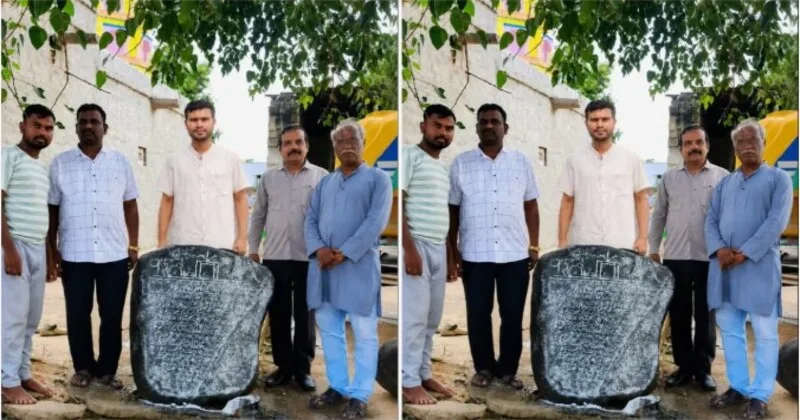
740-year-old Koppal inscription reveals a society that valued art
July 21, 2026
  • Read Ecopy
  • Circulation
  • Advertise
  • Careers
  • About Us
  • Contact Us
Android AppiPhone AppArattai
Organiser
  • ‌
  • Bharat
    • Assam
    • Bihar
    • Chhattisgarh
    • Jharkhand
    • Maharashtra
    • View All States
  • World
    • Asia
    • Europe
    • North America
    • South America
    • Africa
    • Australia
  • Editorial
  • International
  • Opinion
  • RSS @ 100
  • More
    • Op Sindoor
    • Analysis
    • Sports
    • Defence
    • Politics
    • Business
    • Economy
    • Culture
    • Special Report
    • Sci & Tech
    • Entertainment
    • G20
    • Azadi Ka Amrit Mahotsav
    • Vocal4Local
    • Web Stories
    • Education
    • Employment
    • Books
    • Interviews
    • Travel
    • Law
    • Health
    • Obituary
  • Subscribe
    • Subscribe Print Edition
    • Subscribe Ecopy
    • Read Ecopy
  • ‌
  • Bharat
    • Assam
    • Bihar
    • Chhattisgarh
    • Jharkhand
    • Maharashtra
    • View All States
  • World
    • Asia
    • Europe
    • North America
    • South America
    • Africa
    • Australia
  • Editorial
  • International
  • Opinion
  • RSS @ 100
  • More
    • Op Sindoor
    • Analysis
    • Sports
    • Defence
    • Politics
    • Business
    • Economy
    • Culture
    • Special Report
    • Sci & Tech
    • Entertainment
    • G20
    • Azadi Ka Amrit Mahotsav
    • Vocal4Local
    • Web Stories
    • Education
    • Employment
    • Books
    • Interviews
    • Travel
    • Law
    • Health
    • Obituary
  • Subscribe
    • Subscribe Print Edition
    • Subscribe Ecopy
    • Read Ecopy
Organiser
  • Home
  • Bharat
  • World
  • Operation Sindoor
  • Editorial
  • Analysis
  • Opinion
  • Culture
  • Defence
  • International Edition
  • RSS @ 100
  • Magazine
  • Read Ecopy
Home Bharat

Karnataka: Discovery of 740-year-old Koppal inscription reveals royal patronage to scholars, musicians & artists

A rare 13th-century inscription discovered in Talakal village of Koppal district has revealed fascinating details about medieval Karnataka's cultural and intellectual heritage. Linked to the Mailaralingeshwara tradition, the 740-year-old inscription records land grants and monetary rewards given to scholars, singers and musicians, highlighting royal patronage of arts and learning

IndreshIndresh
Jun 2, 2026, 09:00 am IST
in Bharat, Culture, Karnataka
Follow on Google News
Koppal Archaeological Find Highlights Medieval Patronage of Education and Arts

Koppal Archaeological Find Highlights Medieval Patronage of Education and Arts

FacebookTwitterWhatsAppTelegramEmail

Koppal: A rare 13th-century stone inscription discovered in Talakal village of Koppal district has thrown fresh light on the cultural, religious and intellectual life of medieval Karnataka. The inscription, which belongs to the revered Mailaralingeshwara tradition, contains valuable historical details about land grants and monetary rewards bestowed upon scholars and musicians more than seven centuries ago.

The significant discovery was made near the famous Udachalamma Devi Temple in Talakal village of Kukanur taluk. According to noted historian and epigraphist Dr. Sharanabasappa Kolkar of Gangavathi, the inscription offers a unique glimpse into the social and cultural fabric of the period and opens a new chapter in understanding the medieval history of the Kalyana Karnataka region.

Black stone inscription linked to Mailaralingeshwara tradition

Researchers said the inscription has been carved on a hard black stone and contains 20 lines of writing. The upper portion of the stone features intricate sculptures depicting a horse, a trident-bearing shrine structure, a sword and ceremonial fly-whisks. These symbolic carvings, along with the style of the inscription, strongly indicate its association with the Mailaralingeshwara religious tradition, which enjoyed immense popularity during the medieval period in Karnataka.

Experts believe the artistic and religious symbols engraved on the stone provide crucial evidence of the influence of the Mailaralingeshwara cult and its patronage by ruling elites of the time.

Dating the inscription through an eclipse reference

One of the most remarkable aspects of the inscription is its precise chronological reference. The text begins with invocations to Hindu deities Ganesha, Saraswati and Shiva, following the traditional format adopted in many medieval inscriptions.

The inscription specifically mentions an eclipse that occurred on “Chaitra Bahula Shuddha 15” during the Shaka year 1201 in the Pramadi Samvatsara. Historians who examined the record have correlated this reference with astronomical calculations and concluded that it corresponds to 1279 CE.

This means the inscription is approximately 740 years old, making it an invaluable historical document from the late 13th century.

Evidence of royal support for learning and culture

The primary purpose of the inscription was to record grants of land and financial assistance provided to distinguished scholars and respected members of society. Although the name of the king or donor responsible for these grants has unfortunately been lost due to damage caused by the passage of time, the details of the donations remain largely intact.

The inscription refers to the present-day village of Talakal as “Talkallu.” More importantly, it reveals that the settlement was not merely a rural habitation but a prominent agrahara, a centre of learning where Vedic scholars and intellectuals resided.

These learned men were referred to as “Mahajanas,” indicating their respected position in society. The inscription thus highlights the role played by Talkallu as an important educational and cultural centre during the medieval era.

Read More: From Gurukul to Exam Hall: How colonial reforms, Macaulay’s legacy created havoc with Indian education system

Fascinating details of rewards for singers and performers

The inscription also offers rare evidence of the recognition and rewards extended to artists and musicians in medieval Karnataka.

Among the beneficiaries mentioned is a talented female singer named Maheshwari, who was awarded 12 panas, a form of currency used during the period, in appreciation of her musical excellence. Another performer named Jogama received a similar reward of 12 panas for his outstanding singing abilities.

The inscription further records that an individual named Khemanna was granted two panas and 12 honnus, or gold coins, as a mark of royal favour.

These references are particularly significant because they demonstrate that musicians, including women performers, enjoyed social recognition and financial support during the period. Historians believe such records provide rare insights into the vibrant artistic traditions that flourished under medieval patronage.

Land grants carefully documented

In addition to monetary rewards, the inscription records that agricultural land in a village called Honnakahala, known today as Honnakahala, was donated to the recipients.

The document meticulously describes the boundaries of the granted lands in all four directions. Such details were commonly included in medieval inscriptions to ensure legal clarity and prevent disputes regarding ownership.

For historians, these geographical descriptions are invaluable as they help reconstruct historical landscapes, settlement patterns and administrative practices of the era.

Community efforts preserve priceless heritage

The preservation of the inscription has become a model example of community participation in heritage conservation. Under the leadership of village elder Uday S. Rayareddy, a team of historians and researchers, including Dr. Channabasappa Malkandinni, Dr. Siddalingappa Kotnekal, Ramesh Gabbur, Dr. Jaji Devendrappa and Dr. Badri Prasad, worked closely with local residents to safeguard the artifact.

With the support of villagers, a strong concrete platform was constructed adjacent to the temple wall, and the inscription was carefully installed to ensure its long-term protection.

Historians say the discovery not only enriches the documented history of Koppal district but also provides compelling evidence of the importance attached to scholarship, music and religious traditions in medieval Karnataka. The inscription stands today as a remarkable testament to a society that valued knowledge, culture and artistic excellence, preserving their legacy for future generations.


Topics: Koppal inscriptionUdachalamma Devi TempleMailaralingeshwara traditionChaitra Bahula Shuddha 15
ShareTweetSendShareSend
✮ Subscribe Organiser YouTube Channel. ✮
✮ Join Organiser's WhatsApp channel for Nationalist views beyond the news. ✮
Previous News

From Gurukul to Exam Hall: How colonial reforms, Macaulay’s legacy created havoc with Indian education system

Next News

Telangana statehood day: Remembering historic movement & celebrating new era; President Murmu, PM Modi extend greetings

Related News

No Content Available
Load More

Latest News

AI Generated Image

Bharat Beyond Western Lens: How science, tech, education, defence & infrastructure progress are powering nation’s rise

Karnataka: Cops suspended over Rs 5,000 monthly hafta from illegal Bangladeshi immigrants

Plywood workshop (Representative image)

Keralam: Nine child labourers rescued from Perumbavoor plywood factories; organised child trafficking racket suspected

Fazal-ur-Rehman and Asim Munir

Pakistan: Fazal-ur-Rehman challenges Asim Munir to ‘take off uniform & fight election’; Slams for failure in Kargil war

MEA condemns MV Golden Leo attack, death of 4 Indians; Summons Russian diplomat over maritime security

Ayodhya: Three boatmen detained after viral video shows beer drinking, mutton consumption on sacred Saryu river

Karnataka: HC refuses to quash Rs 5.3 crore fake govt job scam case against Shamshad Begum, daughter of Mansur Ahmed

Hera Panchami marks Maa Lakshmi's symbolic anger with the ceremonial breaking of Bhagwan Jagannath's Nandighosha chariot

Hera Panchami: The divine story behind Maa Lakshmi’s anger and the breaking of Nandighosha chariot

Centre's SMILE scheme to cover 295 cities by 2030-31, aims to rehabilitate 35,000 persons engaged in begging

SMILE Scheme Expansion: Government plans to make 295 cities begging-free, over 10,200 already rehabilitated

Karnataka HC pulls up Congress govt for chasing tweets instead of criminals, stays FIR probe

Load More
  • Privacy
  • Terms
  • Cookie Policy
  • Refund and Cancellation
  • Delivery and Shipping

© Bharat Prakashan (Delhi) Limited.
Tech-enabled by Ananthapuri Technologies

  • Home
  • Search Organiser
  • Bharat
    • Assam
    • Bihar
    • Chhattisgarh
    • Jharkhand
    • Maharashtra
    • View All States
  • World
    • Asia
    • Africa
    • North America
    • South America
    • Europe
    • Australia
  • Editorial
  • Operation Sindoor
  • Opinion
  • Analysis
  • Defence
  • Culture
  • Sports
  • Business
  • RSS @ 100
  • Entertainment
  • More ..
    • Sci & Tech
    • Vocal4Local
    • Special Report
    • Education
    • Employment
    • Books
    • Interviews
    • Travel
    • Health
    • Politics
    • Law
    • Economy
    • Obituary
  • Subscribe Magazine
  • Read Ecopy
  • Advertise
  • Circulation
  • Careers
  • About Us
  • Contact Us
  • Policies & Terms
    • Privacy Policy
    • Cookie Policy
    • Refund and Cancellation
    • Terms of Use

© Bharat Prakashan (Delhi) Limited.
Tech-enabled by Ananthapuri Technologies