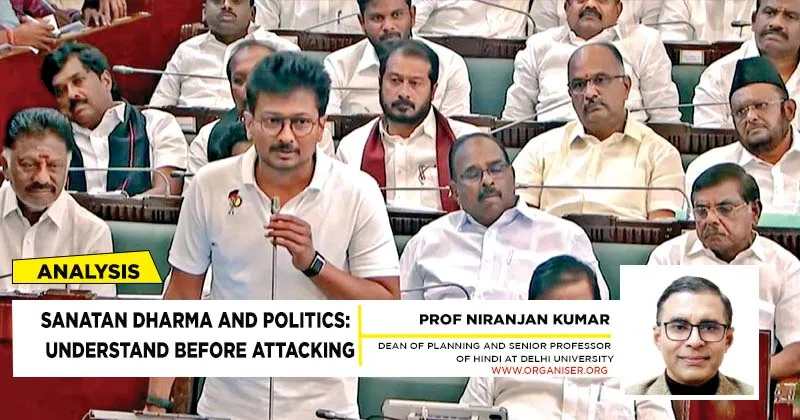
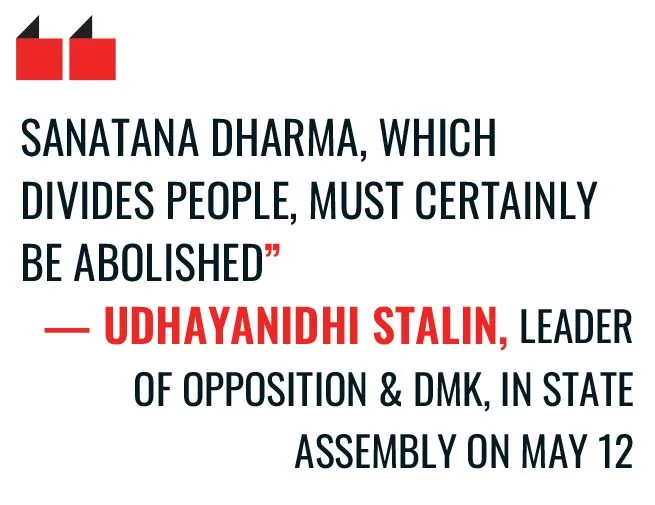
Political biases or inadequate factual knowledge are frequently the driving forces behind negative narratives. The ongoing smear campaign against Sanatan Dharma is a prominent illustration of this. The irony is that Sanatan Dharma is fundamentally inclusive, tolerant, peaceful, and committed to the well-being of everyone. But, unfortunately, Sanatan Dharma has been the target of a coordinated effort by ‘Western’ ideologies for ages. Some Indian political parties, politicians, and so-called intellectuals, motivated by their vested political interests, as much as by these foreign machinations, have also united against Sanatan Dharma. The most recent example of this opposition was witnessed on May 12, 2026, during the Tamil Nadu Legislative Assembly session, when DMK politician Udhayanidhi Stalin viciously said, “Sanatan must be eradicated.” Sanatan divides society, he claims. Udhayanidhi and many others have made anti-Sanatan remarks before as well. A closer look reveals that behind such dangerous remarks is not merely a malice and political opportunism, but also a fundamentally defective and perverted understanding of the concept of Sanatan Dharma.
The word Sanatan has evolved from the Sanskrit root ‘Sad’. Panini’s grammatical aphorisms indicate that the suffix ‘Num’ added to the root ‘Sad’ results in the term ‘Sana’ meaning ‘that which survives eternally’ or ‘the everlasting’. The second part of the word ‘Sanatan’ is ‘Tan’, meaning expansion. Thus, ‘Sanatan’ means that which goes on expanding endlessly or which keeps flowing. The Sanskrit dictum goes: “Sanatanasya Dharmah iti Sanatan Dharmah” – that which has existed since eternity and shall continue to exist forever is Sanatan. It has neither an ‘Adi’ (beginning) nor an ‘Ant’ (end). Opponents of Sanatan must understand that the very notion of eradicating or destroying Sanatan Dharma, which knows no beginning or end, and which is inherently eternal and timeless, is nothing more than a mere pipe dream. In the annals of history, figures such as Alexander, Mihirakula, Muhammad Ghori, Mahmud of Ghazni, Khilji, Genghis Khan, Timur Lang, Babur, and Aurangzeb, among others, endeavoured to obliterate the Sanatan Dharma and culture; yet, to this very day, ‘Sanatan Dharma‘ stands unvanquished. The Universality Of Sanatan.
In September 2023, Udhayanidhi Stalin stated, “Just as mosquitoes, dengue, malaria, and COVID-19 are eradicated, merely opposing Sanatan Dharma is not enough; it must be completely eliminated”
The foundation of this timeless nature of Sanatan lies in certain cosmic principles that are universal across space, time and scope. These cosmic principles include Truth, Karma, Duty, Ethics, Virtue, Universal Welfare, Tolerance, Nature Worship, and Moksha among others. In essence, Sanatan is not merely a religion but a holistic way of life. Religions such as Islam or Christianity differ significantly from this Sanatan Dharma, as they are founded upon a single Prophet, a single scripture, or a specific mode of worship, and typically do not accept alternative paths. In contrast, the guiding tenets of the all-inclusive Sanatan Dharma are: “Ekam Sat Vipra Bahudha Vadanti” (Rigveda) — meaning that the Ultimate Truth or Supreme Reality is One, though scholars interpret it in various ways; “Sarve Bhavantu Sukhinah” (Brihadaranyaka Upanishad) — meaning, may all be happy, implying the welfare of everyone, not just those who follow Sanatan; “Vasudhaiva Kutumbakam” (Maha Upanishad) — meaning, the entire world is one family, encompassing not just members of one’s own ‘religion’ but all of humanity; and “Ishavasyam Idam Sarvam” (Isha Upanishad) — meaning, a single, unifying consciousness resides not only in human beings but also in animals, plants along with rivers, mountains, and all animate and inanimate entities. Consequently, Sanatan Dharma embraces the aspiration for universal welfare and acknowledges the equal existence of all beings. How then, could Sanatan Dharma be considered discriminatory or divisive? Sanatan Dharma, it must be noted, in ancient times, was also referred to as Manav Dharma (the Religion of Humanity), which later came to be known as Hindu Dharma. Over the course of time, certain social evils, such as caste prejudice, did infiltrate this tradition. At the same time, however, from ancient times to the present day, these evils have been opposed, as indeed they should be. Nevertheless, to advocate for the complete eradication of Sanatan Dharma itself merely on account of the existence of a few such evils is utterly reprehensible.
Questionable Silence Over Inflammatory Remarks
It is extremely unfortunate that, driven by Marxism and other foreign ideologies, as well as the politics of appeasement, not only the DMK, but leaders of other political parties also, like the Congress and the Samajwadi Party etc, repeatedly disparage Sanatan or Hindu Dharma. In September 2023, Udhayanidhi Stalin stated, “Just as mosquitoes, dengue, malaria, and COVID-19 are eradicated, merely opposing Sanatan Dharma is not enough; it must be completely eliminated.” The Madras High Court characterised his 2023 statements as tantamount to ‘hate speech.’ Such speech under Article 19(2) of the Constitution, is deemed unconstitutional. Regrettably, parties such as the Congress and the Samajwadi Party have maintained tacit acquiescence towards such statements that attack Sanatan or Hindu Dharma. Congress party, rather than condemning Udhayanidhi’s recent statement, subtly distanced itself by labelling it as his ‘personal opinion’ or a matter of ‘regional politics.’ On Udhayanidhi’s 2023 statements too, the Congress invoked the principle of Sarva Panth Samabhav (equal respect for all religions), but skillfully added that every political party is free to express its own views. Priyank Kharge, son of Congress National President Mallikarjun Kharge, went so far as to indirectly endorse Udhayanidhi’s statement.
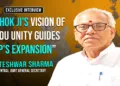
Udainidhi’s Anti-Sanatan Remarks Must be Expunged from Assembly Proceedings: Alok Kumar
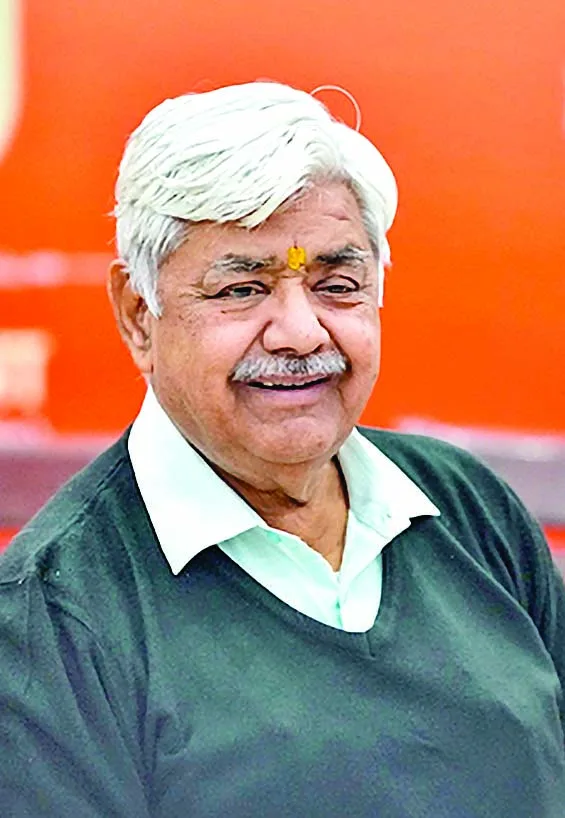
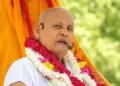
Alok Kumar, International President of the Vishva Hindu Parishad, strongly condemned the anti-Sanatan remarks made by Udhayanidhi Stalin in the Tamil Nadu Legislative Assembly. He questioned whether such a statement could ever be made by him against any other religion. He stated that the repeated insult and denigration of Sanatan Hindu Dharma and Hindu beliefs are contrary to democratic and constitutional values. The remarks made by the Leader of the Opposition should be immediately expunged from the Assembly proceedings. He further stated that it is extremely ironic that the very families and political parties which directly or indirectly derive benefits from Sanatan traditions, temples, and Hindu society are themselves speaking about eliminating Sanatan.
The Government of Tamil Nadu receives substantial revenue from the state’s renowned temples and religious institutions associated with the Sanatan tradition. Despite this, displaying an anti-Sanatan mindset amounts to undermining the very source from which they benefit. Shri Alok Kumar also said that the new Chief Minister of Tamil Nadu should clearly state his government’s position on whether it stands for the respect of Sanatan traditions and Hindu
beliefs, or it supports such divisive, malicious, and anti-Hindu statements. He demanded that such highly objectionable and divisive remarks be immediately removed from the Assembly records and that necessary measures be taken to prevent the recurrence of such incidents in the future.
Alok Kumar also stated that Sanatan Dharma is the cultural soul of not only Tamil Nadu but the entire nation of India. History bears witness that many ideologies which attempted to eradicate Sanatan have themselves disappeared, while Sanatan continues to guide society with the same strength, faith, and universality, and will continue to do so in the future as well.
Similarly, Samajwadi Party Supremo Akhilesh Yadav, instead of condemning Udhayanidhi’s remarks, sidestepped the issue by characterising ‘religion’ as a personal matter. In fact, Akhilesh Yadav himself has consistently launched direct or indirect attacks on Sanatan Dharma. In May 2022, addressing the issue of the Ram Mandir in Ayodhya, he remarked, “In Hindu Dharma, if you simply place a stone anywhere and hoist a red flag, it becomes a temple beneath a Peepal tree.” This comment amounted to a mockery of the Hindu faith. Likewise, in 2025, Akhilesh Yadav made another malicious statement asserting that he prefers pleasant fragrances, hence his government established a Perfume Park in Kannauj, whereas the BJP prefers ‘foul odours,’ which is why it is constructing Gaushalas (cow shelters). This trend is not new to the politics of Samajwadi Party, which is driven by minority appeasement. Mulayam Singh Yadav, while defending his decision to order firing upon Kar Sevaks, during the Ram Janmabhoomi Mandir Yajna, had asserted that had the firing not taken place, the Muslim community would have lost its faith in the country.
DMK MP A Raja went to extremes by comparing Sanatan Dharma to HIV and leprosy. The new Chief Minister of the TVK government in Tamil Nadu, Joseph Vijay, remained a silent spectator during Udhayanidhi’s speech. This was interpreted as a tacit approval of Sanatan bashing. It is not without reason that on May 14, 2026, TVK MLA VMS Mustafa, while endorsing Udhayanidhi’s remarks, stated that his party had “entered the fray to eradicate Sanatan Dharma.”
It is indeed ironic that the very Sanatan tradition, which, at its core, is supremely tolerant, liberal, and inclusive, is the one subjected to the most intense attacks. In fact, a defining characteristic of Sanatan is that it accords space even to differences of opinion
Meanwhile, the stance of the principal opposition party, the Congress, regarding Sanatan Dharma has frequently been mired in controversy — Indira Gandhi ordering firing upon Gau Sevaks (cow devotees) in November 1966; or the Congress party’s refusal, in the Supreme Court during the 2007 Ram Setu case, to accept the characters and events of the Ramkatha as historical evidence; or Rahul Gandhi describing Bhagwan Ram as a “mythical” (non-historical) figure at Brown University in the US in April 2025 — all serve as clear evidence of this approach.
Sanatan: The Only Balanced & Sustainable Solution
It is indeed ironic that the very Sanatan tradition, which, at its core, is supremely tolerant, liberal, and inclusive, is the one subjected to the most intense attacks. In fact, a defining characteristic of Sanatan is that it accords space even to differences of opinion. From the tradition of Vaad and Samvaada (debate and dialogue) found in the Upanishads to the scholarly Shastrarth (disputations) between figures such as Gargi and Yajnavalkya, or Adi Shankara and Mandan Mishra among others, Bharatiya civilisation has viewed dissent not as a source of conflict, but as a medium for the expansion of knowledge. Regrettably, certain political entities mistake this very tolerance as a weakness inherent in Sanatan. Conversely, these same political parties remain conspicuously silent regarding radical ideologies, for fear of violent repercussions should they voice any opposition. The so-called secular and progressive political circles often maintain a studied silence in the face of radical slogans such as, “Sar Tan se Juda”. This silence appears to be no mere coincidence but a rather clear manifestation of the politics of appeasement.
Today, the world is grappling with challenges such as terrorism, violence, war, cultural intolerance, and social disintegration. Amidst this, a balanced and sustainable solution for human civilisation will emerge solely through the path of Sanatan. Those who seek to obliterate or disparage Sanatan Dharma must understand this unequivocally.