

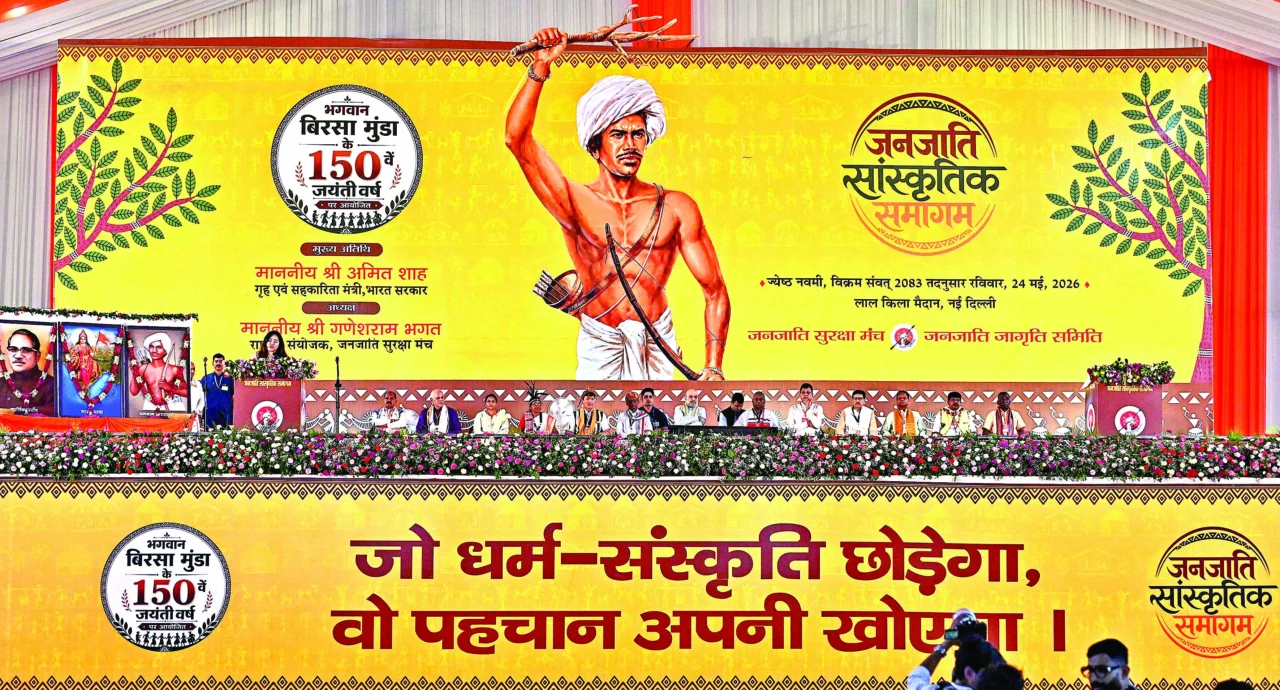
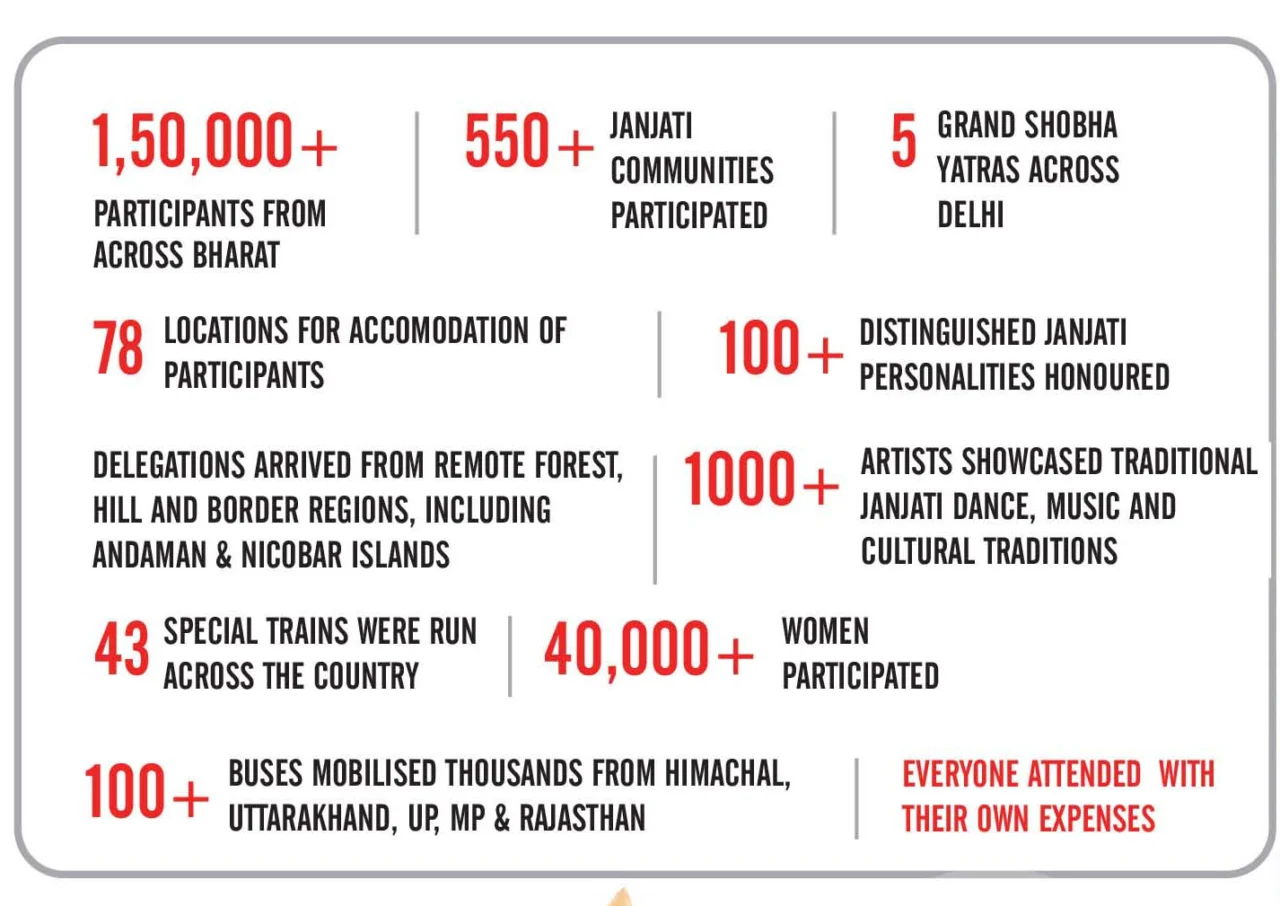
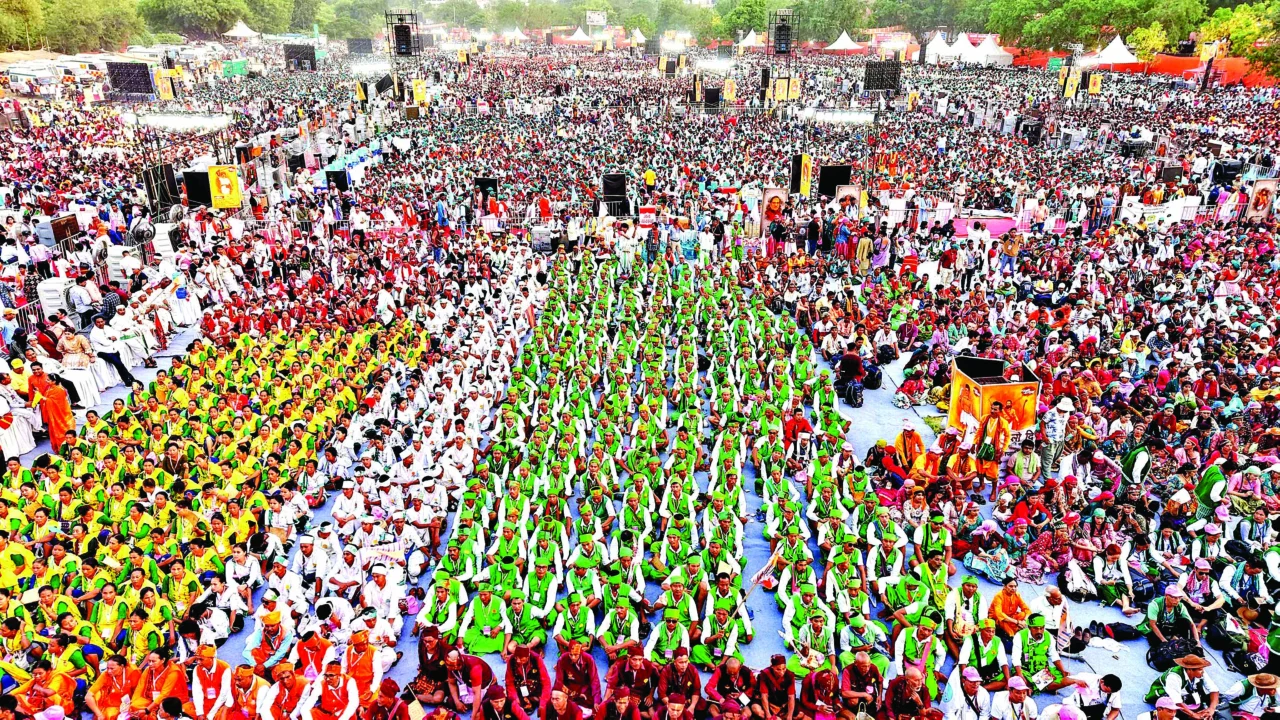
Under the shadow of Delhi’s iconic Red Fort, drums echoed through the summer air as thousands of Janjati men, women, and children marched in colourful traditional attire carrying their community symbols, musical instruments, and sacred traditions. The occasion was the Janjati Sanskritik Samagam 2026, organised on the 150th birth anniversary year of Bhagwan Birsa Munda, remembered across Janjatis as “Dharti Aaba.” What unfolded at the national capital was not merely a cultural programme or a symbolic gathering. It became one of the largest assertions of Janjati identity in recent years, bringing together approximately 1.5 lakh participants from nearly 550 Janjati communities across India.
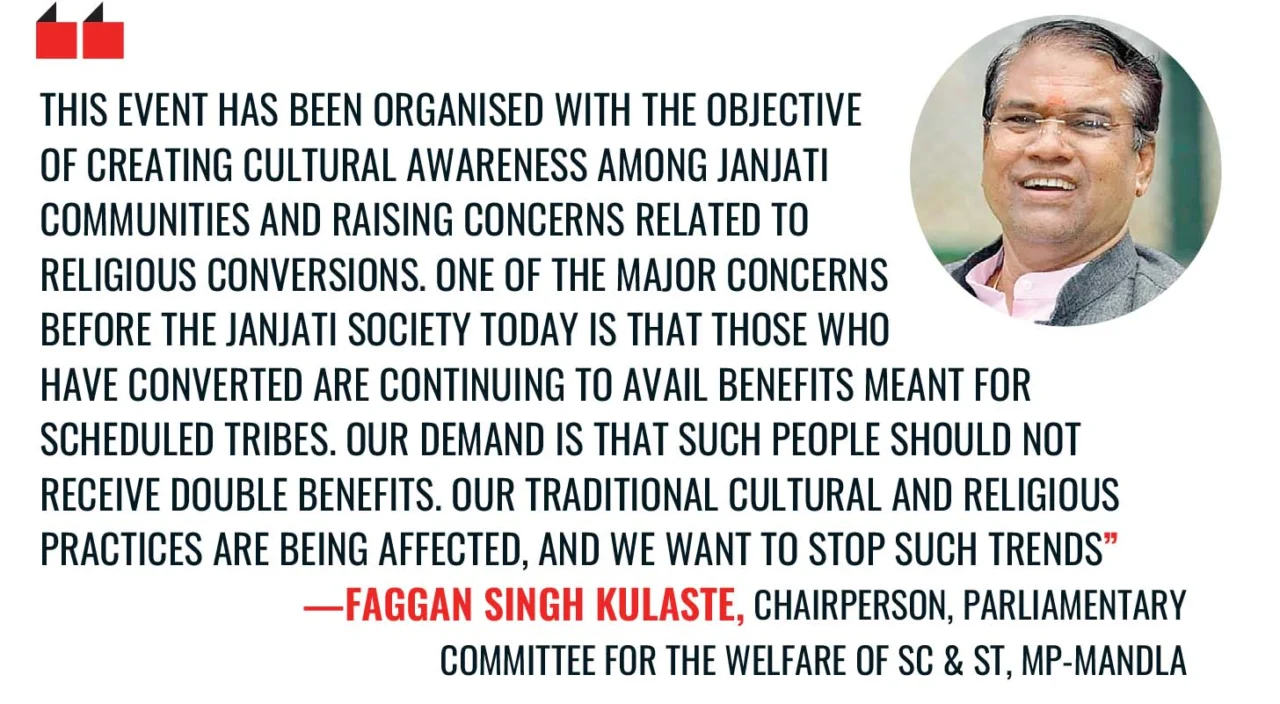
The event, organised by the Janjati Suraksha Manch, transformed Delhi into a living canvas of Janjati traditions, languages, dances, songs, and spiritual practices. Delegations arrived from Rajasthan, Maharashtra, Bihar, Jharkhand, Assam, Arunachal Pradesh, Gujarat, Odisha, Mizoram, and even the Andaman & Nicobar Islands. For many participants, this was their first journey outside their village and their first visit to the national capital. Yet despite differences in language and attire, one message repeatedly echoed across the Red Fort complex: the protection of Janjati identity, opposition to religious conversion, and the demand for “delisting” of those who convert out of Janjati traditions while continuing to avail the Scheduled Tribe reservation benefits.
The Samagam began with five massive processions emerging from different parts of Delhi — Rajghat Chowk, Ramlila Maidan, Ajmeri Gate Chowk, Qudsia Bagh, and Shyamgiri Temple near Shastri Park. Traditional drums reverberated through the streets as groups performed folk dances as they moved towards the Red Fort. The yatras themselves became visual demonstrations of India’s Janjati diversity. Some communities carried bows and arrows as cultural symbols; others wore elaborate feathered headgears, bamboo ornaments, bead jewelleries, or handmade woven garments representing generations of indigenous craftsmanship.
At the venue, the atmosphere resembled a Janjati Kumbh. Folk songs from the North East blended with drumbeats from central India. Dancers from Jharkhand performed Santhal traditions while groups from Maharashtra showcased Bhil cultural expressions. Delegations from Assam explained their Dimasa rituals, while Arunachal participants proudly spoke about their distinct identity within the broader Sanatan civilisational framework. The gathering was not curated as a museum-like display of “Janjati culture”; rather, it was presented as a living civilisational identity that communities claimed still survives despite modern pressures. That sentiment was visible in nearly every interaction during the event.
Standing amidst the crowd near the Red Fort complex, Mukesh Bhil from Rajasthan’s Dungarpur district explained why he had travelled all the way to Delhi. “Janjati communities are very innocent and simple,” he said. “Because of that, many people are getting converted to other religions. Our main demand is that those who leave the Janjati faith and adopt another religion should be delisted.”
Red Fort
Mukesh repeatedly emphasised what many participants described as “double benefits.” According to him, individuals who convert continue to avail Scheduled Tribe reservation benefits while simultaneously receiving benefits from minority institutions. “They are taking benefits from both sides,” he argued. “The rights meant for Janjatis are being taken away.”
When asked how conversions take place, Mukesh described a gradual process rather than direct persuasion. “They do not come directly,” he explained. “They first approach people in the name of treatment, education, and financial help. Slowly, they tell people not to worship traditional deities, not to apply sindoor, not to wear a mangalsutra, and not to follow our customs. Gradually, they distance people from their own traditions.”
His concerns were echoed by Veerendra Raoji Valvi from Maharashtra’s Bhil community. According to him, the Janjati Sanskritik Samagam was not only about cultural celebration but also about protecting traditions that are slowly weakening under social and ideological pressures. “This gathering will send a message to the younger generation that Janjati culture is still alive and must survive forever,” he said.
Valvi linked conversion directly to cultural disruption. “We worship nature, the sun, and celebrate festivals like Karma. These are all part of our Sanatan tradition. But once people convert, they stop following all these practices. Women stop wearing bangles and sindoor. Their lifestyle changes completely,” he said.
What stood out during the event was how consistently the idea of “identity” surfaced across regions. Whether participants came from Rajasthan or Assam, their vocabulary differed, but their anxiety seemed similar — that future generations might lose connection to ancestral customs.
One of the most striking moments came during conversations with two 14-year-old Santhal boys from Bihar. Soft-spoken and visibly overwhelmed by the scale of the gathering, they nevertheless displayed remarkable clarity. “We have come here to protect our religion and stop conversions in our society,” one of them said.
When asked why he wanted to remain within his own faith, the boy replied with disarming simplicity: “Our religion is good for us. We want to remain in our own religion.”
The exchange captured something deeper about the Samagam. While political and constitutional demands dominated speeches, the emotional core of the gathering revolved around continuity, the desire to preserve inherited customs, rituals, and memory.
Women participants from Assam’s Dimasa community articulated this concern in particularly vivid terms. Explaining their rituals, one woman described how every aspect of life — from food to clothing to worship, reflected their distinct cultural identity. “Our language is different, our clothes are different, our rituals are different. But we worship Shiv Baba and Kali Mata in our own ways,” she said.
Carrying Steel Plates, Preserving Nature: A Silent Message from Janjatis
An interesting aspect witnessed during the Janjati Sanskritik Samagam and the grand Shobha Yatras in Delhi was the simplicity and discipline displayed by 1.5 lakh Janjati participants who had travelled from distant parts of India to attend the gathering at the Red Fort.
Ahead of the programme, 78 schools across Delhi were converted into temporary accommodation centres for participants representing more than 550 Janjati communities from states including Arunachal Pradesh, Mizoram, Gujarat, Odisha, and the Andaman & Nicobar Islands. For many among them, this was their first visit outside their villages and native regions, and in several cases, their first journey to the national capital.
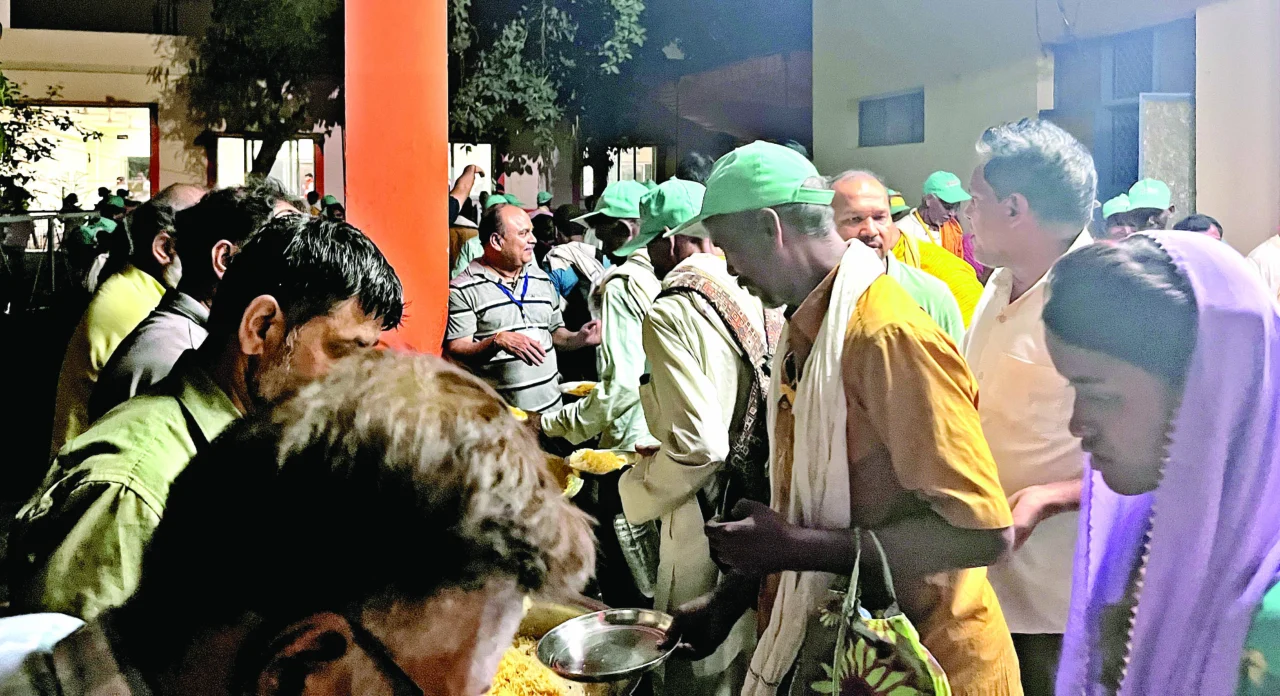
Despite travelling thousands of kilometres, organisers noted that most participants made only simple requests regarding food arrangements. When asked about their preferences, many replied that dal and rice would be sufficient.
Swayamsevaks from Delhi, along with their family members, coordinated arrangements for accommodation, transportation, drinking water, medical assistance, and heat management. Essential items, including milk, lemon drinks, soaps, and ration supplies, were distributed among participants staying at various camps and schools.
The accommodation centres also reflected India’s cultural diversity, as traditional attire, folk songs, musical instruments, and customs from different Janjati communities were on display together in one place. Many local residents visited these schools to interact with participants and observe the cultural traditions brought from different regions of the country.
Another striking aspect witnessed during the programme was the deep sense of environmental consciousness among the Janjati participants. Despite travelling more than a thousand kilometres from different parts of the country, many participants carried their own steel plates and glasses with them. As a result, the use of plastic and disposable items during the event was kept to a minimum. This simple yet thoughtful practice reflected the Janjati community’s traditional lifestyle and their deep-rooted reverence for nature and sustainable living.
She repeatedly stressed that preserving traditions was necessary for future generations. “If we ourselves do not learn our traditions today, then how will our children know them tomorrow?” she asked.
For many communities, therefore, the debate around conversion was not framed merely as a religious issue but as a civilisational and cultural one. Participants argued that once traditional rituals disappear, entire social systems collapse — festivals vanish, sacred spaces lose meaning, ancestral customs weaken, and oral traditions break.
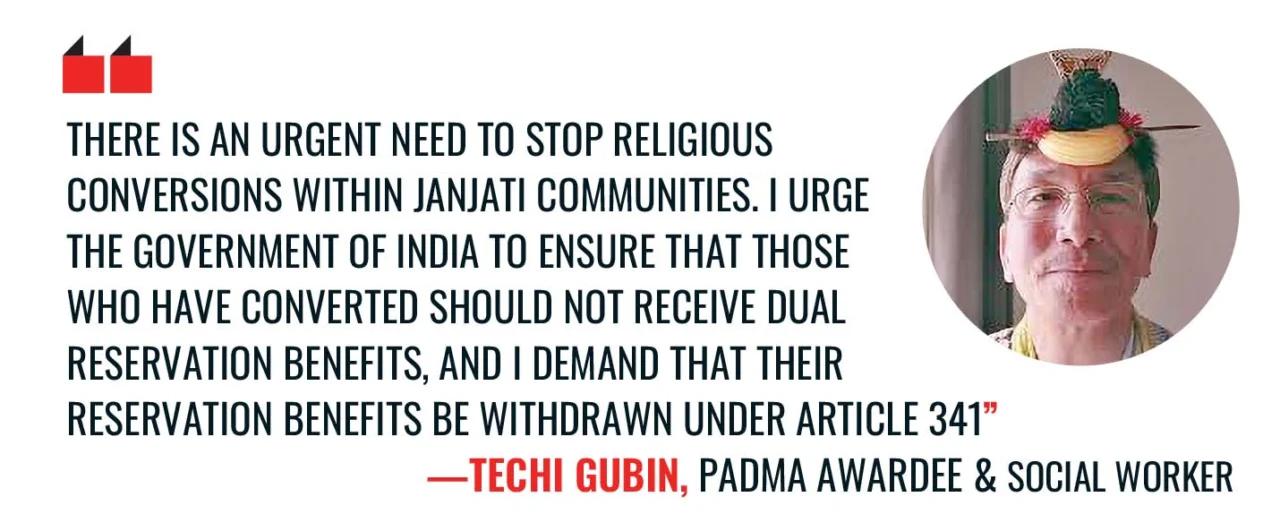
The idea of “delisting” thus emerged as the central political demand of the gathering. Participants repeatedly referred to Articles 341 and 342 of the Constitution while demanding amendments that would remove reservation benefits from those who convert to Christianity or Islam. Several speakers argued that reservations were intended to protect historically rooted Janjatis and, therefore, should not extend to those who abandon the faith practised by Janjatis.
Apart from creating awareness on delisting, another powerful aspect of the Samagam was its sheer organisational scale and discipline.
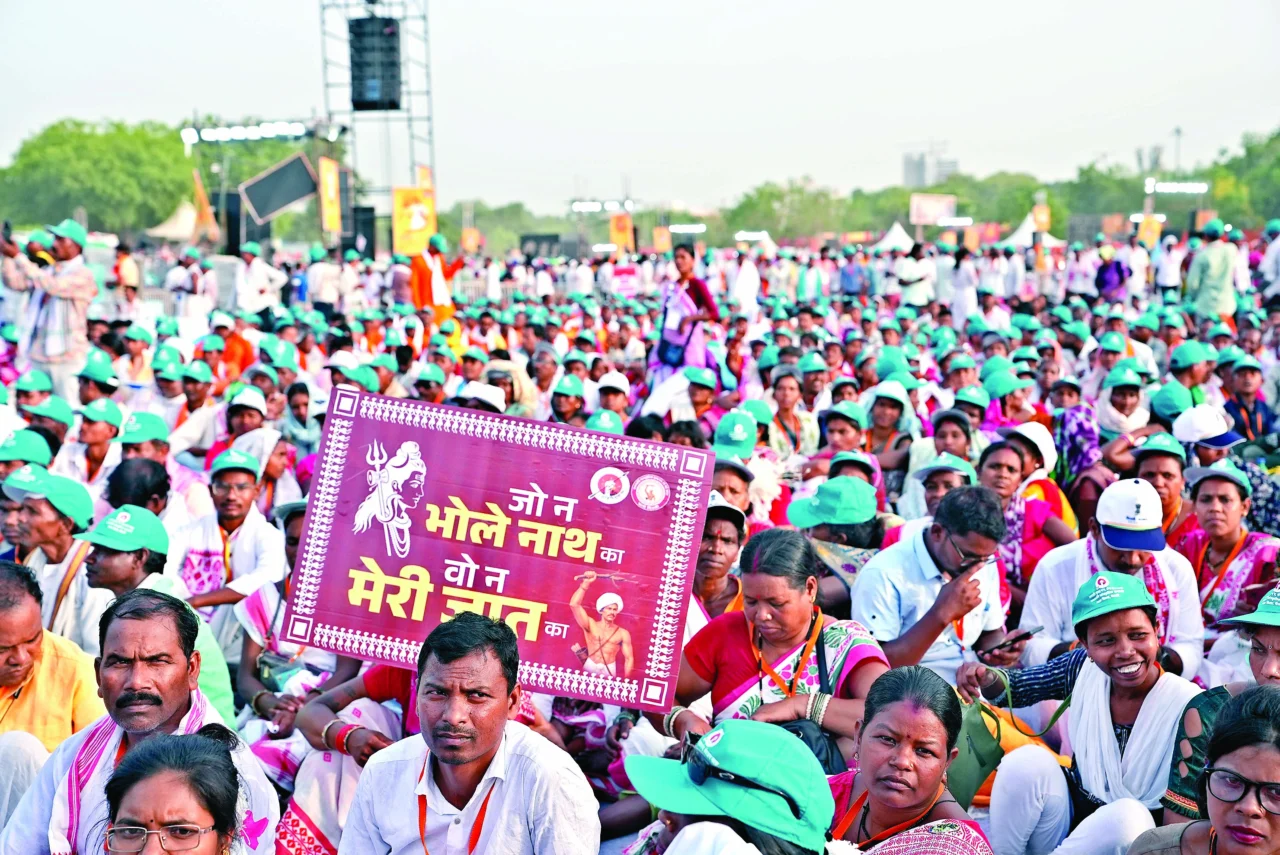
sentiment that really echoed throughout the event was the fundamental similarities between Sanatan and
Vanvasi culture
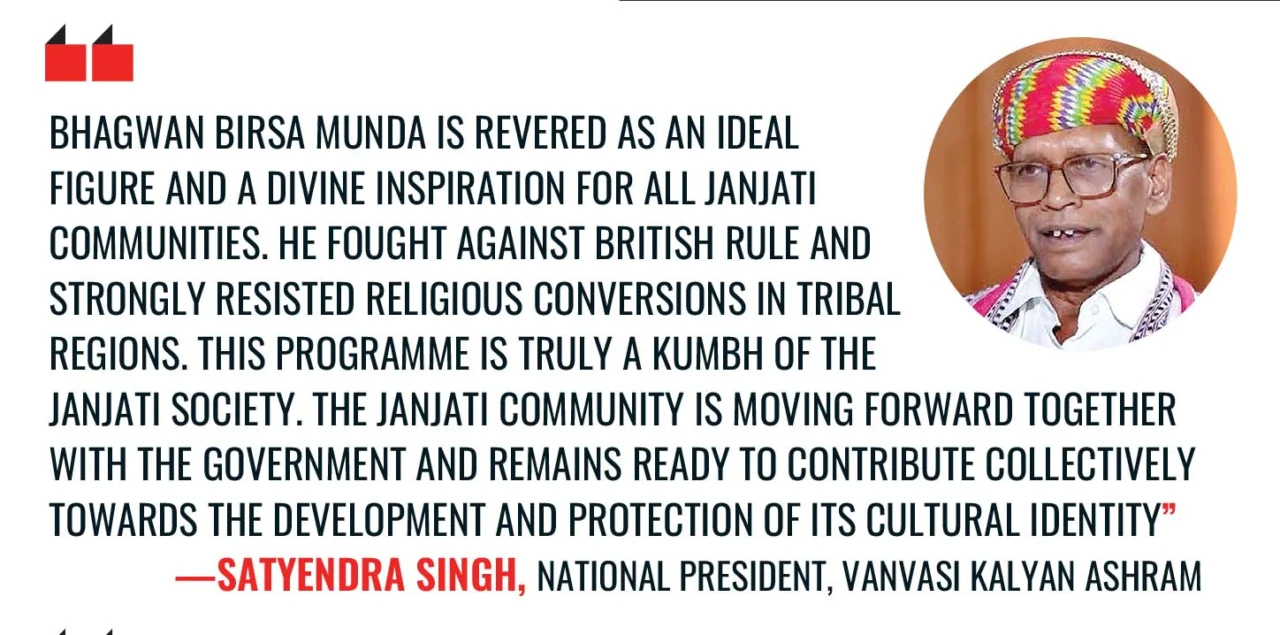
Throughout the event, Bhagwan Birsa Munda remained the unifying figure connecting these diverse voices. Participants described him not merely as a historical freedom fighter but as a symbol of resistance against cultural disruption. Many speakers invoked his struggle against British colonial policies and missionary influence in Janjati areas.
An Arunachal Pradesh participant explained why the gathering held emotional significance for him. “Earlier, we were scattered,” he said. “Now we are coming together. Bhagwan Birsa Munda fought for Janjati identity, and today we are gathering in the nation’s capital to continue that spirit.”

As the evening descended over the Red Fort and folk songs slowly gave way to preparations for departure, the essence of the Janjati Sanskritik Samagam became increasingly clear. On the surface, it was a spectacular cultural congregation — a celebration of colours, dance, music, and indigenous traditions. But beneath that celebration lay a deeper assertion: a demand for recognition, cultural continuity, and political voice.
The participants repeatedly described themselves not as isolated communities living on the margins, but as integral inheritors of India’s civilisational traditions. One phrase echoed across the gathering and seemed to summarise the larger sentiment of the day: “Nagarvasi, Gramvasi, Vanvasi — hum sab Bharatvasi.”
For the organisers of the Janjati Suraksha Manch, the Samagam was about far more than cultural display. It was about placing Janjati concerns at the centre of the national conversation, saying that Janjati identity is not a relic of the past but a living force shaping India’s present and future.
And as thousands began their journeys back home from Delhi, carrying drums, flags, memories, and demands, one thing had become unmistakably clear, the Janjati Sanskritik Samagam was not merely a one-day gathering, it was an attempt to create a larger cultural and political movement around identity, faith, tradition, and the future of India’s Janjatis.