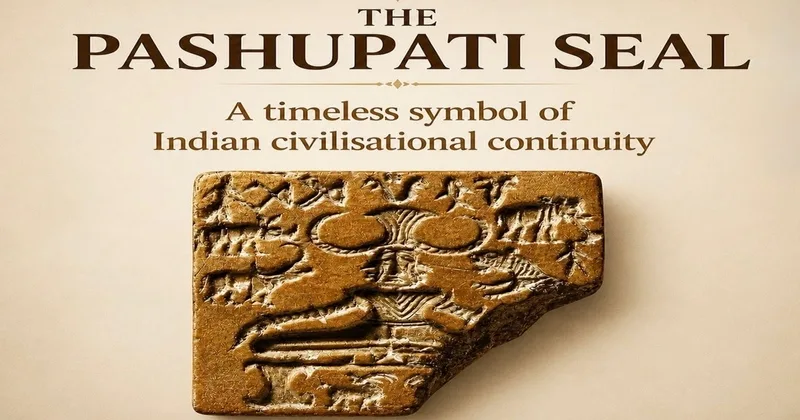
Among the many archaeological treasures discovered from the ancient cities of the Indus-Saraswati Civilisation, few symbols have captured the imagination of historians, spiritual seekers, and civilisational scholars as deeply as the famous Pashupati Seal of Mohenjo-daro. Dating back nearly 4,300 years, this small steatite seal stands today not merely as an artefact of antiquity, but as one of the most profound visual testimonies to the continuity of India’s spiritual and cultural civilisation.
One of the most powerful symbols of India’s unbroken civilizational continuity!
Discovered at Mohenjo-daro in undivided India this steatite seal, about 4,300-year-old, shows a seated figure in yogic posture (widely seen as Shiva-Pashupati) seated in Mulabandhasana, surrounded… pic.twitter.com/MxgoEGilxu
— Ministry of Culture (@MinOfCultureGoI) May 27, 2026
Discovered in the ruins of Mohenjo-daro, one of the principal urban centres of the Indus Valley Civilisation in present-day Pakistan, the seal depicts a mysterious seated figure in a yogic posture, surrounded by animals. Over the decades, many scholars and traditional thinkers have identified this figure with an early form of Shiva, particularly Shiva as “Pashupati,” the Lord of Animals. Whether viewed through archaeology, spirituality, iconography, or philosophy, the seal represents a civilizational memory that continues to live vibrantly in India even today.
The discovery of the Pashupati seal
The seal was excavated during the early 20th-century archaeological explorations at Mohenjo-daro, one of the most advanced urban settlements of the ancient world. Crafted from steatite and measuring only a few centimetres in size, the artefact contains remarkable detail despite its small dimensions.
At the centre of the seal sits a horned figure, apparently seated in a posture closely resembling Mulabandhasana or a meditative yogic pose. Around the figure appear various animals, including an elephant, tiger, rhinoceros, and buffalo, while beneath the seat are deer-like creatures. The composition immediately drew attention because of its striking resemblance to later Shaivite symbolism found across Indian traditions.
The archaeologist Sir John Marshall, who first studied the seal extensively, famously suggested that the image may represent a proto-Shiva figure. This interpretation later became widely discussed because many aspects of the seal resonate strongly with characteristics associated with Lord Shiva in later Hindu traditions.
Shiva as Pashupati – The lord of living beings
In Hindu philosophy and Shaivite traditions, Shiva is often worshipped as “Pashupati,” meaning the Lord of Animals or Lord of All Living Beings. The symbolism on the seal strongly echoes this concept.
The seated figure appears calm, centred, detached, and immersed in meditation — qualities deeply associated with Shiva. The surrounding animals symbolise harmony between nature and consciousness, another central aspect of Shaivite philosophy. Shiva is not merely a deity of destruction, but also the cosmic yogi, the ascetic, the guardian of nature, and the source of spiritual awakening.
Even today, countless temples across India depict Shiva in meditative form, seated in yogic stillness upon Mount Kailash, transcending worldly attachments. The continuity between these living traditions and the imagery on the ancient seal is what makes the Pashupati Seal so culturally significant.
Mohenjodaro seal M-304 is essentially Shiva from Ch 284 of Santi Parva, Ch 14,17 of Anusasana Parva of MahaBharata…
–Prototypes of SIVA in W Asia by H.C. Rayachaudhuri p120https://t.co/JANSIXkmAa https://t.co/UvQt4HyEWu pic.twitter.com/COahQEXXi3
— yajnadevam (@yajnadevam) October 2, 2022
Evidence of ancient yogic traditions
One of the most fascinating aspects of the seal is the yogic posture of the figure. The posture resembles advanced meditative asanas that continue to be practised in Indian yogic traditions even today. This has led many scholars to argue that the roots of yoga may extend far deeper into antiquity than previously assumed. Long before yoga became globally popular as a physical discipline, India preserved it as a profound spiritual science aimed at self-realisation, inner balance, and liberation.
The Pashupati Seal suggests that practices involving meditation, bodily discipline, and spiritual contemplation may already have existed within the Indus-Saraswati Civilisation thousands of years ago. This continuity becomes even more remarkable when one observes that India remains the world’s living centre of yogic traditions today.
From the Himalayan caves of ascetics to the ghats of Varanasi, from ancient monasteries to modern yoga schools, the spiritual culture hinted at in the seal never truly disappeared. Instead, it evolved while preserving its philosophical core.
Civilisational continuity beyond political borders
Modern political boundaries often obscure the deeper continuity of ancient civilisations. Although Mohenjo-daro now lies in present-day Pakistan, the civilisation to which it belonged predates the creation of modern nation-states by millennia.
The cultural, spiritual, and philosophical traditions associated with the Pashupati Seal found their fullest continuity and survival in India. Across Bharat, Shaivite worship, yogic practices, temple rituals, Sanskrit traditions, Vedic philosophy, and spiritual symbolism have remained continuously alive for thousands of years.
The Pashupati Seal. From Mohanjo-Daro.
Nearly 4,500 years old.
For a century, it refused to speak to us.Then I came across the work of Dr. Rao (@yajnadevam).
During the COVID lockdown, this Indian computer scientist used cryptography to read what generations of scholars could… pic.twitter.com/e7s8sSD8Vu— Amish Tripathi | Author | Broadcasting | History (@authoramish) May 27, 2026
This is what makes India unique among world civilisations. Many ancient civilisations survive only in ruins, museums, or historical memory. India, however, continues to practice living traditions whose roots extend into deep antiquity.
The chanting of “Om Namah Shivaya,” the worship of the Shiva Linga, meditation practices, temple festivals, ascetic traditions, and yogic disciplines all form part of an unbroken civilizational stream that stretches from the ancient world into the present day.
The symbolism of the seal in Indian consciousness
The Pashupati Seal is not merely an archaeological object. It represents several enduring themes of Indian civilisation:
* The harmony between humans, animals, and nature
* The importance of meditation and inner awakening
* Reverence for ascetic wisdom and yogic discipline
* The integration of spirituality into everyday life
* The continuity of sacred symbolism across millennia
In Indian thought, civilisation is not defined only by political empires or material achievements, but by the preservation of Dharma — the cosmic and moral order that sustains life. The seal reflects this spiritual worldview, where the human being is seen not as separate from nature, but deeply interconnected with all existence.
India as the living custodian of ancient heritage
The significance of the Pashupati Seal lies not only in its age, but in the fact that its symbolism is still alive. India continues to preserve and practice many traditions that resonate with the imagery found on the seal.
The world still comes to India seeking yoga, meditation, Shaivite spirituality, Ayurveda, and philosophical wisdom rooted in ancient traditions. Pilgrimages to Kashi, Kedarnath, Amarnath, Chidambaram, Somnath, and countless Shiva temples continue uninterrupted. Yogis, sadhus, gurus, and spiritual seekers remain part of India’s cultural landscape exactly as they have for centuries. This continuity is rare in human history.
From the Vedic age to the modern Republic of India, the spiritual thread of Indian civilisation has endured invasions, colonialism, political upheavals, and changing eras without losing its essential identity.
I created this poster to provide a clear explanation about why the IVC Pashupati Seal clearly cannot be derived from the Proto-Elamite "Master of Animals" motif. https://t.co/vhFsARoPAT pic.twitter.com/QmxtHr9oKV
— Savitri Mumukshu – सावित्री मुमुक्षु (@MumukshuSavitri) May 29, 2026
The Pashupati Seal, therefore, stands not only as an artefact of the past, but as a symbol of continuity, a reminder that India’s civilisation is among the oldest continuously living civilisations in the world.
The 4,300-year-old Pashupati Seal of Mohenjo-daro remains one of the most powerful symbols of India’s civilizational depth and continuity. Whether interpreted as a proto-Shiva figure, an ancient yogi, or a spiritual archetype, the seal reveals a culture deeply rooted in meditation, sacred symbolism, and harmony with nature.
What makes this heritage extraordinary is that it is not frozen in history. The yogic traditions, Shaivite worship, philosophical ideas, and spiritual practices reflected in the seal continue to thrive across India even today.
In a rapidly changing modern world, the Pashupati Seal serves as a timeless reminder that civilisations endure not merely through monuments or political power, but through living traditions carried forward by generations of people who continue to preserve their spiritual and cultural inheritance.