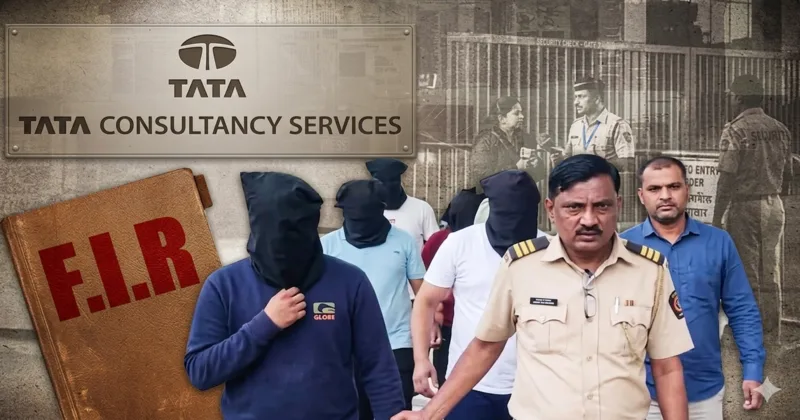
Nashik: In a significant development in the shocking case of complaints of sexual misconduct and other serious charges such as forced religious coercion, etc. at Tata Consultancy Services’ Nashik facility, the city police have filed eight separate chargesheets across multiple FIRs, marking a decisive phase in the investigation led by a Special Investigation Team.
The charges relate to allegations of molestation, sexual harassment of women employees, attempts at religious conversion, and acts said to have hurt religious sentiments. The filings were made before a local court on Thursday, completing documentation in all registered cases.
SIT Probe and Scale of Evidence
The Special Investigation Team was constituted under the direction of Nashik Police Commissioner Sandeep Karnik to ensure a focused and time-bound probe. Earlier, a detailed chargesheet exceeding 1,500 pages had been filed in a related case registered at Deolali Camp Police Station. With the latest submissions, the cumulative documentation now runs into more than 2,000 pages.
According to investigators, the chargesheets are supported by extensive material evidence, including digital records, WhatsApp conversations, CCTV footage, and technical data. Statements of more than 45 witnesses have also been recorded as part of the probe.
Multiple FIRs, Separate Chargesheets
Police confirmed to the media that each FIR has been treated independently, with separate chargesheets filed against the accused named in each case. The complaints were lodged by employees against their colleagues, leading to the arrest of eight individuals, including two women.
Among those under scrutiny is Nida Khan, identified as a key accused in one of the cases. Investigators also questioned AIMIM corporator Matin Patel from Chhatrapati Sambhajinagar for several hours over allegations that he provided shelter to one of the accused.
Deolali Camp FIR (filed first of the lot) last week appears to be the first or anchor case, with a massive 1,500-page chargesheet. The charge sheet was filed on May 23 before the court at Nashik in the sexual assault and attempted religious conversion case linked to a TCS facility in the city. According to SIT Chief Sandeep Mitke, the charge sheet was filed against four accused, Matin Patel, Nida Khan, Danish Shaikh and Tausif Attar.
Investigators also alleged that Nida Khan, who had absconded for nearly 40 days, was provided shelter in Chhatrapati Sambhajinagar by Matin Patel, following which a separate case was registered against him.
FIR-wise Details of Accused (Mumbai Naka Police Station Cases)
FIR No. 163/26
Accused: Raza Rafiq Memon
Shah Rukh Hussain Shaukat Qureshi
Adhni Chainani
FIR No. 164/26
Accused: Tausif Bilal Attar
Shafi Bhikhan Sheikh
FIR No. 165/26
Accused: Tausif Bilal Attar
FIR No. 166/26
Accused: Danish Ijaz Sheikh
Tausif Bilal Attar
Nida Ejaz Khan
Raza Rafiq Memon
Shah Rukh Hussain Shaukat Qureshi
FIR No. 167/26
Accused: Tausif Bilal Attar
Shafi Bhikhan Sheikh
Asif Alam Ansari
FIR No. 168/26
Accused: Tausif Attar
Raza Memon
Shafi Sheikh
Asif Ansari
Shah Rukh Qureshi
FIR No. 169/26
Accused: Raza Rafiq Memon
Shafi Bhikhan Sheikh
FIR No. 171/26
Accused: Raza Memon
Shah Rukh Qureshi
The same set of accused appear across multiple FIRs, indicating overlapping roles across incidents. Matin Patel (AIMIM corporator, Chhatrapati Sambhajinagar) was questioned for 10 hours for allegedly providing shelter to Nida Khan, linking the Deolali case to a wider network angle.
Bail Rejected, Accused in Custody
Courts have rejected the bail applications of all the accused, citing the nature of the allegations and the evidence presented. All individuals named in the chargesheets are currently lodged in judicial custody.
Police officials have indicated that further legal action remains open, including the possibility of supplementary chargesheets if additional evidence emerges during the ongoing investigation.
Broadly, what is the case about?
The complaints, filed by mostly women (save for one male) employees within the TCS Nashik office, broadly allege that the female employees were routinely subjected to molestation and sexual harassment at the workplace by their Muslim male colleagues who were given active support by one Muslim colleague called Nida Khan.
Nida’s official designation has been gathering a lot of controversy ever since the shocking happenings were first reported in the press. Though she is not an HR official, she wielded quite a clout in her role as a telecaller with hardly anyone checkmating her excesses.
There were attempts to coerce or pressure women into conversion to Islam, the chargesheets say and also, there were acts intended to hurt religious sentiments of the Hindu Dalits and the other non-Muslims.
Police treated each complaint as a separate offence, leading to nine FIRs for which the chargesheets have now been filed as stipulated by the law. Police say the cases are backed by digital evidence such as WhatsApp chats, CCTV footage, and witness testimonies.
How was the lid blown?
The case surfaced through a series of internal complaints by employees:
Multiple women employees approached the police with formal complaints against the Muslim colleagues who had built an informal network of supporting the exploitation of the non-Muslim junior colleagues. These complaints revealed a pattern rather than isolated incidents, prompting registration of multiple FIRs
Given the seriousness and overlap of allegations, a Special Investigation Team (SIT) was constituted
The probe gathered momentum with digital trails and corroborating witness statements (over 45 witnesses)
Arrests followed, and custodial interrogation strengthened the case, leading to detailed chargesheets
One thread that drew attention during the investigation was the alleged harbouring of a key accused Nida Khan by a local political functionary Matin Patel of the AIMIM political party, which widened the probe’s scope.
‘It was a network, not a one-off case’
This is not a single-incident case but a cluster of complaints pointing to systemic misconduct within a workplace, say the police and victims. It was uncovered after victims came forward, and built into a case through documented digital and testimonial evidence by the SIT.