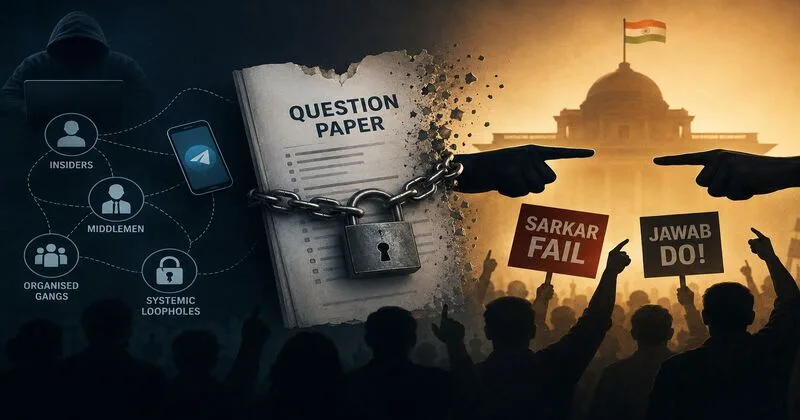
Every time a competitive exam paper leak or recruitment scam happens in India, the incident quickly moves beyond the education system and becomes a political flashpoint. While opposition parties often target the ruling government of the day, governments defend their administrative systems. The core issue is systemic failures in exam security, and it often gets overshadowed. If we look closely over the years, the paper leak problem in India is not new, not limited to one political regime, and cannot be explained only through party politics. Instead, it shows long-standing problems in the system, growing digital crime networks, and weak enforcement by agencies.
Moreover, in a country as large and diverse as India, conducting multiple examinations annually across multiple agencies, states, and recruitment bodies presents an inherent administrative challenge. Even with strong safeguards, no system globally can guarantee absolute zero risk, especially when human and technological elements interact at scale.
Why does blame quickly shift to the government?
In India, all large-scale examinations are conducted or overseen by government bodies. Whether it is a central agency or a state recruitment board. Because the government is the visible authority, public anger is naturally directed at the ruling party, i.e., the BJP. However, the paper leak system involves multiple layers:
Paper setting agencies
Printing presses
Transportation and storage contractors
Examination centers
Invigilators and local administrative staff
India has witnessed exam paper leaks and cheating scandals for decades, even before the current political dispensation. Earlier, such incidents were mostly manual and localised, involving physical theft or unauthorised photocopying of question papers. Over time, however, the nature of these leaks has changed significantly. With the increasing use of digital technology, the paper leaks have become more organised. Sometimes they involve hacking, digital sharing through social media, and structured rackets that operate across multiple states or maybe across India.
Likely root cause of paper leak
The real drivers behind this persistent issue are structural. One of the biggest reasons is the intense competition for government jobs in India, where millions of candidates compete for a small number of seats. This creates a strong black market demand for leaked papers. It encourages criminal groups to monetise the desperation of aspirants. In several cases, investigations have revealed the involvement of organised crime networks that operate systematically. They exploit the weak points in the examination process. Alongside this, human greed and corruption also play an extremely major role. Individuals with access to sensitive information, such as the printing staff or intermediaries, sometimes misuse their position for financial gain.
Technology, nowadays, has become a double-edged sword. The modern examination system and security infrastructure are not hand-in-hand at the moment. Weak encryption, inadequate monitoring, and human handling of digital systems have created a lot of vulnerabilities that are likely to be exploited. At the same time, exams in India are handled by different states and agencies, each with its own rules and security methods. This makes it difficult to maintain the same level of protection everywhere. During such transitions, gaps between old processes and new technologies can temporarily create vulnerabilities that are actively being addressed by respective authorities.
Even with these realities, political blame becomes almost impossible to avoid. Public expectation is naturally high of the government to ensure fair and transparent recruitment. When a leak occurs, candidates and families demand accountability from those in power. Opposition parties also use such incidents to question the BJP’s governance and administrative efficiency. Because of public pressure and political competition, the ruling BJP government is usually the first to face criticism, even when later investigations reveal the involvement of contractors, middlemen, or criminal groups.
In response to repeated incidents, governments have introduced several reforms, including encrypted question paper systems, stricter surveillance at exam centres, Aadhaar-based verification, and special investigation teams for major cases. New laws with stricter punishment for cheating and organised exam fraud have also been introduced or proposed. However, enforcement on the ground is still uneven, and loopholes in the system continue to exist.
Until weaknesses in the system are fixed through stronger security measures, better coordination between agencies, and strict action against everyone involved, regardless of their position, paper leaks are likely to continue. As a result, political blame and public criticism will also continue after every major incident.