India eyes strategic Chenab diversion as IWT remains in abeyance
June 19, 2026
  • Read Ecopy
  • Circulation
  • Advertise
  • Careers
  • About Us
  • Contact Us
Android AppiPhone AppArattai
Organiser
  • ‌
  • Bharat
    • Assam
    • Bihar
    • Chhattisgarh
    • Jharkhand
    • Maharashtra
    • View All States
  • World
    • Asia
    • Europe
    • North America
    • South America
    • Africa
    • Australia
  • Editorial
  • International
  • Opinion
  • RSS @ 100
  • More
    • Op Sindoor
    • Analysis
    • Sports
    • Defence
    • Politics
    • Business
    • Economy
    • Culture
    • Special Report
    • Sci & Tech
    • Entertainment
    • G20
    • Azadi Ka Amrit Mahotsav
    • Vocal4Local
    • Web Stories
    • Education
    • Employment
    • Books
    • Interviews
    • Travel
    • Law
    • Health
    • Obituary
  • Subscribe
    • Subscribe Print Edition
    • Subscribe Ecopy
    • Read Ecopy
  • ‌
  • Bharat
    • Assam
    • Bihar
    • Chhattisgarh
    • Jharkhand
    • Maharashtra
    • View All States
  • World
    • Asia
    • Europe
    • North America
    • South America
    • Africa
    • Australia
  • Editorial
  • International
  • Opinion
  • RSS @ 100
  • More
    • Op Sindoor
    • Analysis
    • Sports
    • Defence
    • Politics
    • Business
    • Economy
    • Culture
    • Special Report
    • Sci & Tech
    • Entertainment
    • G20
    • Azadi Ka Amrit Mahotsav
    • Vocal4Local
    • Web Stories
    • Education
    • Employment
    • Books
    • Interviews
    • Travel
    • Law
    • Health
    • Obituary
  • Subscribe
    • Subscribe Print Edition
    • Subscribe Ecopy
    • Read Ecopy
Organiser
  • Home
  • Bharat
  • World
  • Operation Sindoor
  • Editorial
  • Analysis
  • Opinion
  • Culture
  • Defence
  • International Edition
  • RSS @ 100
  • Magazine
  • Read Ecopy
Home Bharat

India eyes strategic Chenab diversion as Indus Treaty remains in abeyance; Rs 5,000 Cr plan signals new hydro strategy

The excess water from Chenab River is likely to be transferred to Beas River located far east at two points, one located in Lahaul Spiti area of Himachal Pradesh and another from a take-off point near Akhnoor, west of Jammu city. If these two projects materialise in the next decade or so, they can help irrigate new areas and provide drinking water to thousands of people

Sant Kumar SharmaSant Kumar Sharma
May 27, 2026, 09:10 pm IST
in Bharat, World, Jammu and Kashmir, International Edition
Follow on Google News
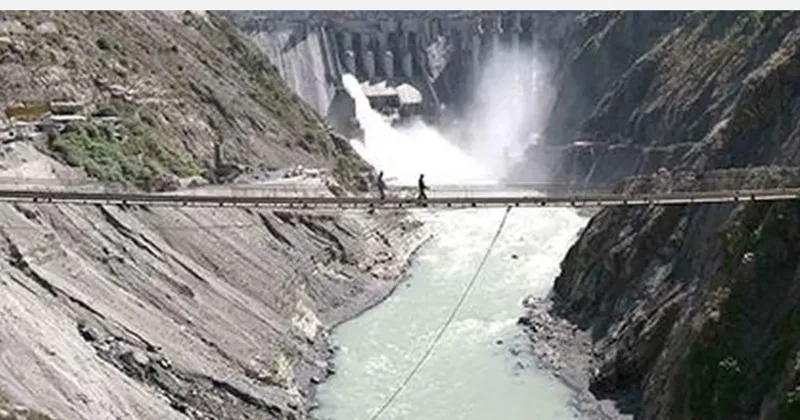
Labours walking on the bridge on top of the river Chenab

Labours walking on the bridge on top of the river Chenab

FacebookTwitterWhatsAppTelegramEmail

JAMMU: The government headed by Prime Minister Narendra Modi is reportedly working on an ambitious Chenab-Beas Link project. This big and strategically very significant project, if executed properly, can become a game changer for north India. In terms of enhanced hydropower generation, more land getting irrigated, drinking water availability for lakhs of people and better river management.

At the drawing board stage right now, this significantly enhances India’s strategic leverage over a very crucial Western River, the Chenab, which was allotted to Pakistan under the Indus Waters Treaty 1960. The Marala headworks on Chenab near Sialkot city, located 39 km southwest of Jammu, date back to 1906-12 when a weir was first built there.

The weir was meant to feed the Upper Chenab Canal, as part of what was called the `Triple Canals Project’. A much bigger structure, the new Marala Barrage, was constructed in 1969 to feed the Marala-Ravi Link Canal in addition to the Upper Chenab Canal, eight years after the IWT was signed in Karachi on September 19, 1960, in abeyance since April 23, 2025.

Read More: Tamil Nadu: CM Joseph meets PM Modi, thanks him for Aanaimangalam copper plates, raises Vande Mataram, fishermen issues

New Indian Project Getting Readied

The Indian project, which may take more than a decade or two to actually fructify, is more ambitious than what Pakistan had done. Pakistan had only linked Chenab to Ravi in the east but Indian plans envisage linking Chenab to Beas, further east of Ravi river, and may involve transfer of 1,000 cusecs of water. The link between these two rivers, Chenab and Beas, one Western and one Eastern, according to IWT 1960 definitions, can be established by constructing a tunnel/canal over 120 km in length.

Part diversion of Chenab waters may happen via a 8.7 km long tunnel at Koksar in Lahaul Spiti area of Himachal Pradesh, along a proposed 19-metre-high barrage on the Chandra River, a tributary of the Chenab. In fact, the main Chenab River starts after two stems of Chandra and Bhaga River meet and become one.

Some estimates suggested that these tweaks in the flow of Chenab could add at least 4,000 MW of additional hydropower generation. Besides clean energy, Punjab, Haryana, Rajasthan and Delhi may benefit through improved availability of irrigation and drinking water for farmers and ordinary citizens.

The Chenab waters transferred to the Ravi River catchment area fed the Lower Bari Doab Canal. This inter-basin transfer led to the Ravi River waters left free to irrigate the semi-arid states of Bikaner in Rajasthan (India) and Bahawalpur in Pakistan now. At one level, the inter-basin transfer or river waters and the link canal concept became the basis for the IWT. These transfers and subsequent development of canal networks to irrigate new areas has been replicated elsewhere too in transfer of waters from an area of abundance to an area facing shortfall or having no natural source of water.

Marala-Ravi Link Canal

The Marala-Ravi Link Canal was constructed by Pakistan between 1952 and 1956 in the wake of the India-Pakistan water dispute of 1948. This dispute had arisen after West Punjab (Pakistan) failed to negotiate with East Punjab (India) arrangements for water supply beyond March 31, 1948. It may be mentioned here that there were standstill agreements for supply of waters from Madhopur headworks till that date after Independence.

After independence on August 15, 1947, India spent substantial amounts of money for the upkeep of the Madhopur headworks. This money was mainly spent by the East Punjab government, and it reminded its western counterpart (Pakistan Punjab) repeatedly for continued supply of waters from Madhopur, it must share the burden for upkeep. The upkeep of both the headworks and the canals on the Indian side had become responsibility of the East Punjab government (India) but its beneficiaries were West Punjab (Pakistan) farmers.

The West Punjab (Pakistan) government knew fully well that the then existing water supply arrangements were only up to March 31, 1948. However, it deliberately did nothing to reach out an understanding with the East Punjab government on sharing waters and sharing the costs of maintenance. This deliberate ignoring and refusal to pay upfront for waters received by it through Madhopur headworks led to a lot of bad blood between the two nations.

The transfer of over 600 cusecs of Chenab waters via Marala-Ravi Link Canal led to supplies being maintained in Balloki and Sulemanki headworks in Pakistan.

The total length of the Chenab River is 1,086-kilometre and it originates from Chandra Taal in remote Lahaul Spiti (Himachal Pradesh). It becomes known as Chenab only after two tributaries, Chandra and Bhaga join at Tandi though it enters Jammu and Kashmir in Kishtwar district. Incidentally, in India, Chenab has vast hydropower potential most of which remains untapped, mainly due to unwarranted objections raised by Pakistan over them, taking dispute redressal mechanism of IWT as leverage for doing so. With IWT in abeyance, there has been hastening of several projects and J&K is emerging as major beneficiary of all the positive developments.

The Indian plan being drawn right now is likely to be executed by the NHPC, a company which has the wherewithal, both technically and financially, to execute a project of this nature. According to some conservative estimates, one aspect of the project, which envisages diverting Chenab waters from a take-off point near Akhnoor can cost upwards of Rs 5,000 crore.

These days, one parliamentary committee after another is visiting the Union Territory (UT) of Jammu & Kashmir to get hands-on information regarding various projects on the Western Rivers. A couple of these committees have undertaken more than one visit and for the next one month also, NHPC officials in J&K may have their hands full meeting the MPs and explaining things to them.


Topics: IWTChenab-Beas Link projectPM Narendra ModiIndus Water Treaty
ShareTweetSendShareSend
✮ Subscribe Organiser YouTube Channel. ✮
✮ Join Organiser's WhatsApp channel for Nationalist views beyond the news. ✮
Previous News

ABVP committed to struggle against educational discrepancies and urban naxalism: Dr Virendra Singh Solanki in Odisha

Next News

Cow slaughter & insult to Sanatan is unbearable; Hindus ready to go to any extent for cow protection: Dr Surendra Jain

Related News

PM Modi and French President Emanuel Macron during the G7 summit in Evian in France

EU-India Strategic Realignment: How PM Modi’s Europe push offers a de-risking alternative to China

J&K: India fast-tracks Kirthai II hydropower project on Chenab; A startegic move against Pakistan post IWT abeyance

Prime Minister Narendra Modi

Even the US bows to PM Modi’s long-standing leadership!

Russian President Vladimir Putin and Prime Minister Narendra Modi(File Photo)

Russia Day: From Buddha Dhamma to BrahMos, Why India-Russia Friendship Has Endured Every Geopolitical Storm

Prime Minister Narendra Modi

The MODI Era: Legacy of 4399 days of Transformation

PM Narendra Modi addressing the NDA meeting

‘The problem was Congress, not Hindus’: PM Modi’s blistering attack, lists India’s milestones in last 12 years

Load More

Latest News

Indian Coast Guard (ICG) team with indigenous Air Cushion Vehicles (ACVs) in Goa on June 18, 2026

Indian Coast Guard inducts Indigenous Air Cushion Vehicle (ACV) for coastal security operations

Lebanon must get out of the clutches of Hezbollah

Demand to Free 22 Muslim Prisoners Sparks Fresh Political Controversy in Tamil Nadu (This image is generated by AI)

Tamil Nadu: After Muslim quota push, calls for early release of long-term Muslim prisoners stirs political storm

Prime Minister Narendra Modi with US President Donald Trump

A Handshake, Not a Hug: Why PM Modi must assert India’s strategic red lines in his crucial meeting with Trump

Next Radical Move by Muslim League in Kerala? Plants Jamaat-e-Islami Men in Congress Ministers’ Offices; Youth Protests

Golden Temple after Operation Blue Star in 1984

The immoral attempt by Congress to link BJP to Operation Blue Star

Madras High Court

Madras HC stays Church near temple in Coimbatore; petitioner alleges post-TVK govt push, flags malafide intentions

India’s first made-in-India C-295 aircraft marks a shift from state control to nation-building through public-private partnership

From Nationalisation to Nation Building: The difference between socialism and integral humanism

Representative Image

Karnataka’s fake teacher salary scam: RTI exposes closure of departmental inquiry against tainted officials

PPP Chairman Bilawal Bhutto Zardari

Pakistan: Bilawal Bhutto Zardari’s PPP to form govt in Gilgit-Baltistan with 11 seats after elections for 24-member

Load More
  • Privacy
  • Terms
  • Cookie Policy
  • Refund and Cancellation
  • Delivery and Shipping

© Bharat Prakashan (Delhi) Limited.
Tech-enabled by Ananthapuri Technologies

  • Home
  • Search Organiser
  • Bharat
    • Assam
    • Bihar
    • Chhattisgarh
    • Jharkhand
    • Maharashtra
    • View All States
  • World
    • Asia
    • Africa
    • North America
    • South America
    • Europe
    • Australia
  • Editorial
  • Operation Sindoor
  • Opinion
  • Analysis
  • Defence
  • Culture
  • Sports
  • Business
  • RSS @ 100
  • Entertainment
  • More ..
    • Sci & Tech
    • Vocal4Local
    • Special Report
    • Education
    • Employment
    • Books
    • Interviews
    • Travel
    • Health
    • Politics
    • Law
    • Economy
    • Obituary
  • Subscribe Magazine
  • Read Ecopy
  • Advertise
  • Circulation
  • Careers
  • About Us
  • Contact Us
  • Policies & Terms
    • Privacy Policy
    • Cookie Policy
    • Refund and Cancellation
    • Terms of Use

© Bharat Prakashan (Delhi) Limited.
Tech-enabled by Ananthapuri Technologies