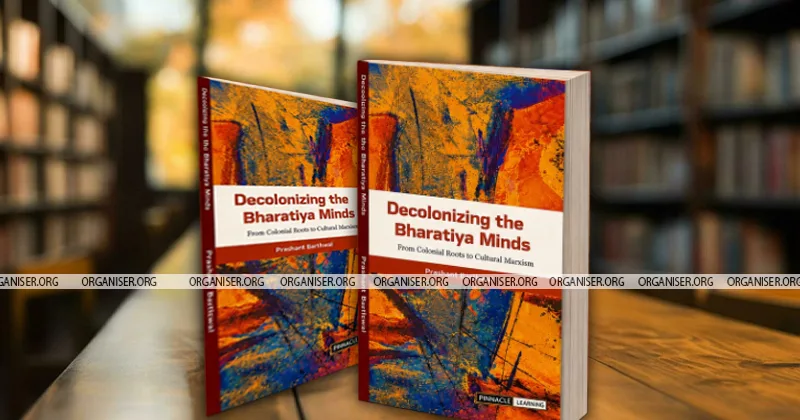
In the crowded field of postcolonial scholarship and civilizational studies, it is a relatively rare occurrence to encounter a work that manages simultaneously to synthesize Western critical theory, indigenous historiographical traditions, and a rigorously argued thesis of cultural continuity into a single, coherent academic monograph. Prashant Barthwal’s Decolonizing the Bharatiya Minds: From Colonial Roots to Cultural Marxism achieves precisely this formidable ambition. This text represents one of the most compelling contributions to the ongoing academic discourse on ideological colonialism, the politics of knowledge production, and the intellectual recovery of Bharatiya civilizational consciousness in recent years.
The book’s central argument is elegant in its formulation and ambitious in its scope. Dr Barthwal contends that the ideological challenge confronting Bharatiya civilization in the modern era is not primarily military or economic, but epistemological. The most consequential battles for civilizational survival, he argues, are waged not on geographic frontiers but in the invisible architecture of thought in classrooms, publishing houses, film studios, academic journals, and the algorithmic curation of digital platforms. The phenomenon he identifies as Cultural Marxism, which he traces genealogically from the Frankfurt School theorists (Max Horkheimer, Theodor Adorno, Herbert Marcuse, Erich Fromm) through Antonio Gramsci’s concept of cultural hegemony and on to postmodern critical theory, represents in his reading a coherent, if internally heterogeneous, intellectual strategy: one that seeks not to seize power by force but to remake the very categories through which a civilization understands itself, its past, and its possibilities.
What distinguishes Dr Barthwal’s treatment from more polemical accounts of the same phenomenon is his insistence on tracing the precise intellectual genealogy of these ideas and demonstrating their specific adaptation to the Bharatiya context. He is careful to distinguish between the European theoretical origins of Cultural Marxism, where its original targets were Christianity, bourgeois morality, and Western nationalism, and its transplantation into the subcontinent, where these categories were methodically replaced with Bharatiya equivalents: Sanātana Dharma, Brahmanical tradition, the epics, and the concept of a continuous civilizational identity. This transplantation, Dr Barthwal argues with considerable scholarly force, was not an innocent act of intellectual borrowing but a deliberate ideological operation, one that exploited the institutional infrastructure bequeathed by colonial rule.
The monograph is organized into five substantive chapters, each of which advances the overall argument while also standing as a self-contained scholarly inquiry where it provides the essential historical foundation. Dr Barthwal here demonstrates, with admirable precision, that the conditions for Cultural Marxism’s penetration of Bharatiya intellectual life were laid well before Cultural Marxism as such arrived. British colonial historiography, from James Mill’s History of British India to Vincent Smith’s tripartite periodization, had already structured the subcontinent’s self-understanding in terms of rupture, stagnation, and dependency. The Aryan Invasion hypothesis, the rendering of the medieval period as an age of glorious synthesis despite overwhelming evidence of desecration and plunder, the delegitimization of indigenous knowledge systems through Macaulay’s famous educational minute of 1835 — all of these, Dr Barthwal argues, constituted the preparatory soil into which later Marxist cultural critique was successfully grafted. This opening chapter is a model of intellectual-historical argumentation, moving fluidly between macro-historical analysis and close reading of specific texts and policies.
Dr Barthwal further engages directly with debates in the philosophy of history, drawing upon the insight that historiography is never a neutral archival exercise but always a profoundly political act. The chapter examines specific case studies in what the author terms the deliberate “manufacturing” of a distorted past: the contested question of the Sarasvati river, whose existence is corroborated by multiple lines of scientific evidence, satellite imagery, sedimentological data, palaeobotanical studies, and isotope analysis of buried geological formations, yet whose historical significance has been systematically minimized within certain strands of academic historiography. This example is particularly well-chosen, as it illustrates with rare clarity how the suppression of inconvenient evidence operates not through outright denial but through the selective deployment of interpretive frameworks. Dr Barthwal’s handling of the archaeological record here is meticulous, and his ability to situate empirical findings within a broader historiographical argument speaks well of his scholarly range.
The Tools of Cultural Subversion in Bharatiya Swa., is the most covering a wide range of mechanisms through which ideological subversion operates in the cultural sphere. The chapter’s breadth is one of its greatest strengths, demonstrating that Cultural Marxism functions not through a single channel but through an entire ecosystem of mutually reinforcing institutions and discourses — educational curricula, literary criticism, media representation, the academic gatekeeping of journals and publishing houses, and the framing assumptions embedded in grant-making bodies and research institutions. Dr Barthwal’s analytical framework here owes something to Gramsci’s own conception of hegemony as a pervasive common sense rather than an explicit ideology, and the author is to be commended for using the tools of the intellectual tradition he critiques with scholarly fairness and precision.
The discussion over Bharatiya Civilizational Resistance against the Manufactured Culture,” pivots from diagnosis to recovery and represents the book’s most constructive and, arguably, most theoretically original contribution. Where the preceding chapters have mapped the mechanisms of cultural subversion, this chapter turns to the equally important question of civilizational resilience. Dr Barthwal advances the compelling thesis that Bharat’s endurance across millennia of external aggression, from the Ghaznavi raids to the Ghurid invasions to the comprehensive project of colonial subjugation, rests not on mere political or military survival but on the remarkable philosophical depth and adaptive capacity of Sanātana Dharma as a living civilizational consciousness. Unlike the great empires of Rome and Greece, which dissolved into museum relics, Bharat endured as a continuing presence precisely because its inner philosophical core was capable of absorbing shocks, digesting contradictions, and reasserting its own paradigms of meaning. This chapter introduces the concept of Bharatiya Jñāna Sampadā, the indigenous epistemic inheritance, as the primary resource for cultural renewal, and examines how alternative media, independent research institutions, and grassroots cultural movements are constituting what Dr Barthwal calls a renaissance of resistance.
The concluding observation synthesizes the preceding analyses into a constructive programme. Dr Barthwal is admirably careful here to distinguish decolonization from a reactionary retreat into a frozen or idealized past. He explicitly rejects nostalgia as an intellectual or political programme, insisting instead on the distinction between organic civilizational evolution, through which traditions grow by reinterpreting their own inheritance, and deliberate ideological subversion, which seeks to sever a people from the resources of their own past. The chapter’s treatment of Thomas Babington Macaulay’s Minute on Indian Education (1835) as the paradigmatic act of epistemic colonialism is particularly cogent, and the author’s analysis of what he terms the persistence of “Macaulayism” in postcolonial Indian academic institutions provides both a sobering diagnostic and a precise identification of the structural reforms that decolonization requires.
Several distinctive strengths merit particular acknowledgement. Dr Barthwal draws not only upon canonical Western critical theorists, Horkheimer, Adorno, Gramsci, Marcuse, but also upon indigenous historiographical traditions, Vedic literary sources, archaeological literature, and a wide range of contemporary scholarship on postcolonial theory and civilizational studies. This breadth ensures that the argument is never parochial and never merely reactive; it is engaged, on equal terms, with the best of both the traditions it seeks to place in dialogue. The author’s prose is consistently lucid without sacrificing analytical depth. Academic writing too often purchases rigour at the cost of readability; he succeeds in the more demanding task of making a complex, multi-layered argument accessible to the educated general reader while retaining the precision necessary for specialist engagement. The preface in particular demonstrates a writer of genuine literary sensibility — it is a remarkable piece of sustained reflection on the stakes of intellectual inquiry in a civilization whose identity is contested.
Perhaps most significantly, the book makes a genuine methodological contribution by demonstrating how the tools of Western critical theory, the genealogical method, the concept of hegemony, the critique of power-knowledge formations, can be turned reflexively back upon the very Western intellectual traditions from which they originate, recovering thereby a space for non-Western civilizational self-understanding that is neither defensive nor derivative. Decolonizing the Bharatiya Minds: From Colonial Roots to Cultural Marxism is a work of substantial intellectual ambition, executed with scholarly care and animated throughout by a genuine conviction that the life of ideas carries consequences for the life of civilizations. Dr Barthwal has produced a volume that deserves to be read widely — by scholars of postcolonial theory, intellectual historians, students of Bharatiya civilization, and all those who share the conviction that understanding the mechanisms of cultural power is a prerequisite for the recovery of cultural agency. It is the kind of book that this moment, characterized as it is by rapid transformations in the politics of knowledge and identity, genuinely requires. As a scholarly monograph, it announces the arrival of a thinker of considerable promise, one whose future contributions to these debates will be eagerly anticipated.