
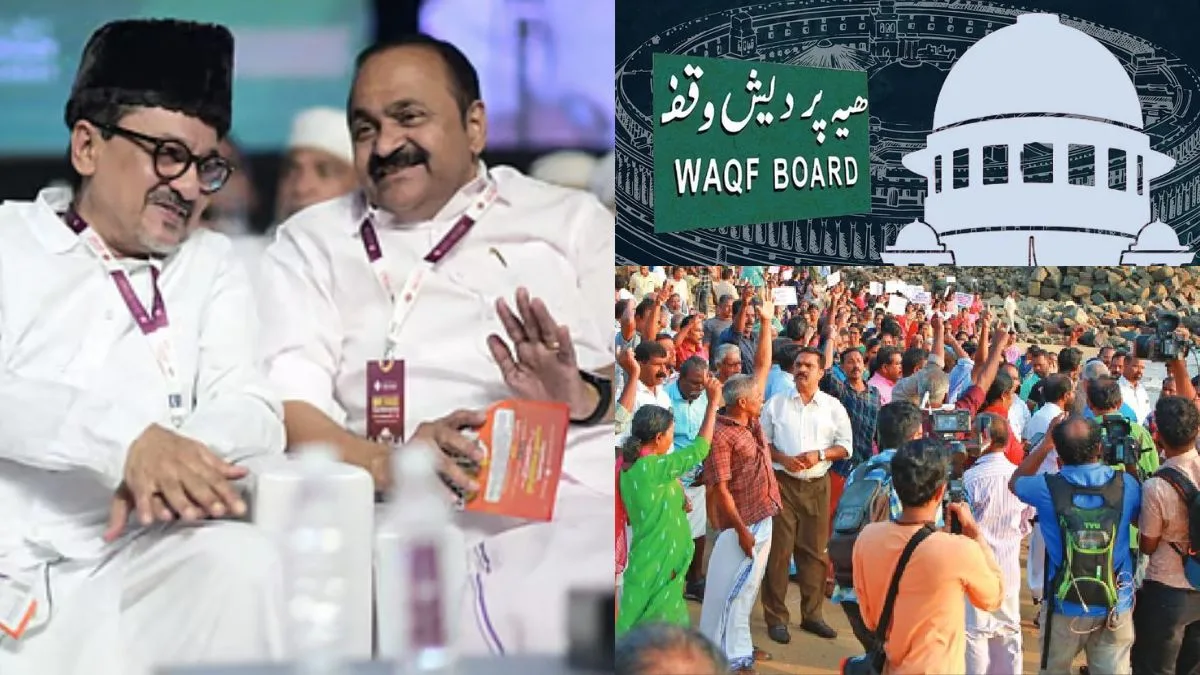
Over 600 families in Munambam — a tight-knit coastal fishing community huddled around the Velankanni Matha Church on Vypeen Island in Ernakulam — had already spent years with their fates bound up in a land dispute not of their making. The Kerala State Waqf Board had seized upon 404.76 acres of their coastline, declaring it Waqf property and effectively erasing the legal ground beneath their feet. Title deeds they had held for decades meant nothing to them now.
Tax receipts in their names meant nothing. The land their grandparents had built homes on — nothing. The total impact stretched far beyond the headline number: across the full stretch of affected households and their dependents, nearly 4,000 people were watching their futures being quietly confiscated by the Waqf board. The board have stated clearly— You can live there for decades coming but can’t own or sell their property.
Munambam Row: Did CM VD Satheesan Backtrack to Protect Muslim League?
Into this open wound of the people residing, Opposition Leader VD Satheesan stepped last year aimed at the state assembly elections due this year— not with a plan, not with a legal strategy, but with a throwaway line delivered – If the UDF came to power, he said, the Munambam Waqf crisis could be resolved in “just ten minutes,” and the land will be with the original owners. He said, a simple invocation of Section 97 of the Waqf Act. A state government order. A letter. Ten minutes, and it would be done.
Now after assuming the Chief Minister’s office, he had his hands spread wide, tone measured, words carefully chosen — Satheesan told the very people who had staked their homes, their futures, and 413 days of protest on his word that the matter was now, regrettably, too complicated to resolve quickly. The reason he mentioned was that the Waqf board have registered the Munambam land onto the central UMEED portal just days before he took charge – It was a clear-cut lie from a person who rules the state.
The fact was the registry of the Munambam land was already done by the Waqf board in 2019, when prominent Muslim League ‘family’ member Sayyid Rasheed Ali Shihab was the chairman of the Kerala State Wakf Board in 2018 tenure conducted and recommended the registry of the Munambam land.
What happened now, according to Kerala State Waqf Board chairman KS Hamza, was that the land details were uploaded to the central portal before the Centre’s May 15 deadline for completing the digital documentation process.
Meanwhile, under the new Waqf (Amendment) Act, 2025, the Centre has removed the Waqf Board’s previously unchecked authority to unilaterally declare any property as Waqf property. Supporters of the amendment argue that the new law curbs the board’s “absolute authority” and introduces greater legal scrutiny and procedural safeguards in property-related disputes.
Munambam Row: Why Did the CM Mislead People — Registry or Mere Uploading?
Keralam Chief Minister VD Satheesan said the roots of the present controversy lay in decisions taken during the previous government. According to him, while political leaders at the time publicly assured residents that they would not face eviction, the Waqf Board — which he described as a politically appointed body under the earlier administration. He further added that several legal hurdles were deliberately created by the Waqf Board, including actions that reportedly stalled even the Waqf Tribunal’s decision. Maintaining that the matter would now be handled strictly through legal means, he swallowed his ’10-minute remedy’ to give back the land to the Munambam residents.
The newly appointed Chief Minister’s press conference appeared to many as an attempt to defend himself after earlier promising that the 404-acre Munambam land issue could be resolved in just “10 minutes” — a claim that became a major part of his election campaign and helped build public trust ahead of the polls.
However, his latest remarks gave a very different impression. The press conference reflected a shift from confidence to helplessness, with the Chief Minister suggesting that once the Waqf Board had designated the land under its control, the matter had become legally complex and could not be resolved quickly.
For many residents, the message sounded less like reassurance and more like an admission that the legal battle could drag on for years. Opposition voices also alleged that the Chief Minister was carefully avoiding direct confrontation with his Muslim League ally, whose leaders had previously been associated with the Waqf Board during key stages of the dispute and support the land grabbing by the Waqf Board.
This has strengthened the perception among critics that the Congress-led front is now politically constrained in the Munambam issue, caught between its election promises and the sensitivities of coalition politics.
Political analysts be
Key Legal Developments
1967-1975 cases: A suit (O.S. No. 53/1967) in Paravur Subordinate Court confirmed Waqf status in favor of Farook College (upheld by Kerala HC in 1975). A receiver was appointed for parts of the land.
2019 onwards: Waqf Board’s suo motu notification sparked fresh litigation.
Kerala High Court (2025): A Division Bench ruled the Waqf Board’s 2019 declaration “bad in law” and a “land-grabbing tactic.” It held the land was more likely a gift (not a valid Waqf) and criticized the Board’s actions. The court allowed residents to pay land tax in some interim orders.
Supreme Court (Dec 2025 onwards): Stayed the Kerala HC’s finding that the land is not Waqf property and ordered status quo. The inquiry commission (headed by former judge Justice C.N. Ramachandran Nair) can continue. The matter remains pending; SC has extended stays.
Other proceedings: Cases before Waqf Tribunal; petitions for eviction (e.g., against a church on alleged Waqf land); challenges to government commissions. Kerala HC has issued notices and interim reliefs on tax/mutation issues.
Munambam Land Row – VD Satheesan and Muslim League
This distinction between “registration” and “uploading” has now become politically significant. Opponents argue that the Chief Minister blurred the two processes to justify why his earlier “10-minute solution” could no longer be implemented. According to Kerala State Waqf Board chairman KS Hamza, the recent action merely involved uploading land details to the central portal before the Centre’s deadline. Obviousely, CM should be aware of this. Even though he tried to mislead in the presser.
The controversy has also reignited debate over the role of coalition politics in Kerala. Critics allege that the Muslim League — which has historically supported the Waqf framework rooted in Islamic charitable and religious principles — played a major role in shaping the government’s cautious approach to the Munambam issue. According to these critics, Chief Minister VD Satheesan’s apparent shift from his earlier “10-minute solution” reflects political pressure from key allies within the Congress-led front.
They further claim that Satheesan is unwilling to take a direct stand against the Muslim League or influential centres such as the Panakkad Kodappanakkal family, which has long held significant influence in Kerala’s Muslim League politics. Some political observers and opposition voices also argue that Satheesan’s elevation as Chief Minister was strongly backed by sections of the Congress alliance, including the Muslim League and influential Sunni organisations, making the Munambam issue politically sensitive for the new government.
For many residents protesting in Munambam, these political undercurrents have deepened the feeling that their land dispute is no longer just a legal matter, but a larger battle shaped by coalition compulsions, electoral calculations, and competing ideological interests.