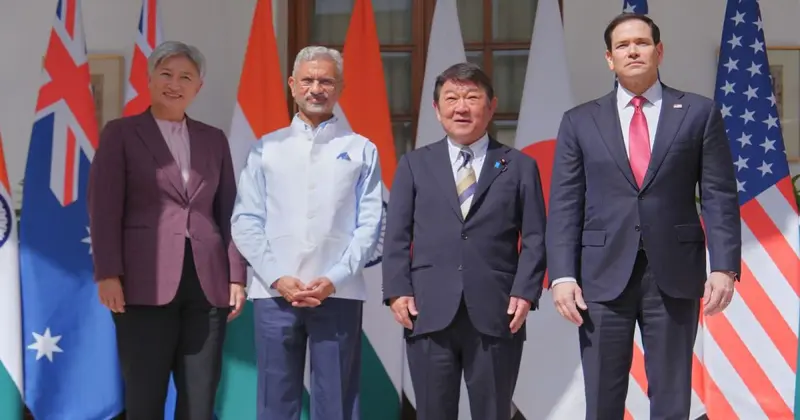
New Delhi: India, Australia, Japan and the United States on May 26, Tuesday unveiled the Quad Critical Minerals Initiative Framework, pledging to mobilise up to USD 20 billion in government and private sector support to strengthen secure and resilient critical minerals supply chains across the Indo-Pacific region.
The announcement was made shortly after the Quad Foreign Ministers Meeting which saw the partner countries arriving at the Quad Critical Minerals Initiative Framework to support the development of secure critical minerals supply chains, which are essential for advanced technologies, economic growth and the resilience of our industrial bases.
The framework sets out key areas for cooperation among the Quad partners on critical minerals supply chains giving due regard for each partner’s domestic policies and priorities. This will cover three ambits namely investments and project development, regulatory alignment and the recycle and recovery of critical minerals.
Quad partners intend to mobilize up to $20 billion in government and private sector support through new and existing efforts to strengthen critical minerals supply chains, including in mining, processing and recycling, through actions such as identifying projects with a Quad alliance that addresses critical mineral supply chain gaps, supporting strategic critical minerals projects and exploring new mechanisms to help mobilize private capital and strengthen critical minerals supply chains in Quad partner countries and beyond.
QUAD critical mineral policy is comprehensive: From mining & licensing to processing & recycling
The statement further noted that the Quad partners will aim to improve the overall environment for critical minerals development, in accordance with their respective domestic laws through actions such sharing information on good practices and technical approaches to permitting, licensing and regulatory processes, including measures to accelerate or streamline permitting timelines and processes and cooperating on technology development and capacity building related to geological mapping and resource assessment.
The partners also aim to work together to improve the recovery and use of critical minerals from e-waste and other scrap materials to enhance the supply chain and promote recycling of contained critical minerals within Quad partner and like-minded countries by facilitating investment in critical minerals recycling technologies.
The Ministers said “trusted collaboration in critical and emerging technologies underpins our ability to protect security interests, strengthen supply chains and sustain competitive, strong economies”.
QUAD fosters to build sound digital ecosystem & next-generation technologies
The Quad reaffirmed its commitment to “building secure, resilient digital ecosystems” and advancing next-generation technologies, including 5G, 6G and Artificial Intelligence. The grouping also stressed the importance of “open and interoperable architectures built on sound technical standards” to improve network security, foster innovation and reduce dependence on “single-vendor systems”.
The Ministers announced that Quad countries would advance work in the coming months on “next-generation communications standards”, a workshop on digital identity standards and a Track 1.5 dialogue on standards workforce development.
On digital connectivity, the Ministers underscored the importance of “trusted undersea cable systems” as “the backbone of the global digital economy”. The statement warned of risks, including “threats and sabotage” to cable infrastructure and noted that Quad partners had supported efforts to ensure all Pacific Islands Forum countries are connected through undersea cables by 2026.
In the technology sector, the statement welcomed “Pax Silica” as “a pillar of shared economic security agenda”, emphasising cooperation across “the full technology stack, from critical minerals and advanced manufacturing to compute, semiconductors and trusted networks”. The Quad also reaffirmed the importance of biomanufacturing and pledged to strengthen collaboration with trusted stakeholders to build resilient pharmaceutical supply chains across the Indo-Pacific.
QUAD raises concerns over arbitrary trade practices and market coercion in critical minerals sector
A major focus of the statement was economic security and resilient supply chains. The Quad said it had “grave concerns over the use of economic coercion and non-market policies and practices, including arbitrary export restrictions, price manipulation and disruptions, particularly on critical minerals that impact global supply chains and critical industrial sectors”.
The grouping thus announced the launch of the “Quad Critical Minerals Framework,” aimed at coordinating investments and economic policy tools to strengthen supply chains in mining, processing and recycling of critical minerals.
They reinforced the importance of secure and uninterrupted trade flows, including the safety of navigation and the protection of critical maritime routes and infrastructure, as essential to global economic stability and energy security and underlined the importance of ensuring unimpeded freedom of navigation and uninterrupted flow of global commerce, including in the Strait of Hormuz and opposing any restrictive measures hampering the flow of commercial vessels.
Quad Fuel Security Forum for Indo-Pacific energy security
On energy security, the Ministers announced the “Quad Initiative on Indo-Pacific Energy Security,” saying disruptions to global energy markets and fertiliser supply chains disproportionately affect the Indo-Pacific region. The statement emphasised the importance of “open, well-functioning and stable energy markets” and resilient supply chains.
In this direction, QUAD partners announced their intention to convene a Quad Fuel Security Forum to coordinate high-level discussions and facilitate cooperation in the energy realm. The details were shared by the Ministry of External Affairs in the Quad Statement on Indo-Pacific Energy Security. It said that the United States, Australia, India and Japan will work to identify areas of energy cooperation cooperation in technology management, international market analysis and emergency response exercises through an engagement plan.
To achieve this, the Quad will convene a Quad Fuel Security Forum to coordinate high-level discussions and facilitate cooperation, which would aim to recognise and leverage the unique resources and capabilities of each country’s energy sector, including to strengthen their respective strategic petroleum systems. “We recognise impacts of disruptions to global markets, particularly in relation to oil, gas and petrochemical products as well as essential goods and critical downstream derivatives such as fertilisers, fall heavily on the Indo-Pacific region. Our leaders have expressed a clear collective intent to cooperate on energy security and resilience”, the statement asserted.
The Quad countries affirmed their support towards a strong commitment to ensuring well-functioning, stable, transparent, secure and resilient energy markets. In times of significant energy market volatility and disruptions, the members encouraged all energy market participants, including producing, transit and consuming countries, to maintain transparent and open energy markets to ensure the stable availability of energy products across the Indo-Pacific region.
(With Inputs from ANI)