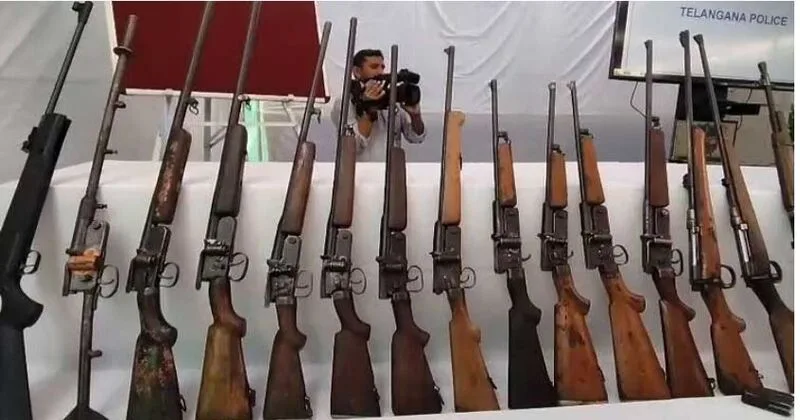
Bhubaneswar: The Odisha Police has launched a large-scale operation to trace and recover sophisticated weapons allegedly looted by Maoists over the past three decades. They are reaching out to police departments in seven states and central security agencies for assistance in locating the missing firearms.
The Special Intelligence Wing (SIW) of the Odisha Police has written to the Directors General of Police (DGPs) in Andhra Pradesh, Telangana, Chhattisgarh, Jharkhand, Maharashtra, Bihar, and West Bengal, seeking cooperation in identifying and recovering weapons stolen during Maoist attacks on security establishments in Odisha between 1992 and 2022.
The Border Security Force (BSF) and the Central Reserve Police Force (CRPF) have also been requested to assist in this recovery effort. This initiative follows the official declaration of Odisha as being free from Maoist activity, which came after sustained anti-insurgency operations and the surrender and rehabilitation of several Maoist cadres.
While many surrendered Maoists deposited their weapons during the rehabilitation process, authorities are now focusing on recovering firearms looted during attacks on police stations, armories, and security camps throughout the state over the years.
Hundreds of Weapons Looted
According to official records, Maoists have allegedly looted 650 weapons, including sophisticated firearms, from various locations in Odisha over the years.Of these, 420 have already been traced, while efforts are underway to locate the remaining 230 firearms, which are believed to be hidden in Odisha or neighboring states.
Investigators suspect that some of the missing weapons may be concealed in Chhattisgarh, Jharkhand, Telangana, Maharashtra, and West Bengal, where Maoist groups previously maintained operational networks.
ADG (Anti-Naxal Operations) Sanjeeb Panda stated that “We have shared detailed specifications of the missing weapons with police departments in seven states, as well as with the CRPF and BSF. They have been requested to verify seized weapons and facilitate their return to Odisha,” Panda said.
The recovery coordination is being overseen by DIG (Special Intelligence Wing) Akhileshvar Singh, who is collaborating closely with state police forces and paramilitary agencies to expedite the tracing process.
The Maoists attacked the Chitrakonda police station on March 17, 1992, and the Kalimela police station on August 10, 2001, looting several sophisticated firearms during these assaults.
Officials reported that 29 weapons from these incidents remain untraced, including 18 .303 rifles, two Self-Loading Rifles, three AK-47 assault rifles, three 9mm Sten guns, one 51mm mortar, one VLP signal pistol, and one 1.5 CP riot gun.
Centre Prioritises Recovery Efforts
Panda indicated that recovering the looted weapons has become a top priority following the successful elimination of Maoist activities in Odisha as of March 31 this year.
“After eliminating Naxal activities, our primary focus is to ensure that all remaining looted weapons are traced and returned to Odisha. We are confident of achieving this objective soon. The Union Ministry of Home Affairs has also prioritized the backtracking of these weapons,” he said.
Following directions from Union Home Minister Amit Shah, states affected by Red Terrorism have been instructed to prepare databases of looted and recovered weapons and to share detailed information to facilitate the identification and return of firearms to their respective states.
Officials pointed out that each police-issued firearm carries a unique body number and butt number, allowing for accurate identification even if weapons are recovered years later during security operations.
Concerns Over Hidden Arms Caches
Security agencies believe that recovering the missing firearms is crucial to preventing misuse and dismantling any residual Maoist infrastructure in the region. Officials suspect that several weapons may have been buried underground or concealed in dense forest areas during the peak of Maoist activity.
Search operations are currently underway in suspected Maoist strongholds and forest regions to locate hidden weapon caches.
A former Odisha Police officer noted that Maoist activity in the state began gaining momentum during the 1990s, with Odisha often serving as a strategic operational corridor for Maoist groups active in neighboring states.
“Over more than three decades, Maoists have looted weapons from several districts in Odisha. Many of these arms were carefully hidden. Although a large number of cadres have surrendered, some have yet to return to the mainstream. Recovering these weapons is a crucial step toward dismantling any remaining Maoist infrastructure,” the former officer said.
He added that information regarding hidden weapons is typically known only to select cadre-level operatives and senior Maoist leaders, making recovery efforts particularly challenging even after the decline of insurgent activity in the state.
Officials maintain that the ongoing recovery operation aims not only to reclaim stolen arms but also to ensure long-term internal security and prevent any possibility of extremist regrouping in the future.