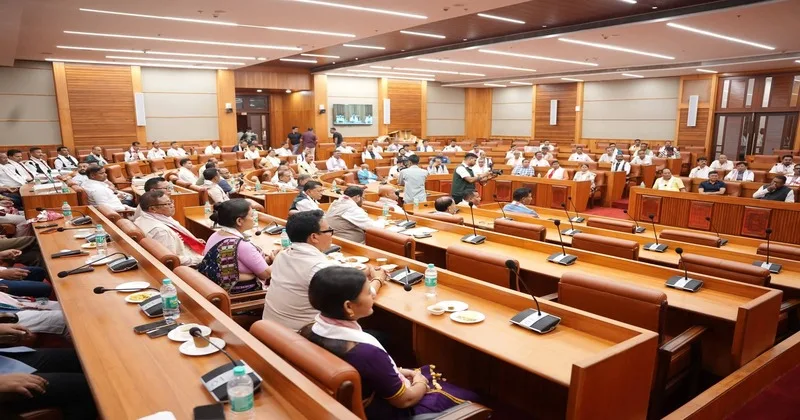
Guwahati: In a bid to fulfil the election promise by the BJP led NDA, the Assam government on May 25, tabled the Uniform Civil Code (UCC) Bill in the state assembly, setting the stage for what is expected to be a fiery political and social debate in the coming weeks.
Parliamentary Affairs Minister Atul Bora placed ‘The Uniform Civil Code, Assam, 2026 Bill’ on the table of the House on behalf of Chief Minister Himanta Biswa Sarma during the third day of the inaugural session of the 16th Assam Legislative Assembly.
What does Bill say?
The Statement of Objects and Reasons attached to the Bill states that its core purpose is to “consolidate and simplify laws governing marriage, divorce, succession and live-in relationships” across communities in the state.
Here are the major points of the Bill
Ban on Polygamy — The practice of having more than one spouse at a time will be strictly prohibited under the proposed law.
Minimum Age of Marriage — The Bill fixes the legal minimum age of marriage at 21 years for men and 18 years for women, bringing it in line with broader national-level discussions on the subject.
Mandatory Registration of Live-In Relationships — In a first-of-its-kind provision for the state, all live-in relationships will have to be compulsorily registered. This is aimed at ensuring legal protection for both partners and any children born out of such unions.
Rights of Children from Live-In Unions — The Bill formally recognises and protects the rights of children born to couples in live-in relationships, giving them legal standing.
Exemption for Scheduled Tribes — In a crucial carve-out, the Bill clearly states that its provisions will not apply to Scheduled Tribes residing in Assam, thereby excluding tribal communities from its ambit and protecting their customary practices.
Unified Framework for Personal Laws — The legislation seeks to bring all communities — barring Scheduled Tribes — under a single, unified legal framework covering marriage, divorce, and inheritance.
Senior BJP MLA Sushanta Buragohain said, “ the bill is an issue for those who practises triple talaq. Congress has 18 out of 19 MLAs who believe in triple talaq, so it is obvious from them to oppose the bill.”
CM Sarma lauds UCC
Speaking on the occasion, Chief Minister Sarma described the tabling of the Bill as an opportunity to have an “on-record discussion” on why such a law is the need of the hour. Taking to social media platform X, CM Sarma said the proposed legislation would go a long way in realising the constitutional vision that the architects of independent India had always aspired for.
“For the first time, the Bill provides a legal framework for live-in relationships. By requiring registration, the law ensures that the rights of partners, and any children born from such unions, are formally recognised and protected,” the Chief Minister noted.
Congress opposes
The introduction of the Bill, however, did not go down well with the Opposition benches. Parties including the Indian National Congress, Raijor Dal, and the All India Trinamool Congress strongly objected to the manner in which the Bill was being pushed through, calling for broader stakeholder consultations before it is taken up for deliberation.
The Opposition’s concern centres around the Bill potentially overriding the personal laws of religious and cultural minorities without adequate dialogue and consensus-building — a charge the ruling dispensation has yet to directly address on the floor of the House.
The Big Picture
Assam became one of the early movers among Indian states to introduce a UCC framework at the state level, following Uttarakhand and Gujarat which had enacted its own UCC legislation. With an absolute majority and a weak opposition, BJP is confident of passing the bill in the assembly. The discussion on the bill will be held on 27th May in the assembly. Once passed in the assembly with governor’s approval the UCC will be a valid act in the state of Assam.