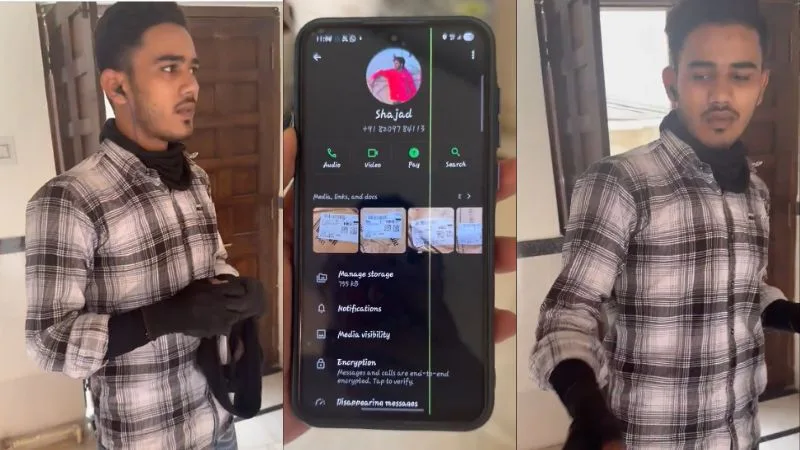
A video circulating widely on social media has triggered outrage after a delivery agent identified as Ibrahim was heard admitting that he sold Hindu women customers’ personal phone numbers to a man named Shahzad for Rs 10 each. The viral clip has raised serious concerns over customer privacy, data misuse and the safety of women using online delivery platforms.
The controversy escalated after social media users tagged Amazon and demanded immediate action against the accused delivery worker, warning that legal complaints and police action would follow if the company failed to respond.
Viral video claims delivery agent shared women’s phone numbers
The controversy began after a video was shared on social media platform X by user Archi Tandewal, who alleged that the delivery agent had been selling personal contact details of Hindu women customers.
In the video, the man identified as Ibrahim allegedly admits that he used to share customer phone numbers with another individual named Shahzad in exchange for money.
According to claims made online, the delivery worker allegedly received Rs 10 for every number shared.
@amazonIN Your delivery agents are completely compromising customer safety. One named Ibrahim is on record admitting to leaking Hindu female customers’ numbers and addresses to Sajad for incentives. Either take action or I will file an FIR. pic.twitter.com/r0qj3I6w3B
— Archie Tandewal (@archi_tandewal) May 23, 2026
The video quickly went viral, with several users expressing anger and concern over the alleged misuse of private customer information collected through delivery apps.
Many users questioned how delivery agents were able to access sensitive customer data and whether sufficient safeguards existed to prevent misuse.
Social media users demand accountability from Amazon
After posting the video, Archi Tandewal tagged Amazon on X and demanded accountability from the company.
She stated that if strict action was not taken against the accused delivery worker, she would approach police authorities and file an FIR in the matter.
The incident sparked widespread debate online, with users demanding stronger verification systems and stricter monitoring of delivery personnel handling customer information.
Several social media users linked the controversy to broader concerns regarding misuse of personal data and alleged targeting of Hindu women through digital platforms.
Some users also referenced previous incidents involving allegations of organised attempts to target women through workplace or online networks.
Amazon seeks details through direct message
Following the outrage online, Amazon responded in the comment section of the viral post and requested complete details of the incident through direct message.
The company reportedly assigned a customer support executive named Ruhina to handle the complaint and review the matter.
According to screenshots shared online, the customer support representative assured users that the company would respond within six to twelve hours after examining the complaint.
Thanks for bringing this to our notice. We’d like to escalate this on your behalf. We’d like to help you with this. Please reach out to us via DM through the ‘Send us a Private Message’ option below, without sharing your order or account specifics, and we’ll do our best to… https://t.co/1XyLaGkcaN
— Amazon Help (@AmazonHelp) May 23, 2026
However, several users later alleged that even after more than 22 hours, no visible public action or detailed clarification had been issued by the company.
This further intensified criticism on social media, with some users accusing the company of responding slowly to serious allegations involving customer privacy and women’s safety.
As of now, there has been no official public statement from Amazon confirming the authenticity of the viral video or announcing disciplinary action against the accused individual.
Concerns over privacy and misuse of customer data
The incident has once again highlighted growing concerns over digital privacy and the risks associated with sharing personal information through online platforms.
With online food delivery, e-commerce orders, bike taxis and UPI-based services becoming part of daily life, cyber experts say users must remain cautious while sharing mobile numbers and personal details.
Users are also advised to enable privacy settings that hide their phone numbers wherever possible.
Cyber safety professionals further suggest strengthening WhatsApp privacy settings so that unknown individuals cannot access profile photos, status updates or last-seen details.