
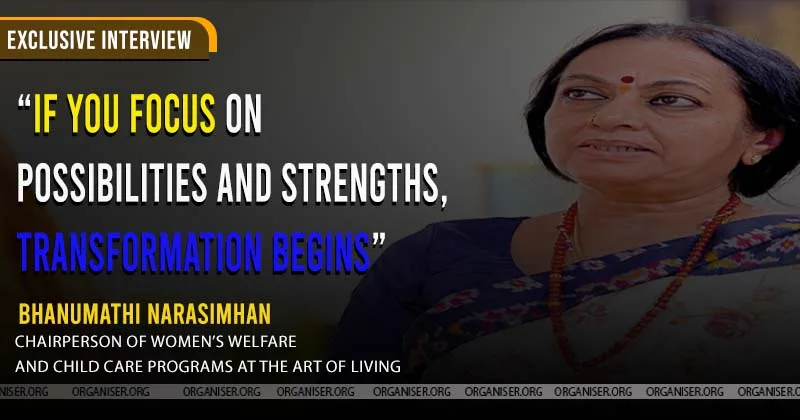
In this conversation with Organiser Editor Prafulla Ketkar, Bhanumathi Narasimhan, Chairperson of Women’s Welfare and Child Care Programs at The Art of Living and sister of Gurudev Sri Sri Ravi Shankar, speaks about education, women empowerment, spirituality, mental well-being and philosophy that has guided the movement for decades
You work extensively with children and educational initiatives. How difficult is it to integrate spirituality and values into modern education?
It is definitely challenging, especially in rural areas and particularly when it comes to girls’ education. But because we have worked consistently in this direction for 45 years, we can now proudly say that nearly 49 per cent of the 1.2 lakh children studying in our institutions are girls. We have successfully broken many barriers in villages where earlier educating girls was not considered important.
One important aspect of our schools is that we remain deeply connected with local culture and traditions. We employ teachers from local communities, encourage regional customs and teach in local languages. Alongside academics, children are introduced to yoga, spirituality and practical skills.
Today, we run schools in 11 local languages. There are certainly many challenges, but we always focus on possibilities rather than limitations.
You have particularly focused on issues related to women and children. How do you see the challenges women face today – balancing professional life, personal responsibilities and family structures,
Our primary approach has always been through yoga and meditation because we believe societal transformation begins with individual blossoming. When an individual becomes stress-free and internally strong, only then can genuine transformation happen in society.
We always say that whatever we possess internally is what we ultimately share with the world. If I am peaceful and happy, I spread peace and happiness. If I am stressed and disturbed, that is what I will transmit outward. Only after that can we truly think about universal transformation or social change. Otherwise, social service becomes superficial. In fact, I personally feel that people engaged in social work should not become stressed or burned out.
But is this message equally applicable to women from economically weaker backgrounds as well as modern educated urban women? Do you see differences in the way they receive these ideas?
That is precisely why, for nearly two decades now, we have been organising women’s conferences aimed at bridging the gap between rural and urban women. There is often a misconception that rural women are uneducated or backward, but honestly, urban society can learn a great deal from them – especially in terms of values, sharing, caring and emotional resilience.
Today, urban families are increasingly becoming nuclear, whereas villages still preserve many aspects of community and joint-family culture. There is so much mutual learning possible between these two worlds.
You have personally witnessed this movement from its earliest days 45 years ago. How do you look at this journey today?
In one sense, the growth has been truly exponential. For us, this has been a deeply fulfilling journey. Forty-five years ago, we had only one school started by my father with 30 children. Today, we have more than 1,300 schools across 22 states, where nearly 1.2 lakh children receive free education. For me, that itself is an extraordinary fulfilment.