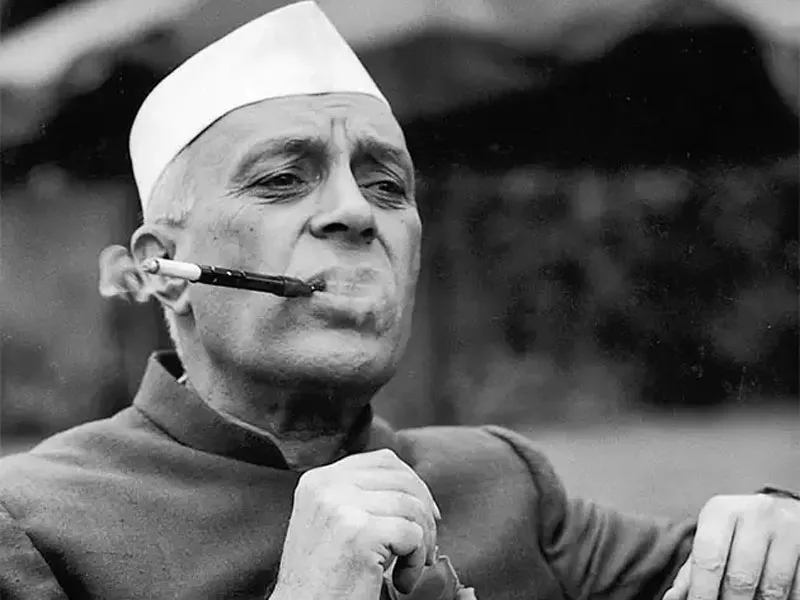
A 1954 letter written by India’s first Prime Minister Jawaharlal Nehru has resurfaced, exposing the grim human and economic consequences of the Congress government’s Zamindari Abolition policies. Far from the idealistic public narrative of “social justice” and “land reform,” the letter reveals Nehru privately acknowledging that thousands of dispossessed landowners had been pushed into financial collapse while compensation remained indefinitely delayed.
The letter, dated May 24, 1954, was written from “The Retreat, Mashobra, Simla” and addressed to “Sri Babu,” understood to be Bihar Chief Minister Sri Krishna Sinha. In the correspondence, Nehru candidly admitted that many zamindars in Bihar had lost all rental income after their estates were acquired by the state, yet had received virtually no compensation in return.
Nehru wrote that President Rajendra Prasad had raised serious concerns about the plight of the dispossessed zamindars. The Prime Minister acknowledged that many among them were facing “great distress” because their sources of income had vanished entirely.
“Apparently no compensation has been given to them yet. They have lost all their income of rent,” Nehru wrote.
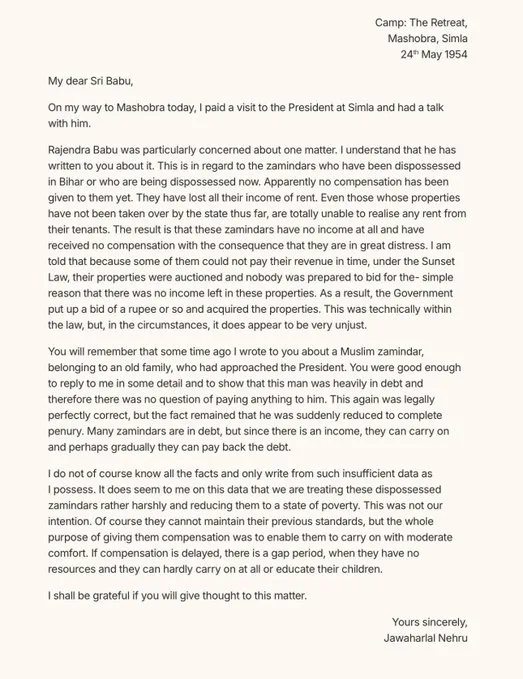
The letter becomes even more revealing when Nehru admits that several estates had become economically worthless after abolition. According to him, even properties not formally taken over by the state could no longer generate revenue because tenants stopped paying rent and the legal structure surrounding the estates had collapsed.
He further explained that because some zamindars failed to pay land revenue in time under the “Sunset Law,” their estates were auctioned. However, no buyers were willing to purchase them because there was “no income left in these properties.”
“The Government put up bid of a rupee or so and acquired the properties,” Nehru admitted in the letter.
The statement raises troubling questions about the actual implementation of Congress-era land reforms. While the abolition of zamindari was publicly projected as a revolutionary step toward equality, Nehru’s own words suggest that many families were stripped of inherited property and economic stability without any meaningful rehabilitation.
Perhaps the most explosive part of the letter is Nehru’s striking admission that although the process may have been legally valid, it was morally questionable.
“This was technically within the law, but, in the circumstances, it does appear to be very unjust,” Nehru wrote.
The line stands out as a rare confession from the architect of India’s socialist economic framework. It suggests that even Nehru understood that the execution of these policies had crossed into economic injustice.
In another revealing passage, Nehru referred to a Muslim zamindar from an old family who had approached President Rajendra Prasad seeking help. Nehru admitted that although the government considered the matter legally correct, the individual had been “suddenly reduced to complete penury.”
The Prime Minister acknowledged that many zamindars had fallen into debt and could not sustain themselves because their income sources had disappeared overnight.
The letter also demolishes the claim that the state had ensured smooth compensation mechanisms for dispossessed landowners. Nehru openly admitted that compensation delays created severe hardship, leaving affected families without resources even for basic survival and education of children.
“If compensation is delayed, there is a gap period, when they have no resources and they can hardly carry on at all or educate their children,” he wrote.
The admission is politically significant because it directly exposes the contradictions of Nehruvian socialism.
Congress governments repeatedly portrayed land reforms as a moral and economic necessity for building a more equal India. However, Nehru’s own private communication reveals that the implementation often resulted in economic destruction, uncertainty, and social humiliation for thousands of families.
Many argue that the letter reflects a larger pattern within Congress-era economic policymaking, where ideological commitment to socialism frequently overrode concerns about practical consequences and individual rights. The abolition of zamindari may have dismantled feudal structures, but the letter suggests that it also created a class of economically broken former landowners who were abandoned by the state after acquisition.
The correspondence has now reignited debate over the legacy of post-Independence economic reforms under Congress rule, especially at a time when the party continues to glorify the Nehruvian era as the foundation of India’s progress.
Historians and political leaders point out that while land reforms are routinely celebrated in textbooks and political speeches as “historic social justice measures,” far less attention has been paid to the economic destruction, compensation failures, and prolonged suffering faced by thousands of families who lost their lands, livelihoods, and inherited social security under the system. Nehru’s own words expose a reality far harsher than the idealistic narrative repeatedly projected by the Congress party for decades.
The resurfaced letter also raises uncomfortable questions about the moral foundations of Congress-era socialism and state-led economic intervention. If Jawaharlal Nehru himself privately admitted that the process appeared “very unjust,” many argue that the Congress leadership was fully aware of the suffering being caused, yet continued pushing policies driven more by ideology than humane implementation.
The letter strengthens long-standing criticism that Congress governments often treated ordinary citizens, taxpayers, farmers, traders, and landholders as instruments for political experimentation while failing to ensure fair rehabilitation or timely compensation.
The document is not merely about zamindari abolition but about a larger pattern that defined decades of Congress governance: excessive state control, bureaucratic socialism, delayed justice, confiscatory economic policies, and disregard for those ruined in the process.
Many argue that while the Congress ecosystem still romanticises the Nehru era, millions spent decades battling poverty, red tape, economic stagnation, and state exploitation under policies that frequently weakened wealth creators instead of empowering them.
The contrast becomes sharper when viewed alongside the economic transformation seen under Prime Minister Narendra Modi. Over the last decade, India has witnessed rapid infrastructure expansion, record digital growth, direct benefit transfers, massive rural connectivity, welfare delivery without middlemen, rising entrepreneurship, and an economy projected among the world’s fastest growing.
Unlike the Congress-era model accused of centralised control and economic suffocation, the Modi government has consistently projected itself as focused on empowerment, wealth creation, transparency, and development reaching the last mile.
At a time when Congress leaders continue invoking the Nehru legacy, the letter has reopened difficult questions about whether the party’s celebrated socialist policies actually uplifted India, or whether generations quietly paid the price for ideological experiments carried out in the name of reform.