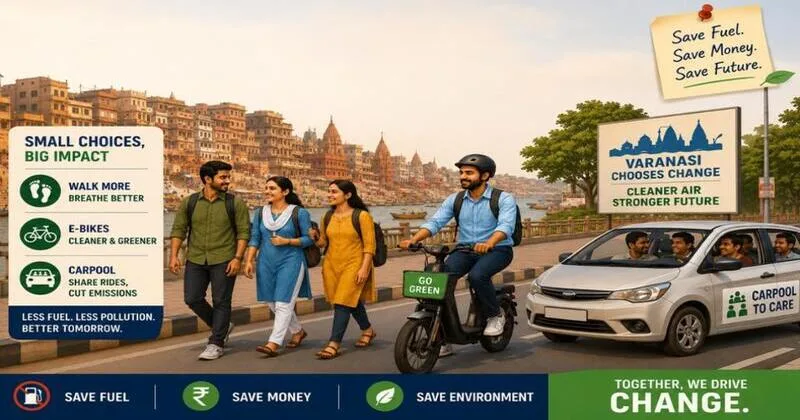
Within 48 hours, three separate bodies in Prime Minister Narendra Modi’s parliamentary constituency acted on his fuel-conservation appeal: the Varanasi Municipal Corporation observed a ‘No Fuel Day,’ BLW Varanasi (Bareka) ran a carpooling drive, and the Varanasi Development Authority ordered 100 e-bikes for its staff. The city has moved from a symbolic gesture to an institutional programme.
The Mayor Who Walked to Work
On May 16, Varanasi Mayor Ashok Kumar Tiwari walked from his residence to the Municipal Corporation office with an umbrella in hand, midday summer sun overhead. Municipal Commissioner Himanshu Nagpal arrived on an e-scooter. His gunman, personal assistant and Additional Municipal Commissioners reached the office by e-rickshaw. Dozens of employees followed their lead, switching from personal petrol vehicles to cycles, public transport and electric alternatives all on a single working Saturday. This was not a one-off photo opportunity. Commissioner Nagpal announced that every Saturday will now be observed as ‘No Fuel Day’ across the municipal body. The decision makes Varanasi Nagar Nigam one of the first municipal corporations in Uttar Pradesh to institutionalise a weekly no-fossil-fuel commute.
Mayor Tiwari framed the action squarely within the national context. “If every person stops using petrol and diesel vehicles even one day a week, it will reduce environmental pollution and strengthen the country’s economy,” he said.
Bareka Shared-Vehicle Experiment
On Saturday, Banaras Locomotive Works (BLW), Varanasi, known locally as Bareka, organised a ‘Pooled Vehicle Day’ under the direction of General Manager Ashutosh Pant. Senior divisional heads, department chiefs and officers came to office in shared vehicles, while several opted for cycles or walked.
The initiative was described internally as a response to PM Modi’s call for energy conservation, frugality and a better workplace culture. For a manufacturing hub that runs on rail infrastructure, BLW setting these precedents carries weight beyond one day’s commute.
VDA Goes Structural: 100 E-Bikes on Order
While the Municipal Corporation and BLW acted on single-day symbolism, the Varanasi Development Authority (VDA) went a step further with a structural intervention. On May 17, VDA launched its ‘Green Mobility Campaign’ and placed an order for 100 electric two-wheelers for staff use in Phase 1.
The numbers behind the decision are direct. VDA has over 400 regular and outsourced employees of whom approximately 90 per cent use petrol or diesel two-wheelers daily for office commute, field inspection, enforcement duties and project monitoring. That is a substantial daily fuel footprint from a single civic body.
VDA estimates the campaign will save 200 to 300 litres of petrol and diesel per day once implemented. The authority led by Vice-Chairman Purna Bora is also negotiating institutional discounts with e-vehicle dealers and coordinating with banks for low-interest loans to make e-bike ownership accessible to employees below senior grades.
Central and state government subsidies on electric vehicles, road tax exemptions and registration fee waivers will be passed on to VDA staff under the programme. Charging stations are being set up at VDA’s main office and all zonal offices with public access built in, extending the infrastructure benefit to ordinary citizens.
The Larger Picture
These three actions are not isolated civic enthusiasm. They are a direct institutional response to PM Modi’s public appeal to citizens and government bodies to cut fossil fuel consumption amid rising import costs and currency pressure. India’s petroleum import bill remains one of the largest drains on foreign exchange reserves, a concern the Prime Minister has flagged repeatedly in recent months.
Varanasi, as PM Modi’s own constituency, has historically been a testing ground for policy messaging translated into civic action. What stands out this week is the simultaneity of three different types of institutions (municipal government, a central PSU and a development authority) moving together within 48 hours.
Whether this energy holds beyond a single week depends on enforcement, not intent. The Municipal Corporation’s decision to make Saturday a permanent ‘No Fuel Day’ is the one commitment that can be measured and followed up.
VDA e-bike fleet is expected to be operational once the Phase 1 order of 100 vehicles is delivered and the charging infrastructure is activated at its offices across the city. The Municipal Corporation’s second ‘No Fuel Day’ will fall on May 23, the first real test of whether last week was policy or performance.