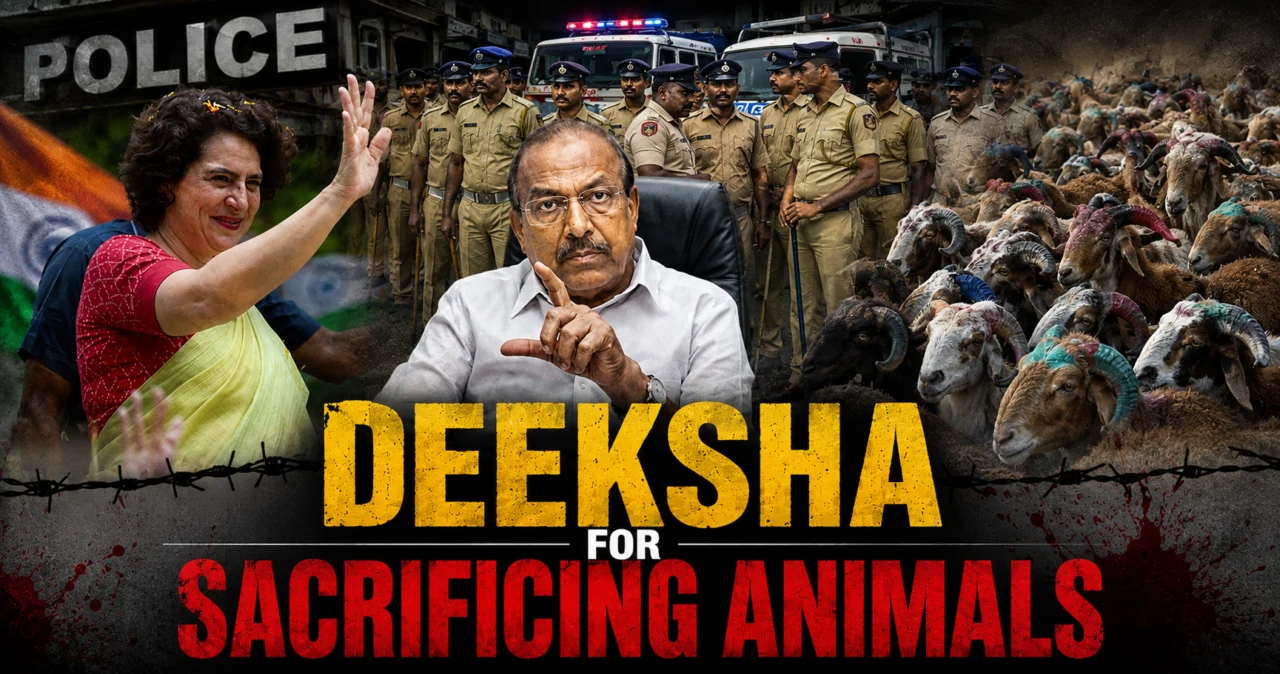
It has hardly been two days since the Muslim League-backed UDF government led by the Congress came to power in Kerala, and a controversial permission granted by the police has already sparked discussion. An ASP office in Priyanka Gandhi’s Wayanad constituency granted permission to a Muslim police officer to grow a beard for Eid-related religious observance linked to animal sacrifice.
While Kerala has a specific law banning animal sacrifice in Hindu temples and their precincts, Eid-linked religious accommodations are increasingly being normalised under the new political atmosphere following the return of the Congress-Muslim League government.
Wayanad police order became controversial because it explicitly referred to “animal sacrifice” while granting temporary religious permission to a police officer for Eid observance. For many observers, the issue is no longer just about a beard or temporary religious accommodation, but about whether laws and administrative standards are being applied equally across communities in Keralam.
The cops didn’t just blink — they bent the knee
This wasn’t administrative flexibility. This was a signal. Ever since the Congress-led UDF swept back to power with the Muslim League holding serious weight in the coalition, something has quietly shifted in Kerala’s institutional spine.
The police didn’t relax a rule. It is not wrong to say that the police ‘chose’ who deserved one.
That’s the question nobody in power wants to answer directly: The Political Islam’s growing grip on this government is visible. While Hindu festivals are still squeezed through a maze of noise restrictions, timing curfews, limiting rituals and procedural chokepoints — rules enforced with almost theatrical rigour — a different calculus seems to apply elsewhere – that too for particular community.
This is what selective secularism looks like when it matures. Not a dramatic announcement. Just a quiet, comfortable double standard that institutional players are no longer even embarrassed to perform publically, as it had been a new normal for Keralam.
The Kerala Animals and Birds Sacrifices Prohibition Act, 1968
The debate has intensified because Kerala already has “The Kerala Animals and Birds Sacrifices Prohibition Act, 1968” in force across the state. The Act defines “sacrifice” as the killing or maiming of any animal or bird for the purpose of propitiating a deity and bars not only the act itself, but also participation, assistance, officiating, or knowingly allowing such rituals within temple premises.
The law extends across the entire state and provides penalties including fines and imprisonment for violations. It replaced earlier laws that existed separately in the Malabar and Travancore-Cochin regions before Kerala’s reorganisation.
The controversy surrounding the Wayanad police beard permission order has now opened a larger debate in Keralam over religious accommodation, selective exemptions, and political influence within state institutions.
The policeman, Abdul Rauf said that he should be given permission to initiate Diksha to perform animal sacrifice on the day of Baliperunal (Bakrid). The action was quick. No reference, no cross checking the police manual, no larger expert consultation. He was granted the ‘Deeksha’ permission ASAP. Wayanad ASP’s order granting permission for ‘Deeksha’ completely dismantled the strict dress code and discipline in Kerala Police.
And what concerns the most — Is the inclusion of words like ‘animal sacrifice’ in the official order. Do the Kerala government perhaps believe so now, especially as the state is effectively being ruled by the Muslim League, that ‘Animal Sacrifice’ is a good term to use and promote in an official order and office directory?
Muslim Policeman Sought ‘Deeksha’; Priyanka Gandhi’s Wayanad Police Headquarters ‘At Your Service’
An official order issued by the Priyanka Gandhi’s Wayanad district police headquarters undermined the strict dress code and discipline of the Kerala Police. The incident has now ignited a huge controversy across the nation. The incident reinforces the truth, that a section of police officers is trying to take advantage of the regime change to bring back Islamists customs and Muslim privileges within the force.
The controversy has also brought back memories of the “Pacha Velicham” (“Green Light”) WhatsApp group controversy from a few years ago, in which certain police personnel were allegedly found communicating and coordinating around Islamist activities.
The Muslim League, widely seen as wielding significant influence in the new dispensation, has begun showing its ideological imprint within just days of the swearing-in ceremony of the new government.
Wayanad Top’s again for Islamists ‘rule’
Wayanad DHQ Civil Police Officer P. Abdul Rauf (CPM 3537) is the policeman who has been officially given permission to grow a beard for ten days from May 19 to May 28. This officer had submitted an application to the District Police Chief stating that he should be given permission to initiate Diksha to perform animal sacrifice on the day of Baliperunnal.
This strange order was issued on 19th May by Wayanad Additional SP KS No. J124401/2026/W considering this application. This move violates all norms, even when previous governments and courts have approached the High Court seeking permission for Muslim officers to grow beards permanently to maintain the secular nature and discipline of the force.
Beards for Sabarimala Pilgrimage Are Seen as Faith — But Permission for Animal Sacrifice?
The controversial order signed by Shaji has been released. Policemen are allowed to wear beards during Sabarimala pilgrimage. That is part of faith. But the problem lies in giving permission to grow beard and hair for animal sacrifice. Reports suggest that the police centres have snubbed the mention of ‘animal sacrifice’ in the order as technical error. This application also came through Internal Administrative Processing System (IAPS), a system that accepts applications online in the police.
Even if these claims are to be believed, how could such a controversial order be signed and released without top officials properly reading the contents before affixing their digital signatures? Now that the issue has turned controversial, the top police officers may conveniently shift the blame onto a computer operator and wash their hands of the matter.
What makes the issue even more sensitive is the larger political atmosphere in the state, where the Muslim League is being accused by critics of exerting growing influence, while Hindu leaders and organisations have publicly raised concerns and alleged intimidation. However, it has reignited debates over religious accommodation, policing norms, and the growing influence of identity politics in the state.
“Pacha Velicham” (“Green Light”) WhatsApp group of Kerala Police
“Pacha Velicham” (meaning “Green Light”) is the name of a WhatsApp group that allegedly included Muslim police personnel from across the Kerala Police force. The group came into public focus in 2018 and triggered major controversy over claims that it had been formed by Islamist elements within the police force.
The controversy deepened after allegations surfaced that the group was being used to share sensitive information, influence investigations, and provide advance alerts or “green signals” to certain organisations, including groups linked to the Popular Front of India (PFI) and SDPI.
Political Islam and New Congress led UDF rule
With the Congress-led UDF returning to power in Keralam, the Indian Union Muslim League has emerged as the coalition’s most influential force, shaping key narratives and administrative decisions behind the scenes. The present political atmosphere of the state reflects identity politics and political Islam which are gaining greater visibility within governance structures, particularly in sensitive sectors such as education, policing, and community affairs.