Norway media exchange sparks debate on India’s democracy
June 10, 2026
  • Read Ecopy
  • Circulation
  • Advertise
  • Careers
  • About Us
  • Contact Us
Android AppiPhone AppArattai
Organiser
  • ‌
  • Bharat
    • Assam
    • Bihar
    • Chhattisgarh
    • Jharkhand
    • Maharashtra
    • View All States
  • World
    • Asia
    • Europe
    • North America
    • South America
    • Africa
    • Australia
  • Editorial
  • International
  • Opinion
  • RSS @ 100
  • More
    • Op Sindoor
    • Analysis
    • Sports
    • Defence
    • Politics
    • Business
    • Economy
    • Culture
    • Special Report
    • Sci & Tech
    • Entertainment
    • G20
    • Azadi Ka Amrit Mahotsav
    • Vocal4Local
    • Web Stories
    • Education
    • Employment
    • Books
    • Interviews
    • Travel
    • Law
    • Health
    • Obituary
  • Subscribe
    • Subscribe Print Edition
    • Subscribe Ecopy
    • Read Ecopy
  • ‌
  • Bharat
    • Assam
    • Bihar
    • Chhattisgarh
    • Jharkhand
    • Maharashtra
    • View All States
  • World
    • Asia
    • Europe
    • North America
    • South America
    • Africa
    • Australia
  • Editorial
  • International
  • Opinion
  • RSS @ 100
  • More
    • Op Sindoor
    • Analysis
    • Sports
    • Defence
    • Politics
    • Business
    • Economy
    • Culture
    • Special Report
    • Sci & Tech
    • Entertainment
    • G20
    • Azadi Ka Amrit Mahotsav
    • Vocal4Local
    • Web Stories
    • Education
    • Employment
    • Books
    • Interviews
    • Travel
    • Law
    • Health
    • Obituary
  • Subscribe
    • Subscribe Print Edition
    • Subscribe Ecopy
    • Read Ecopy
Organiser
  • Home
  • Bharat
  • World
  • Operation Sindoor
  • Editorial
  • Analysis
  • Opinion
  • Culture
  • Defence
  • International Edition
  • RSS @ 100
  • Magazine
  • Read Ecopy
Home World Europe

Trust, Democracy and the Limits of Western Moral Authority: An Indian perspective on the Norway media exchange

Prime Minister Narendra Modi’s recent visit to Oslo sparked a wider debate on democracy, media freedom and Western moral authority after a Norwegian journalist publicly questioned India’s democratic credibility. The episode has since evolved into a broader discussion on India’s civilisational identity, constitutional democracy and the changing dynamics between the West and the Global South

Sumeer BhasinSumeer Bhasin
May 20, 2026, 08:00 pm IST
in Europe, Bharat, World, International Edition
Follow on Google News
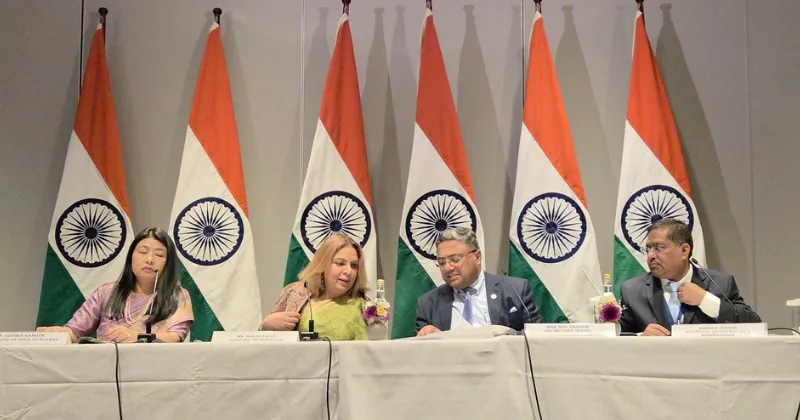
Gloria Gangte, Ambassador to Norway; Pooja Kapur, Additional Secretary, North Europe; Sibi George, Secretary (West);
Randhir Jaiswal, MEA official spokesperson (Left to Right)

Gloria Gangte, Ambassador to Norway; Pooja Kapur, Additional Secretary, North Europe; Sibi George, Secretary (West); Randhir Jaiswal, MEA official spokesperson (Left to Right)

FacebookTwitterWhatsAppTelegramEmail

The now-viral exchange between an Indian diplomat and a Norwegian journalist during Prime Minister Narendra Modi’s visit to Oslo has triggered predictable global commentary around “trust”, “press freedom”, and “human rights” in India. The journalist’s core questions were blunt: “Why should we trust you?” and “Why doesn’t the Indian Prime Minister take questions from the press?”

The Indian diplomat’s response may have appeared somewhat firm in tone, but the larger debate deserves deeper reflection beyond social media outrage and selective moral posturing.

The first issue lies in the very framing of the question: international relations are not fundamentally built on “trust” or even proclaimed “values”. They are built on interests, issues, the common good, strategic convergence and a mutually respected rules-based order. States engage each other not because they trust one another unconditionally, but because they recognise the necessity of coexistence, cooperation and stability.

Ironically, the very Western powers that often lecture the developing world on democratic values today appear deeply divided and increasingly inconsistent in upholding the same standards they advocate globally. In a fragile and polarised international order, selective interventions, unilateral sanctions, regime-change policies and the unrestrained use of military power have weakened the credibility of the “rules-based order” that the West itself created after the Second World War. The perception across large parts of the Global South is increasingly that “might is right” has once again become the dominant geopolitical principle.

Against this backdrop, India’s democratic journey deserves a more balanced and intellectually honest assessment.

India is not a recent artificial construct held together by force. It is a civilisational state that emerged from colonial rule through a freedom struggle rooted in democratic aspiration, pluralism and constitutionalism. Despite the extraordinary diversity of language, ethnicity, religion and culture, India has preserved both its civilisational continuity and democratic framework while managing the aspirations of 1.4 billion people.

India’s human rights, democratic freedoms and legal protections are enshrined in its Constitution. Every citizen, irrespective of caste, creed, gender or faith, has recourse to an independent judiciary, electoral participation and constitutional remedies. This reality is often overlooked in simplistic international narratives shaped by selective NGO reports or external ideological lenses that fail to fully comprehend the scale and complexity of India.

Critics also ignore the remarkable socioeconomic transformation underway in India. Over 600 million people have reportedly been lifted out of poverty in the last decade through welfare delivery, infrastructure expansion, financial inclusion and digital governance. Importantly, free rations, housing schemes, sanitation programmes and healthcare initiatives are not distributed on the basis of religion or caste. India’s welfare architecture reaches citizens irrespective of faith or identity.

Also Read: Pakistan: Renaming of places in Lahore doesn’t wash away crimes committed against minority Sikhs, Christian & Hindus

Equally significant is the social mobility visible across Indian public life. Some of India’s most influential corporate groups, institutions and public figures continue to be led by citizens belonging to non-majoritarian faiths. This is not an exception manufactured for optics; it is part of the lived reality of a deeply diverse society.

India’s entertainment industry offers perhaps the clearest cultural example. Bollywood, one of the most influential instruments of Indian soft power, has long been dominated by actors, musicians and artists from multiple faiths whose fan followings exceed the populations of many European countries, including Norway itself. Such phenomena cannot exist in a deeply exclusionary society. They are indicators of social acceptance, equal opportunity and cultural integration visible to the world.

At the same time, democracies must remain open to scrutiny and debate. Questions around media access and political communication are legitimate in any democracy, including India. A politician’s response in Oslo may perhaps have been more nuanced and politically calibrated than a diplomat’s institutional defence. It could also have emphasised India’s democratic resilience, its constitutional foundations and the success of the Indian diaspora, many of whom today occupy leadership positions across the liberal democratic world.

Indeed, India’s global diaspora remains among the country’s strongest ambassadors. From technology and academia to business and public office, Indians have integrated successfully into Western democracies while contributing meaningfully to their adopted societies. Their success itself reflects the values of education, adaptability, pluralism and democratic participation nurtured within India.

The Norway episode ultimately reflects a larger global tension: the gap between how parts of the West perceive India and how India increasingly sees itself. India no longer views itself through the lens of post-colonial insecurity or external certification. It seeks engagement based on mutual respect, sovereign equality and recognition of its unique scale, complexity and democratic evolution. Trust, after all, cannot be demanded selectively. It must emerge from consistency, reciprocity and the willingness of all sides to introspect with equal honesty.

Topics: Press Freedomwestern mediaIndia-West RelationsdiplomacyNorwayDemocracyPM ModiHuman Rights
ShareTweetSendShareSend
✮ Subscribe Organiser YouTube Channel. ✮
✮ Join Organiser's WhatsApp channel for Nationalist views beyond the news. ✮
Previous News

Telangana: Food Safety officials detect insect-infested flour, expired licence food items at Hyderabad Lulu Mall

Next News

Exercise PRAGATI: Indian Army organises 12 nations Multilateral joints army exercise in Umroi camp in Meghalaya

Related News

Gaurdian Journalist Hannah Ellis-Petersen covering the protest of the Cockroach Janata Party(CJP)

Guardian Journalist Ellis-Petersen amplifies Cockroach Party protest: Exposing anti-India propaganda of western media

Prime Minister Narendra Modi

“Makes every Indian proud”: PM Modi hails India’s 7.7 per cent GDP growth in FY 2025-26

India slams Pakistan’s bid to hold elections in Gilgit-Baltistan, demands end to illegal occupation

Prime Minister Narendra Modi

PM Modi to launch Rs 21,770 cr mega projects in Surat & Daman; Infrastructure, healthcare among key projects

As Beijing tightens its grip ahead of June 4, dissidents inside China face surveillance and intimidation while activists abroad keep alive the memory of the 1989 Tiananmen crackdown

Tiananmen at 37: How China suppresses remembrance of the massacre through fear, censorship and surveillance

A decade transformed Indian Railways through electrification, speed, safety and modern infrastructure under PM Modi's vision

Same Tracks, New Destiny: How Modi government rewrote Indian Railways’ story after 2014

Load More

Latest News

PIB debunks viral claim that Kiren Rijiju, Arjun Ram Meghwal and Judges attended Badminton event in London

Fact Check: PIB busts viral London claim, says Rijiju-Meghwal photos are from New Delhi Judges’ Badminton Championship

Now Islamists Eye Keralam’s Ancient Kottiyoor Temple: How Congress, Muslim Family Built Fake ‘Bavalikkettu’ Narrative

Amaravati Gets Major Boost: Andhra Pradesh Cabinet Clears Rs1,299 Crore Central Government Office Complex

PM Narendra Modi and French President Emmanuel Macron

PM Modi’s six-day Europe tour to focus on G7, AI, innovation and strategic partnerships

POJK Burns (This is an AI generated image)

POJK Boils Over: Rs 1 crore bounty on JAAC leaders as anti-government protests intensify

NSE has announced that 10 per cent of its annual CSR corpus will be routed through the Social Stock Exchange

NSE to route 10 per cent of CSR corpus through Social Stock Exchange, sets new benchmark for impact funding

Organisational Secretary of Bharatiya Mazdoor Sangh (BMS), Bojji Surendran addressing the gathering at the 114th Session of the International Labour Conference (ILC) of the International Labour Organization (ILO) in Geneva

114th ILO Session | Innovation must serve humanity and create inclusive growth for all: BMS Org Secretary B Surendran

Mansoor Ahmed and daughter Shamshad Begum arrested for Rs 5.3 cr government job scam

Karnataka Job Scam Busted: Mansoor, daughter Shamshad Begum arrested for Rs 5.3 crore fraud; 40+ aspirants duped

Shamli Conversion Case: Delhi Nikahnama, Name Changes and Pakistan-Based Preacher Videos Under Scanner; Father Awaits Ayush Malik’s Return Home

Shamli Conversion Case: How a Delhi nikahnama, Pakistani cleric’s lectures and an affair changed Ayush Malik’s life

CM Suvendu Adhikari announces 125-ft Syama Prasad Mookerji statue in Kolkata on 125th birth anniversary

CM Suvendu Adhikari announces 125-foot Syama Prasad Mookerjee statue in Kolkata to mark his 125th birth anniversary

Load More
  • Privacy
  • Terms
  • Cookie Policy
  • Refund and Cancellation
  • Delivery and Shipping

© Bharat Prakashan (Delhi) Limited.
Tech-enabled by Ananthapuri Technologies

  • Home
  • Search Organiser
  • Bharat
    • Assam
    • Bihar
    • Chhattisgarh
    • Jharkhand
    • Maharashtra
    • View All States
  • World
    • Asia
    • Africa
    • North America
    • South America
    • Europe
    • Australia
  • Editorial
  • Operation Sindoor
  • Opinion
  • Analysis
  • Defence
  • Culture
  • Sports
  • Business
  • RSS @ 100
  • Entertainment
  • More ..
    • Sci & Tech
    • Vocal4Local
    • Special Report
    • Education
    • Employment
    • Books
    • Interviews
    • Travel
    • Health
    • Politics
    • Law
    • Economy
    • Obituary
  • Subscribe Magazine
  • Read Ecopy
  • Advertise
  • Circulation
  • Careers
  • About Us
  • Contact Us
  • Policies & Terms
    • Privacy Policy
    • Cookie Policy
    • Refund and Cancellation
    • Terms of Use

© Bharat Prakashan (Delhi) Limited.
Tech-enabled by Ananthapuri Technologies