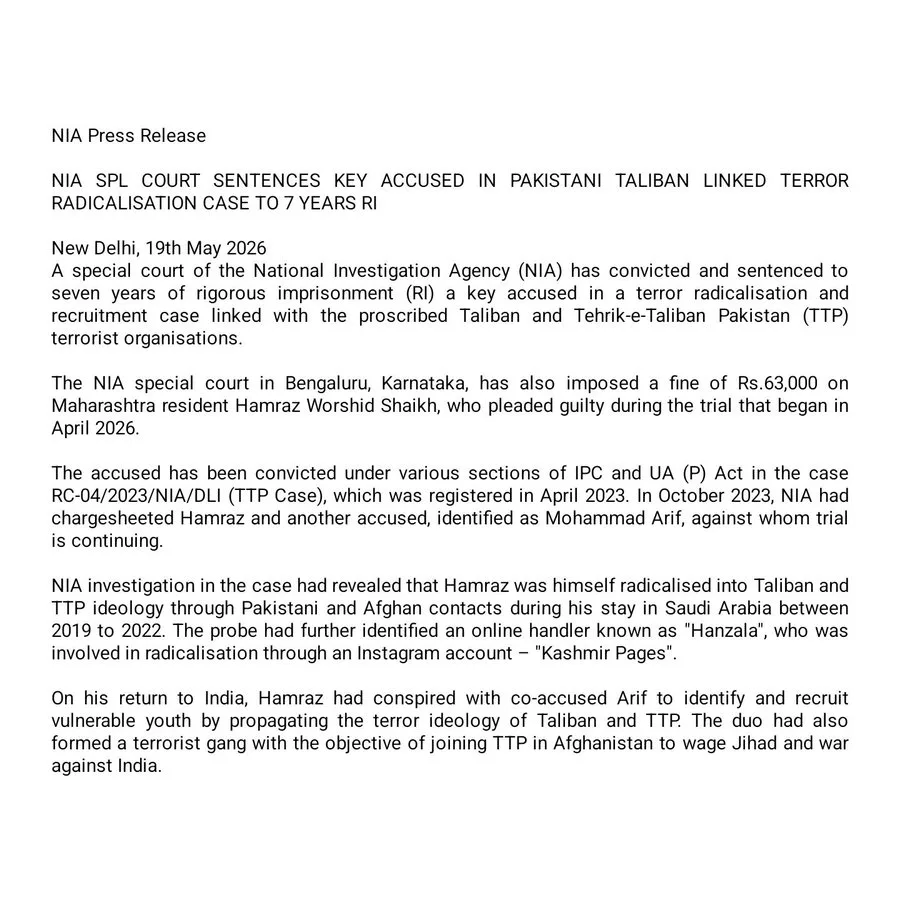
A special court of the National Investigation Agency (NIA) in Bengaluru has convicted and sentenced Maharashtra resident Hamraz Worshid Shaikh to seven years of rigorous imprisonment (RI) in a terror radicalisation and recruitment case linked to the banned Taliban and Tehrik-e-Taliban Pakistan (TTP) terrorist organisations.
The court also imposed a fine of Rs 63,000 on Shaikh, who had pleaded guilty during the trial that commenced in April 2026. The case pertains to NIA case RC-04/2023/NIA/DLI, which was originally registered in April 2023 under various provisions of the Indian Penal Code (IPC) and the Unlawful Activities (Prevention) Act (UAPA).
According to the NIA, the accused had been radicalised into Taliban and TTP ideology through Pakistani and Afghan contacts during his stay in Saudi Arabia between 2019 and 2022. Investigators revealed that Shaikh came in contact with extremist handlers and was influenced by jihadi propaganda during this period.
The probe agency further identified an online handler known as “Hanzala”, who operated radicalisation activities through an Instagram account named “Kashmir Pages”. The NIA stated that the social media platform was used to spread extremist ideology and target vulnerable youth for recruitment.
The agency said that after returning to India, Shaikh conspired with co-accused Mohammad Arif to identify, radicalise, and recruit gullible Muslim youth by propagating the ideology of the Taliban and TTP. Investigators alleged that the duo had formed a terrorist gang with plans to join the TTP in Afghanistan and wage jihad against India.
The NIA had filed a chargesheet against Shaikh and co-accused Mohammad Arif in October 2023. While Shaikh has now been convicted, the trial against Arif is still underway before the special court.
The case had initially gained attention after the NIA arrested Mohammad Arif, a software engineer from Bengaluru, and Hamraz Worshid Shaikh from Thane, Maharashtra, in February 2023 over their alleged links with international terror organisations. Preliminary investigations had revealed that the accused were conspiring online with foreign-based terrorist organisations to radicalise youth and provoke them into acts of violence and terrorism.
According to the investigation, the accused used end-to-end encrypted social media platforms to spread extremist propaganda and recruit youth for terror training in Afghanistan. The NIA also alleged that they were affiliated with banned terrorist organisations Al-Qaeda and TTP and were working towards establishing Sharia globally through violent extremist activities.
The FIR registered by the NIA on April 3 invoked IPC Section 120-B related to criminal conspiracy along with Sections 17, 18, 18-B, 38, 39, and 40 of the UAPA dealing with terror funding, recruitment, conspiracy, and support to terrorist organisations.
Investigators had also found that the accused discussed travelling to Afghanistan and Iran to continue terror-related activities and establish links with extremist groups operating from the region. Electronic devices, including laptops and communication records, were seized during the investigation.
Officials stated that the conviction marks a significant step in the agency’s crackdown on online radicalisation networks and recruitment modules linked to foreign terror organisations operating through digital platforms in India.