The daily fluctuations in petrol and diesel prices are a permanent fixture of public discourse in India. However, a closer look at the retail landscape reveals a striking geographical disparity. While international crude oil volatility and uniform market revisions affect the entire nation equally, motorists in Keralam find themselves paying a massive premium at the pump compared to those in the national capital, Delhi.
As of May 2026, a comparative analysis of the fuel pricing structures shows that local state taxation policy remains the primary factor driving this widening financial gap.
The Retail Reality: Breakdown by the Numbers
Despite sharing identical refinery baselines and national transport mandates, the final price tag attached to a litre of fuel diverges sharply between the two regions.
The Petrol Premium:
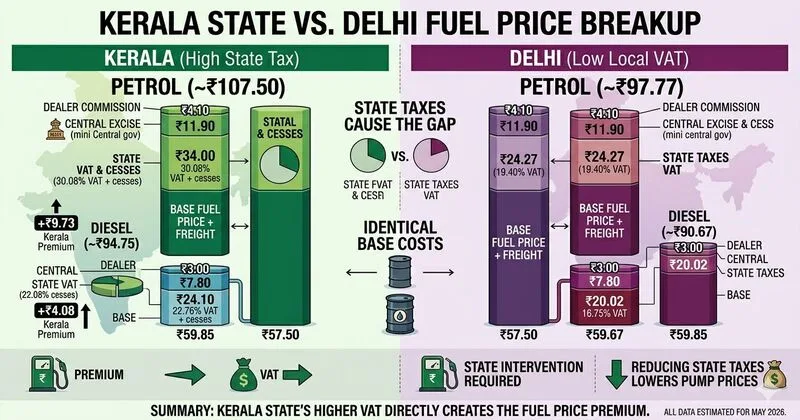
In Keralam, petrol retails at approximately Rs 107.50 per litre, whereas in Delhi, the price stands significantly lower at roughly Rs 97.77 per litre. This translates to a staggering 10 per cent price premium for consumers in Keralam, who effectively pay an additional Rs 9.73 for every single litre. The mathematics behind this gap rests entirely on the state tier:
• The Shared Base: Both states process an identical Base Fuel Price + Freight cost of Rs 57.50, alongside a uniform Central Excise & Cess total of Rs 11.90.
• The Local Divergence: Delhi caps its local Value Added Tax (VAT) at 19.40 per cent. Keralam, conversely, levies a steep 30.08 per cent sales tax/VAT. When compounded with state-specific flat additions—including a Rs 2 Social Security Cess, a 1 per cent additional cess, and a Rs 1 flat tax—Kerala’s state tax collection swallows roughly Rs 34.00 per litre, compared to Delhi’s Rs 24.27.
The Diesel Disparity:
The structural inversion is equally apparent in diesel distribution. Diesel in Keralam costs around Rs 94.75 per litre, while Delhi motorists fill their tanks at a lower rate of Rs 90.67 per litre —a difference of Rs 4.08 per litre.
• The Base Paradox: Interestingly, oil marketing companies (OMCs) ship diesel to dealers nationwide at a higher unrefined base cost (Rs 59.85) than petrol. Central taxes also remain perfectly fixed across state lines at Rs 7.80.
• The Local Divergence: The final retail price inversion occurs because Delhi enforces a competitive 16.75 per cent local VAT on diesel. Kerala applies a 22.76 per cent sales tax rate, which, when paired with the matching flat state cesses, drives the local tax collection to Rs 24.10 per litre versus Delhi’s Rs 20.02 .
The Double Whammy: High State Taxes and Soaring Inflation in Kerala
The fuel price disparity between Keralam and Delhi is not an isolated economic metric; it is part of a much larger, more challenging fiscal reality facing the general public in Keralam. Today, citizens in the state are caught in a financial “double whammy”—enduring historically high local state taxes while simultaneously battling stubbornly high retail inflation that far outstrips national baselines and leaves most North Indian states looking like low-cost havens.
The Disparity with North Indian States:
While headline inflation across India has cooled down significantly, Keralam has actively bucked the national trend.
Economic data reveals a stark geographical divide:
• The High-Cost Zone: Driven by high consumer purchasing power, remittance inflows, and high structural wages, Keralam’s retail inflation breached the Reserve Bank of India’s upper tolerance band, peaking at an extreme 8.05 per cent. Even recent localised monthly metrics show price pressures tracking at 3.67 per cent, indicating sticky cost pressures.
• The Low-Cost North: In contrast, large North Indian states enjoy immense price stability. States like Uttar Pradesh (0.30 per cent), Madhya Pradesh (0.75 per cent), and Rajasthan (0.81 per cent) have recorded near-flat or ultra-low inflation rates. Delhi itself maintains a highly contained price footprint.
Why This Haunts the Kerala Public:
Because Kerala is a consumer-heavy, import-dependent state that relies on external supply chains for food grains, vegetables, and consumer goods, it must “import” these commodities from other producing states.
When you inject a heavy logistics cost—heavily inflated by the state’s own steep 30.08 per cent VAT on petrol and 22.76 per cent on diesel—into the equation, the price of every essential commodity shoots up. The high fuel tax effectively acts as a multiplier on inflation. Every time fuel prices increase, commercial transportation rates spike, compounding the cost of living for common citizens in a state that already suffers from the highest cost-push inflation in the country.
While a consumer in Uttar Pradesh or Delhi is shielded by low state taxes and low retail inflation, a consumer in Kerala is squeezed from both ends. Bringing state taxes to par with competitive national baselines like Delhi would break this vicious cycle and offer immediate economic breathing room to the public.
Summary and Explanation of the Fuel Price Table:
The comparative data table provided above serves as a transparent mathematical breakdown of how fuel pricing works under the hood. It exposes exactly why identical fuel behaves so differently in your wallet depending on where you pump it.
The Level Playing Field (Base Cost & Central Share)
The table highlights that at the initial structural levels, there is zero difference between Kerala and Delhi.
• The Base Price + Freight (the raw refinery cost of delivering the fuel to the pump owners) is fixed nationwide at Rs 57.50 for petrol and Rs 59.85 for diesel.
• The Central Government’s collection is also fully standardised across state boundaries at Rs 11.90 for petrol and Rs 7.80 for diesel.
• Dealer Commissions hover uniformly between Rs 3.00 and Rs 4.10.
This means that up until the fuel reaches the state borders, the pricing is perfectly equalised.
The Turning Point (State VAT & Local Cesses)
The absolute diversion happens in the State VAT & Local Cesses row.
• For Petrol, Delhi charges a flat 19.40 per cent VAT, bringing its component to Rs 24.27. Kerala applies a steep 30.08 per cent VAT along with multiple absolute flat additions (like the Rs 2 Social Security Cess), blowing its state collection up to Rs 34.00. This causes petrol to be Rs 9.73/litre more expensive in Kerala.
• For Diesel, Delhi applies a 16.75 per cent VAT (Rs 20.02) [cite: 2.1.2], whereas Kerala applies a 22.76 per cent tax layout plus cesses (Rs 24.10). This creates a premium of Rs 4.08/litre at Kerala pumps .
Final Verdict:
The table mathematically proves that diesel enters the market with a higher baseline cost (by Rs 2.35) than petrol due to global refining economics. However, because state policy in Kerala per cent)aggressively taxes petrol at a significantly higher percentage bracket (30.08 per cent vs 22.76 per cent), the structural logic is inverted at the pump . Ultimately, the data demonstrates that the retail price gap between the two states is 100 per cent state-tax driven.