
PM Modi, Norway and the clash over media freedom narratives
June 9, 2026
  • Read Ecopy
  • Circulation
  • Advertise
  • Careers
  • About Us
  • Contact Us
Android AppiPhone AppArattai
Organiser
  • ‌
  • Bharat
    • Assam
    • Bihar
    • Chhattisgarh
    • Jharkhand
    • Maharashtra
    • View All States
  • World
    • Asia
    • Europe
    • North America
    • South America
    • Africa
    • Australia
  • Editorial
  • International
  • Opinion
  • RSS @ 100
  • More
    • Op Sindoor
    • Analysis
    • Sports
    • Defence
    • Politics
    • Business
    • Economy
    • Culture
    • Special Report
    • Sci & Tech
    • Entertainment
    • G20
    • Azadi Ka Amrit Mahotsav
    • Vocal4Local
    • Web Stories
    • Education
    • Employment
    • Books
    • Interviews
    • Travel
    • Law
    • Health
    • Obituary
  • Subscribe
    • Subscribe Print Edition
    • Subscribe Ecopy
    • Read Ecopy
  • ‌
  • Bharat
    • Assam
    • Bihar
    • Chhattisgarh
    • Jharkhand
    • Maharashtra
    • View All States
  • World
    • Asia
    • Europe
    • North America
    • South America
    • Africa
    • Australia
  • Editorial
  • International
  • Opinion
  • RSS @ 100
  • More
    • Op Sindoor
    • Analysis
    • Sports
    • Defence
    • Politics
    • Business
    • Economy
    • Culture
    • Special Report
    • Sci & Tech
    • Entertainment
    • G20
    • Azadi Ka Amrit Mahotsav
    • Vocal4Local
    • Web Stories
    • Education
    • Employment
    • Books
    • Interviews
    • Travel
    • Law
    • Health
    • Obituary
  • Subscribe
    • Subscribe Print Edition
    • Subscribe Ecopy
    • Read Ecopy
Organiser
  • Home
  • Bharat
  • World
  • Operation Sindoor
  • Editorial
  • Analysis
  • Opinion
  • Culture
  • Defence
  • International Edition
  • RSS @ 100
  • Magazine
  • Read Ecopy
Home World Europe

PM Modi in Norway: Press Freedom lectures from Europe? Bharat hits back, has the right to ask questions too

Prime Minister Narendra Modi’s visit to Norway triggered a fresh debate on press freedom after a Norwegian commentator interrupted a diplomatic event with a public question. The episode has renewed discussions on Western double standards, media narratives, and Bharat’s right to define democracy through its own civilisational and democratic experience

Siddhartha DaveSiddhartha Dave
May 19, 2026, 06:00 pm IST
in Europe, Bharat, World, International Edition
Follow on Google News
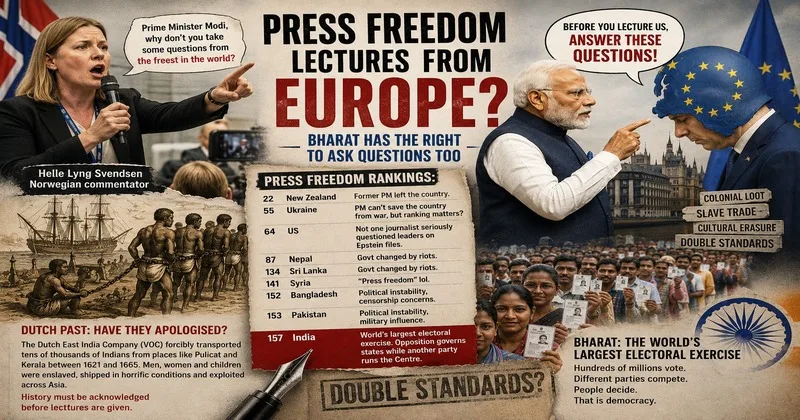
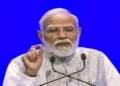
Prime Minister Narendra Modi’s visit to Norway triggered a fresh debate on press freedom after a Norwegian commentator interrupted a diplomatic event with a public question

Prime Minister Narendra Modi’s visit to Norway triggered a fresh debate on press freedom after a Norwegian commentator interrupted a diplomatic event with a public question

FacebookTwitterWhatsAppTelegramEmail

The recent drama created by Helle Lyng Svendsen during Prime Minister Narendra Modi’s visit to Norway says more about the growing desperation of sections of the Western commentary ecosystem than about Bharat itself.

As PM Modi concluded a formal joint statement with Norwegian Prime Minister Jonas Gahr Store and walked away from the podium, a voice from the audience suddenly shouted: “Prime Minister Modi, why don’t you take some questions from the freest in the world?”

The clip was quickly circulated online. Predictably, it was amplified by anti-Modi activists, sections of Western media, and India’s usual political ecosystem eager to portray Bharat as intolerant and authoritarian. But the episode itself was hardly an example of serious journalism.

This was not a press conference. It was a structured diplomatic joint statement. By the time the question was shouted, PM Modi had already turned away and was exiting the venue. There was no realistic expectation of an answer. The purpose was visual theatre, social media virality, and narrative creation.

The timing was equally revealing. PM Modi’s multi-nation visit to Europe and the UAE had largely gone well diplomatically and strategically. Naturally, some attempt had to be made to shift the conversation away from outcomes and back toward the familiar themes of “democracy” and “press freedom.”

The larger issue, however, is not one Norwegian commentator. It is the increasingly questionable credibility of the global ecosystem that lectures Bharat on democracy while applying completely inconsistent standards elsewhere.

Also Read: Maharashtra: Hindu couple attacked, woman’s clothes torn near Mira Road CNG pump; Hilal Khan, Faizan Khan named in FIR

Consider the so-called press freedom rankings. These rankings routinely place Bharat far below countries facing political instability, censorship concerns, military influence, or institutional breakdown. The logic often appears detached from reality.

Ukraine ranks significantly higher despite operating under wartime information controls. The United States, celebrated as a model democracy, witnessed years of media reluctance to aggressively pursue uncomfortable questions surrounding elite scandals like the Epstein files. Countries struggling with deep instability and state pressure often continue receiving better rankings than Bharat. And yet Bharat is pushed down to 157. This, despite being home to the world’s largest electoral exercise. This despite opposition parties governing several states while another party rules at the Centre. This despite thousands of television debates, newspapers, digital platforms, YouTube channels, and social media users criticising the Prime Minister, the judiciary, the military, and national institutions daily.

India’s media ecosystem is not silent. It is arguably among the loudest and most chaotic in the world. One may criticise sensationalism. One may debate journalistic standards. One may question political bias. But to suggest Bharat lacks media freedom requires ignoring visible reality.

The problem increasingly appears ideological rather than empirical. For many Western institutions, “free media” often seems to mean media that align with a particular ideological worldview. Anything outside that framework is quickly labelled nationalist, authoritarian, or problematic. This is where the hypocrisy becomes impossible to ignore.

European commentators routinely question Bharat’s democratic credentials while rarely confronting their own historical baggage with the same intensity. Take the Netherlands and the broader Dutch colonial legacy.
Has the Dutch establishment fully acknowledged the scale of exploitation carried out under the Dutch East India Company across Asia, including Bharat? The global discussion on slavery focuses overwhelmingly on the Atlantic world. Far less attention is given to the Indian Ocean slave trade run by European colonial powers.

During the 17th and 18th centuries, the VOC operated a vast slave trading network across Asia. One of its principal centres was Pulicat on the Coromandel Coast, anchored by Fort Geldria. Historical research suggests that tens of thousands of Indians were forcibly transported to Batavia and other Dutch-controlled territories between 1621 and 1665 alone. Men, women, and children displaced by famine, war, regional collapse, and colonial opportunism were reduced to tradable cargo.

Many were Bengalis captured after Arakanese raids. Others came from regions destabilised after the collapse of the Vijayanagar Empire. Victims of famine were commodified and shipped across Dutch colonial networks.
In Dutch-controlled Cochin on the Malabar Coast, enslaved populations were transported to Ceylon, Batavia, and the Cape colonies under brutal conditions marked by starvation, disease, and high mortality. Yet these chapters rarely dominate Europe’s modern moral discourse. The issue here is not that Bharat is beyond criticism. No democracy is perfect. The issue is selective outrage.

When countries with histories of colonial exploitation and continuing geopolitical double standards attempt to lecture Bharat while ignoring their own contradictions, the moral authority of such criticism naturally weakens. The same pattern is visible in the debate around PM Modi supposedly “avoiding questions.” The assumption that democracy can only function through Western-style open press conferences is itself deeply Eurocentric.

PM Modi communicates extensively through speeches, interviews, Parliament, elections, public outreach, and digital platforms. More importantly, he continues receiving repeated electoral mandates from the people of Bharat.

Ultimately, democratic legitimacy comes from citizens, not from the approval of elite Western commentary circles. What truly unsettles sections of the global establishment today is not merely Bharat’s political rise. It is Bharat’s intellectual decolonisation.

For decades, the West assumed the right to define democracy, secularism, freedom, and legitimacy for the rest of the world. That monopoly is weakening. Modern Bharat is increasingly asserting its right to define itself through its own civilisational experiences and democratic realities rather than borrowed European frameworks. And perhaps that is the real discomfort behind these recurring lectures on “press freedom.”

Topics: western mediaColonial HistoryNorway VisitHelle Lyng SvendsenBharat DemocracyIndia Europe RelationsPM ModiPress Freedom
Siddhartha Dave
Siddhartha Dave
Siddhartha Dave is an alumnus of the United Nations University in Tokyo and a former Lok Sabha Research Fellow. He writes on foreign affairs and national security. [Read more]
ShareTweetSendShareSend
✮ Subscribe Organiser YouTube Channel. ✮
✮ Join Organiser's WhatsApp channel for Nationalist views beyond the news. ✮
Previous News

Yogi Ki Paati: UP CM calls citizens to save India’s ancient palm-leaf manuscripts through Gyan Bharatam Mission

Next News

RSS HQ Recce Case: Jaish-e-Mohammed terrorist Rais Ahmed Sheikh used father’s forex card to book flight

Related News

Gaurdian Journalist Hannah Ellis-Petersen covering the protest of the Cockroach Janata Party(CJP)

Guardian Journalist Ellis-Petersen amplifies Cockroach Party protest: Exposing anti-India propaganda of western media

Prime Minister Narendra Modi

“Makes every Indian proud”: PM Modi hails India’s 7.7 per cent GDP growth in FY 2025-26

Prime Minister Narendra Modi

PM Modi to launch Rs 21,770 cr mega projects in Surat & Daman; Infrastructure, healthcare among key projects

A decade transformed Indian Railways through electrification, speed, safety and modern infrastructure under PM Modi's vision

Same Tracks, New Destiny: How Modi government rewrote Indian Railways’ story after 2014

Prime Minister Narendra Modi

“Sabka Sath, Sabka Vikas, Sabka Hisab”: Decoding PM Modi’s political message on accountability & national security

Prime Minister Narendra Modi with representatives of the Janjati Suraksha
Manch

PM Modi meets Janjati Suraksha Manch in Delhi, discusses tribal empowerment, development and cultural identity

Load More

Latest News

Beyond Alignment: How India is Carving Its Own Strategic Space Amid Global Power Play

Beyond Alignment: How India is Carving Its Own Strategic Space Amid Global Power Play

Chinese President Xi Jinping, Russian President Vladimir Putin and Prime Minister Narendra Modi

China’s New Tone Towards India: Tactical shift or strategic necessity? What Beijing’s push for RIC ties really signals

Keralam’s 2026 Fiscal Health White Paper has unveiled a mounting debt burden of Rs 5.07 lakh crore, exposing deep structural challenges in the state’s economy

Keralam’s Financial Reality Check: White Paper exposes Rs 5.07 lakh crore debt crisis

Tamil Nadu: TVK government arrests YouTuber Maridhas; BJP alleges crackdown on dissent

‘Every grave or dargah is not automatically Waqf property’: Madras High Court’s landmark verdict

US Court strikes down Trump’s $100,000 H-1B fee as executive overreach; Lawmakers & Republicans welcome the verdict

Union Defence Minister Rajnath Singh

Uttar Pradesh: Defence land goes green; Rajnath Singh clears 250 MW solar project in Sitapur

Afghanistan Foreign Minister Amir Khan Muttaqi and External Affairs Minister Dr. S. Jaishankar(File Photo)

India extends gratis long-term business visas to Afghan traders; Slams Pakistan for “trade & transit terrorism”

How Modi's Zero-tolerance doctrine reshaped India's anti-terror policy (This is an AI generated image)

Twelve Years of Modi Government and the rise of India’s zero-tolerance doctrine against terrorism

Press Conference organised by Janjati Suraksha Manch at the Press Club, Ranchi, National Convener Dr Raj Kishore Hansda

Success of Janjati Sanskritik Samagam symbolises unity and cultural pride: Dr Raj Kishore Hansda

Load More
  • Privacy
  • Terms
  • Cookie Policy
  • Refund and Cancellation
  • Delivery and Shipping

© Bharat Prakashan (Delhi) Limited.
Tech-enabled by Ananthapuri Technologies

  • Home
  • Search Organiser
  • Bharat
    • Assam
    • Bihar
    • Chhattisgarh
    • Jharkhand
    • Maharashtra
    • View All States
  • World
    • Asia
    • Africa
    • North America
    • South America
    • Europe
    • Australia
  • Editorial
  • Operation Sindoor
  • Opinion
  • Analysis
  • Defence
  • Culture
  • Sports
  • Business
  • RSS @ 100
  • Entertainment
  • More ..
    • Sci & Tech
    • Vocal4Local
    • Special Report
    • Education
    • Employment
    • Books
    • Interviews
    • Travel
    • Health
    • Politics
    • Law
    • Economy
    • Obituary
  • Subscribe Magazine
  • Read Ecopy
  • Advertise
  • Circulation
  • Careers
  • About Us
  • Contact Us
  • Policies & Terms
    • Privacy Policy
    • Cookie Policy
    • Refund and Cancellation
    • Terms of Use

© Bharat Prakashan (Delhi) Limited.
Tech-enabled by Ananthapuri Technologies