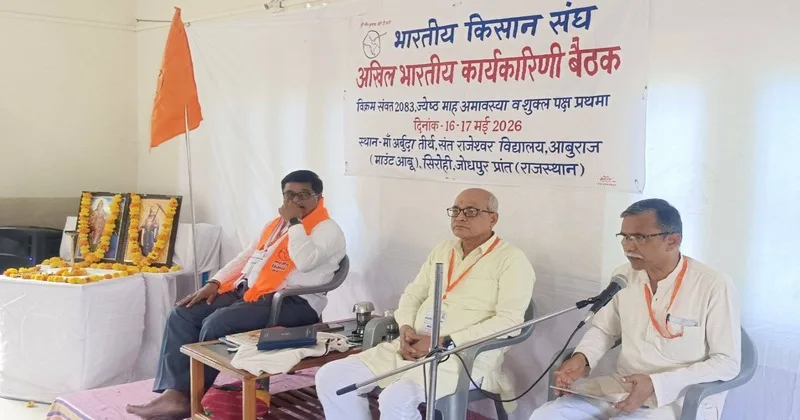
Mount Abu, Rajasthan: After detailed discussions and deliberations during its two-day Akhil Bharatiya meeting in Mount Abu, Bharatiya Kisan Sangh urged the Union Government to adopt a comprehensive and practical approach to achieve self-reliance in the production of pulses, oilseeds, and edible oils in the country. The organisation stated that even after 78 years of Independence, India’s dependence on foreign countries for pulses and edible oils remains a serious concern directly linked to the nation’s food security and sovereignty.
General Secretary Mohini Mohan Mishra said that the currently prevalent “monocropping system” has proved completely unsuitable and exploitative for biodiversity, food diversity, and climate sustainability. As an alternative, he stressed the need for strong crop diversification through intercropping, mixed farming, and crop rotation, along with the adoption of “Gau Krishi Vaanijyam” (cow-based agriculture), which can help maintain soil fertility and reduce farming costs.
The two-day executive meeting also discussed issues such as the International Women Farmers Year, organisational expansion, the upcoming membership drive, global agricultural trade, problems faced by farmers and the agriculture sector, and preparations for the organisation’s Golden Jubilee year programmes.
Major Demands and Suggestions by Bharatiya Kisan Sangh
- 100% Procurement Guarantee
- The organisation demanded that the government ensure 100 per cent procurement of pulses, oilseeds, and edible oil-related crops. It cited the example of 2016, when even limited procurement of pulses led to a substantial increase in production.
Direct Financial Incentives
Farmers adopting measures such as soil rejuvenation, climate resilience, and crop diversification should receive direct financial incentives in their bank accounts, the organisation said.
Preservation of Traditional Seeds
To protect farmers from the cycle of purchasing expensive seeds every year, the organisation called for the promotion, conservation, and development of indigenous seeds and improved crop varieties developed through conventional breeding methods.
Special Encouragement for Animal Husbandry
The organisation emphasised special encouragement for animal husbandry among small and marginal farmers. It said this would provide an alternative to edible oils in the form of desi ghee while strengthening natural and organic farming through cow dung and cow urine.
Opposition to Gene Editing (CRISPR) Technology
Bharatiya Kisan Sangh strongly opposed the gene-editing (CRISPR)-based system proposed by the Parliamentary Standing Committee for crop improvement measures and urged that it be removed from the report.
The organisation warned that technologies like CRISPR could alter the natural resources of crops in ways that may become impossible to reverse. It cautioned that genetic manipulation could disturb ecological and environmental balance, citing the earlier experience of Bt Cotton cultivation in Muktsar, Punjab, which, according to the organisation, disrupted the mandi system and severely affected farmers’ livelihoods.
The organisation further stated that instead of imitating foreign institutions or unsafe technologies, India should seek solutions based on its own ecosystem and traditional agricultural practices. It warned that the use of gene-editing technologies in the name of saving time could lead to serious long-term consequences for genetic and climatic ecology in agriculture.