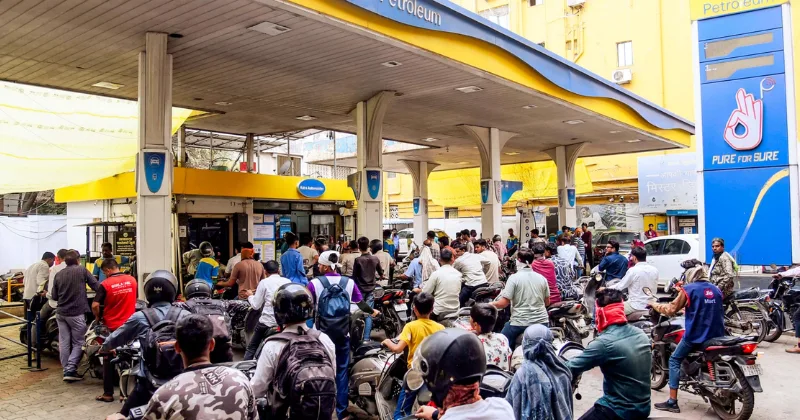
India’s fuel consumption landscape continues to display sharp regional contrasts, with tourist-heavy and highly urbanised regions recording significantly higher petrol usage compared to agrarian and less motorised states.
According to data for 2024-25 released by the Petroleum Planning & Analysis Cell (PPAC), an attached office under the Ministry of Petroleum and Natural Gas, India’s average daily petrol consumption stood at approximately 10.4 litres per 100 people. However, several states and Union Territories reported figures far above or below the national average, underlining the country’s uneven transport and mobility patterns.
At the top of the chart was Goa, which registered an exceptionally high daily petrol consumption of 52.4 litres per 100 people, nearly five times the national average. Officials and analysts attribute Goa’s elevated consumption levels primarily to its thriving tourism industry, dense road traffic, large number of rental vehicles and strong dependence on private transport for intra-state travel.
The Union Territory of Puducherry followed closely with daily petrol consumption of 41 litres per 100 people, while Chandigarh ranked third at 37.8 litres.
These regions share several common characteristics, including high tourist footfall, relatively short travel distances covered primarily through road networks, and a large concentration of personal and commercial vehicles catering to hospitality and tourism sectors.
Tourism and vehicle density driving fuel demand
The PPAC data indicates that tourism-driven economies tend to consume considerably more petrol due to increased movement of taxis, rental scooters, commercial vehicles and inter-city road travel.
Goa, which receives millions of domestic and international tourists annually, relies heavily on road-based transportation. Unlike larger metropolitan regions with extensive metro rail systems or suburban rail networks, many visitors in Goa depend on private taxis, rented motorcycles and self-drive cars, contributing to elevated petrol demand.
Similarly, Puducherry and Chandigarh experience high vehicle density relative to population size. Chandigarh, with its planned urban infrastructure and broad road network, has historically recorded one of the highest per capita vehicle ownership levels in the country.
The data also reflects how rising urbanisation and increasing aspirations for personal mobility continue to shape fuel consumption trends across India.
Despite growing adoption of electric vehicles and expansion of public transport systems in some urban centres, petrol remains the primary transport fuel for millions of Indian households and commercial operators.
Bihar records lowest petrol consumption in India
At the opposite end of the spectrum, Bihar reported the lowest per capita petrol consumption in the country at just 3.3 litres per 100 people per day. West Bengal followed with 5.1 litres.
Experts point out that lower petrol consumption in these states can be linked to comparatively lower vehicle ownership, greater dependence on public transportation and differing socio-economic conditions.
In states like Bihar, a substantial portion of the population still depends on shared mobility systems, public buses, railways and non-motorised transport for daily commuting. Rural populations in such states also tend to have lower levels of private car ownership compared to western and southern regions of India.
The wide gap between Goa and Bihar highlights the growing regional disparities in transport infrastructure, disposable incomes and consumption behaviour across the country.
The figures also indicate how geography, economic activity and population density significantly influence fuel demand patterns.
Diesel consumption patterns show a different trend
While petrol consumption was highest in Goa, diesel usage data reflected a different pattern altogether.
According to the PPAC figures, India’s average diesel consumption stood at 21 litres per 100 people per day. However, the highest diesel consumption was recorded in the Andaman and Nicobar Islands at 144 litres, followed by Ladakh at 111 litres.
Puducherry once again featured among the top-consuming regions.
Officials believe the unusually high diesel consumption in island territories and remote mountainous regions is linked to heavy dependence on diesel generators, marine transportation, logistics movement and limited alternative energy infrastructure.
In areas such as Ladakh and the Andaman and Nicobar Islands, diesel is extensively used not only for transportation but also for electricity generation, military logistics and essential supply chains operating under difficult geographical conditions.
At the lower end of diesel consumption, Bihar again reported one of the lowest figures at six litres per 100 people per day, while Delhi recorded eight litres.
Delhi’s relatively lower diesel consumption is often linked to restrictions on diesel vehicles, increasing reliance on metro connectivity and tighter pollution-control measures implemented in recent years.
Fuel prices and global uncertainties remain key concerns
The release of fuel consumption data comes at a time when global energy markets remain under pressure due to continuing geopolitical tensions in West Asia.
Reserve Bank Governor Sanjay Malhotra recently indicated that prolonged disruption in global oil supplies could eventually impact domestic fuel prices. The ongoing conflict in West Asia and disruptions around the Strait of Hormuz have contributed to uncertainty in international crude oil markets, affecting import-dependent economies including India.
India imports a substantial portion of its crude oil and energy requirements, making domestic fuel prices sensitive to global supply disruptions and shipping bottlenecks.
Amid these concerns, Prime Minister Narendra Modi recently urged citizens to adopt fuel conservation measures, including greater use of metro services, carpooling, rail transport for logistics and work-from-home practices where feasible.
The latest PPAC data not only offers insight into regional fuel consumption trends but also reflects broader economic, infrastructural and lifestyle differences shaping India’s mobility landscape in 2026.