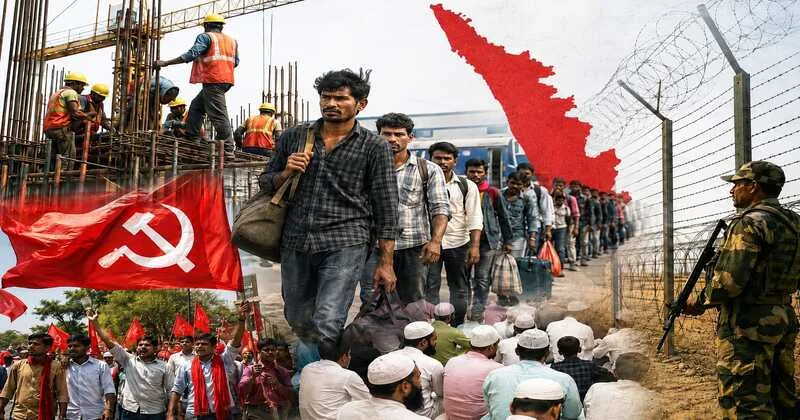
Keralam’s economy is witnessing one of its most serious labour shortages in recent years as large sections of migrant workers from West Bengal and Assam have not returned after travelling home for the Assembly elections. The absence of workers has severely disrupted construction, manufacturing, hotel, plywood, agriculture and bricklaying sectors at a time when economic activity traditionally reaches its peak across the state. According to estimates cited by the Keralam government, out of nearly 40 lakh migrant workers in the state, around 13 to 15 lakh were from West Bengal. Another major segment consisted of more than 8 lakh Assamese workers, many of them skilled labourers employed in construction and allied sectors. Their sudden absence has slowed or halted work across multiple industries, especially house construction projects where concrete work is currently in full swing.
The crisis began unfolding in March when large numbers of workers from Bengal and Assam started returning home ahead of the elections. Many travelled back for voting, while others returned for hearings linked to the Special Intensive Revision (SIR) process and concerns surrounding voter list verification. Rumours had spread among migrant communities that names could be removed from electoral rolls if voters failed to physically return and participate in the process. Labour camps and construction sites across Keralam subsequently began emptying rapidly.
Employers initially expected the workers to return after polling or after the declaration of results. Several companies even arranged buses to transport labourers back to Keralam. However, a substantial number never returned, triggering concern across the state’s economic sectors.
The construction industry has suffered the biggest impact. Builders across districts have reported acute shortages of masons, carpenters, steel workers, concrete workers and daily wage labourers. Plywood units, hotels, brick kilns and farms have also been badly affected. Contractors argue that many of the absent workers belonged to highly specialised labour networks developed over the past decade and replacing them quickly is nearly impossible because Keralam’s local labour structure has long depended on migrant workers from other parts of India.
Political migration and the Bengal Left connection
The labour crisis has simultaneously revived debates surrounding the migration patterns of Bengali workers into Keralam over the past decade. Several observers have linked the migration flow to developments in West Bengal after the defeat of the Left Front government in 2011 and the rise of the Trinamool Congress (TMC) under Mamata Banerjee. After decades of economic stagnation under the Left Front’s uninterrupted 34-year rule, unemployment in Bengal had reached alarming levels. However, the scale of migration to Keralam changed dramatically after 2011. Keralam government estimates indicated that the migrant worker population rose from around 25 lakh in 2013 to more than 40 lakh by 2016.
One argument increasingly being discussed in political and labour circles is that sections of these migrants were not merely economic workers but also individuals displaced by post-election political violence in Bengal. Reports from several districts after the 2011 Assembly elections pointed to attacks, intimidation and harassment targeting supporters and Hindu cadres of the Communist Party of India (Marxist), or CPI(M). Houses of Left supporters were attacked, shops looted and party offices occupied. Communist Party activists were killed in districts including Burdwan, Bankura and West Midnapore.
Political observers and sections within the Left ecosystem have argued that numerous CPI(M) workers, especially Hindu comrades, were forced to leave their homes due to intimidation from TMC activists and Islamist groups.
Several CPI(M) offices were also seized by TMC supporters. According to this line of argument, many displaced workers subsequently migrated to Keralam, where the CPI(M), Muslim League and Congress-led political environment was perceived as safer and more accommodating. The political dimension of this migration has remained visible over the years. In February 2026, nearly 200 Bengali construction workers welcomed a CPI(M) march in Mambaram in Dharmadam constituency in Kannur district using Hindi slogans and waving red flags. In another widely circulated moment from Kannur, migrant workers draped red shawls over party leaders.
Bengali migrant workers have also been seen raising slogans such as “LDF Zindabad” and participating in the CPI(M)’s Northern Region Development Movement March, often referring to Keralam as their “second home.” The CPI(M) itself views these “guest workers” as an important part of its broader support base. At the same time, CPI(M) General Secretary M. A. Baby clarified that former district secretaries or top CPI(M) leaders from West Bengal had not migrated to Keralam for jobs. Yet the visible political participation of Bengali migrant workers has strengthened speculation that at least a section of them may have effectively lived in political exile after fleeing post-2011 violence and intimidation in Bengal.
Bangladeshi infiltration debate returns to the forefront
Alongside the labour crisis and political migration debate, another contentious issue has resurfaced in Keralam, allegations of illegal Bangladeshi infiltration within migrant labour networks. Security agencies had previously arrested Bangladeshi terror suspects from labour camps in districts including Ernakulam and Malappuram. Investigations conducted earlier by agencies such as the National Investigation Agency (NIA) revealed instances in which suspected infiltrators were living under false Bengali or Assamese identities using Aadhaar cards and voter IDs. Reports had also emerged earlier that several such individuals had obtained forged or fraudulent identity documents.
Islamic radical organisations were also carried out outreach and community activities among sections of Muslim migrant workers in Keralam. For instance, a special conference focused on migrant worker families, many of whom were Muslim migrants from other states, was organised in September 2024 in Malappuram by the Kerala Halqa of Jamaat-e-Islami Hind. The event was held at Talent School in Odakannagara in Malappuram district and was attended by around 350 participants from nearly 100 guest worker families.
Political discussions in Keralam are now increasingly questioning whether some workers who failed to return after the Bengal elections feared stricter action against infiltrators following the political shift in West Bengal. The debate intensified after the new West Bengal government led by Suvendu Adhikari approved the transfer of land to the Border Security Force (BSF) for fencing along the India-Bangladesh border. The decision was taken during the first cabinet meeting of the new government. The move involves transferring nearly 600 acres of land within 45 days to accelerate completion of the border fencing project.
Political observers argue that this development may have created anxiety among undocumented Bangladeshi illegal migrants who feared tighter border controls and stronger action against infiltration networks after the change in government. At the same time, allegations have resurfaced that Bangladeshi infiltrators had secured Aadhaar cards and voter IDs in West Bengal with the help of political networks associated with the TMC. According to these allegations, such documents enabled several infiltrators to obtain employment in Keralam while posing as Bengali migrant workers.
As a result, the debate surrounding Keralam’s labour crisis has acquired two parallel political dimensions. One argument suggests that many of the missing migrants were Hindu CPI(M) comrades and political exiles who had fled Bengal after 2011 and are now returning following the BJP’s victory and the weakening of the TMC. Another line of speculation points toward the possibility that sections of undocumented Bangladeshi infiltrators may be exiting India amid fears of stronger border enforcement and identity verification mechanisms.
BJP victory, reclaimed CPI(M) offices and return migration theories
The political developments in West Bengal following the BJP’s victory and the collapse of the TMC government have added further momentum to these debates. Reports began emerging that CPI(M) cadres were reclaiming party offices allegedly occupied since 2011.
According to reports from West Bengal, CPI(M) reportedly reclaimed more than 550 party offices occupied by the TMC over the past 15 years. The highest number of recoveries reportedly took place in Malda and Murshidabad districts.
Among the offices reportedly reclaimed were the CPI(M) office in the Goborjhuri area of Budge Budge in South 24 Parganas district, the Communist Party regional office at Shankura Bazaar in Basirhat in North 24 Parganas district, the party office at Boyalghat in Barasat, the CPI(M) office in Basuldanga under the Diamond Harbour 1 Area Committee, the Chotagandi office in Rajarhat, the branch office in Balgona in Purba Bardhaman, the Chopra office in North Dinajpur district, the Purandarpur branch office under Baruipur West 1 Area Committee and the Budge Budge Area Committee office in Kshiti. CPI(M) cadres also reportedly retook Bhushan Ray Burman Bhavan and the Kanchakali party office in the Majiali area of Uttar Dinajpur district and hoisted red flags again after years of absence.
These developments have strengthened speculation in Keralam that some migrant workers who had stayed in the state for political reasons may now be returning permanently to Bengal and rebuilding organisational networks there.
For Keralam, however, the consequences are immediate and economic. Industries dependent on migrant labour are facing rising costs, project delays and uncertainty over workforce availability. Simultaneously, rising construction material prices have worsened the crisis further. Contractors and business owners say several projects are becoming financially unviable as labour shortages push wages upward while supply chains remain disrupted.
The crisis has also exposed the deep structural dependence of Keralam’s economy on migrant labour. Over the past decade, workers from Bengal and Assam became indispensable to sectors ranging from agriculture to hospitality.
Now, with thousands failing to return after the Bengal elections, Keralam finds itself confronting unresolved questions surrounding labour dependency, political migration, illegal infiltration and the hidden political histories behind its migrant workforce. The developments have further fuelled debate over whether the BJP’s rise in Eastern and North-East India has created a new political environment for former Left cadres seeking organisational freedom, while simultaneously intensifying national security measures and border enforcement against illegal infiltration networks.