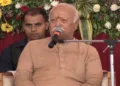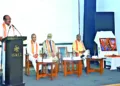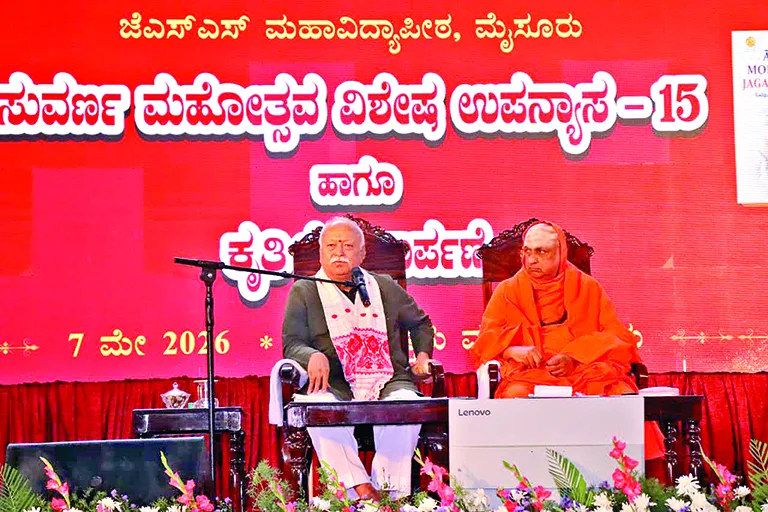
“Society in the West is a congregation of people so that everybody benefits. If you are beneficial to me, I will live with you. If you are not, I will not. The theory of social contract says society exists because man cannot live alone. Those who help are taken along and those who do not help are forgotten. This contract is not there in our society,” said RSS Sarsanghchalak, Dr Mohan Bhagwat, while delivering a Special Lecture on ‘Social Harmony as a Catalyst for National Development’ at JSS Mahavidyapeetha, Mysuru, Karnataka on May 7, 2026.
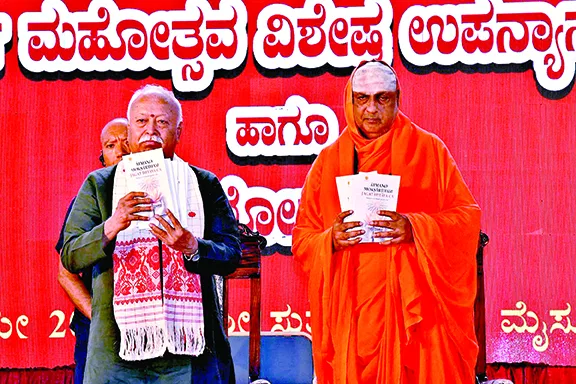
Dr Bhagwat also released a book Atmano Mokshartham Jagat Hitayacha along with Pujya Jagadguru Sri Shivaratri Deshikendra Mahaswamiji of Suttur Kshetra.
He observed that English was inadequate to fully convey several uniquely Bharatiya concepts, particularly those connected to the theme of “Social Harmony as a Catalyst for National Development”. So, the first word is ‘social’, which is related to society. It is a translation of our word ‘Samaj’. In Karnataka it is ‘Samudayee’. The concept of society in the West and the concept of Samaj in Bharat are two different things though they appear to be the same.
Pointing out that Samaj is not just a congregation, Dr Bhagwat said it is not merely an aggregate. “Samaj denotes people living together for a long period, developing affinity towards each other. The feeling of oneness comes automatically through association and surroundings,” he added.
Each of us has our own purpose. I have to live my life with happiness and peace. I have to make my family happy. This purpose extends further. Swami Vivekananda said every nation has a message to deliver and every nation has a mission to accomplish, he said.
Describing the definition of nation, Dr Bhagwat said, “Universally accepted nation is land, people and State. Chanakya also said land, people and State are important. But in the West, State is the prominent factor. In our country, it is not the State but Janapada and Bhumi. We had our States and Chakravarti Samrats”, he said.
Question/Answer Session
At the event, Dr Bhagwat interacted with members of the audience in an interesting question-answer session. Excerpts:
Is oneness among all religions and communities possible?
It is not a question of whether we can have oneness, because all religions try to reach the same truth. Paths may be different, destinations are the same. Some may reach earlier, some later. Some paths are comfortable and some are difficult, but ultimately they move towards the same destination. Creating religions and quarrelling over them is not the purpose. The realisation is that truth is one. Coordination and progression are a must for humanity to survive. There is no choice. Harmony must come within communities and religions, otherwise these conflicts will destroy ourselves. Therefore, we have to set our own example.
Has man become a slave to power, property and position in the scientific age?
Slavery to power, property and position is everyone’s choice. Nobody can make you a slave and nobody can liberate you from slavery. It depends on what you want to become. That is why education should be given to every individual, especially the younger generation. Animals and human beings are biologically similar. Animals eat, sleep and live, but there is one difference in man — Dharma. Dharma is not merely religion. Dharma is that which brings material progress and spiritual progress together. Dharma sustains everything together and ensures simultaneous prosperity. If human beings think they are superior beings, then they also have greater responsibility. With that responsibility, nobody can compel us towards slavery because we possess Viveka.
How young Bharatiyas can be encouraged towards Hindustan and Hindutva when many are attracted towards Western culture.
Do not worry too much about others. Worry about yourself. We have to be Hindus and practise Hindu values. Karmakanda is different for different people and traditions, but all Sampradayas of Hinduism have something common. They begin with the concept that everything is one and culminate in the same behaviour. Shaiva, Vaishnava and other Darshanas may differ, but starting point and end point are same — behaviour and conduct. That behaviour is essence of Dharma. Every Hindu may follow his own Sampradaya and Karmakanda, but behaviour must remain rooted in Dharma. If Hindus practise this sincerely, those who are led astray will one day return because ultimately they will realise those paths cannot satisfy them.
The declining marriage trend among Hindu youth is a matter of concern. What role can RSS play in reversing this trend?
Many young people ask why they should marry and become ‘slaves’ of another individual. But marriage is not about slavery or satisfying desires. Marriage is for creating society. Family is the basis of society — economically, culturally and politically. Better the family, better the society. No individual can become happy alone. Happiness must be shared. No family can remain happy alone unless the village, district and society are also happy. That is why we pray for prosperity, rainfall, healthy society and well-being for everybody. Marriage means taking responsibility for everybody’s happiness. Young people should be taught this not merely through words but through examples in families. Marriage is partnership, not slavery. Husband and wife together create responsible citizens and healthy families.
Noting that many States in Bharat were governed differently but this land remained one nation, Dr Bhagwat said, “Our land protected us, provided peace, prosperity and an environment where we did not require to fight among ourselves or with others. Mountains and seas protected us. Nobody came from outside and therefore, despite many languages, people lived peacefully for thousands of years”, he said.
Describing Bhumi as not merely land, Dr Bhagwat said Matri Bhumi not only raised us but also gave us the particular nature of Bharat. “Bharat pursued knowledge. Since we were settled and peaceful, we searched inwardly and got that knowledge. That knowledge was the truth of oneness of existence — everything is one. If you attain that stage where you feel oneness for 24 hours, then you are completely happy. Nothing can reduce your happiness”, he further said.
“Even today Bharatiya society lives like this despite ignorance about its own truth. Even poor and illiterate people live this way. If you do not have exact change to pay your fare, the poor rickshaw driver says, ‘You come tomorrow, I will take it later.’ This you will never hear in the West. Our society has a common purpose — to live life for attainment of that stage and lead life with Paropakara and Seva. There is no contract. It is our duty. Whether you believe in me or not, you are one of mine”, he said.
“Buddha said life should be lived without sinful acts, without harming others, and one must clean the mind. Only through thought can we move forward. We have to start visiting each other’s houses and families. Despite diversities of language, caste and creed, everybody should become our friend. Families should have friends in every section of society”, he said.
“In Sangh also, people from every section should think of three things — what they are doing for betterment of their own people, what together they are doing for development of their area, and what they are doing for those who are backward because of historical social discrimination. This type of behaviour creates Sadbhavana and compassion comes into action”, he said.
He further said, “Development is not individual prosperity alone. Bharat had rich people earlier too, but if one side of the body is paralysed, can you call the body healthy? Every cell has to become healthy. Development must reach the last man. Nobody should be left out. ‘Sarvepi Sukhinah’ is our prayer. This attitude should be cultivated and passed to the next generation”.
“Instead of lecturing, we must start with small acts. Our languages contain many words that unconsciously express discrimination. Speech should be soft, attractive and mature. Our words and behaviour should not hurt others or make them feel distant”, he said.