
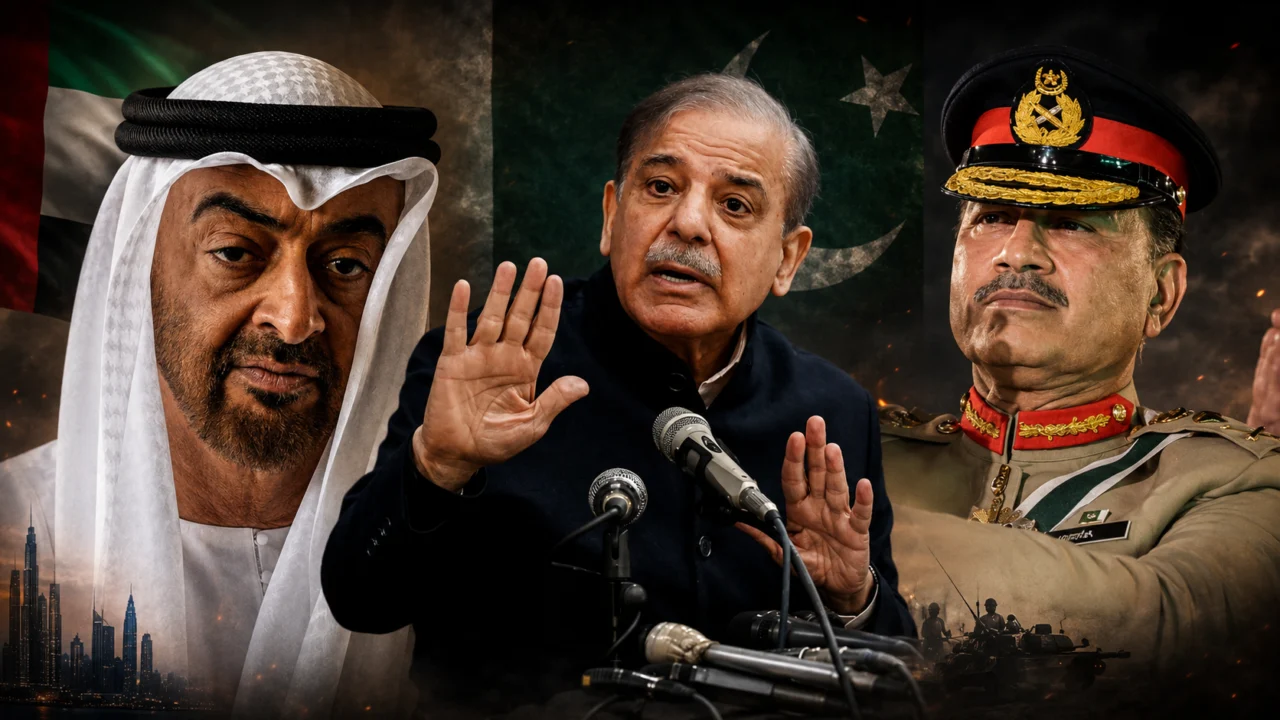
The UAE has quietly intensified action against Pakistani workers, with many reportedly facing deportation or restrictions amid rising tensions between Abu Dhabi and Islamabad over the Iran crisis. Reports suggest that Shiite workers have been particularly affected.
The developments carry deep economic and emotional consequences for Pakistan, where millions of families rely on jobs and remittances from the Gulf. The UAE remains one of Pakistan’s most important economic partners and a major destination for migrant workers seeking livelihoods abroad.
The reported crackdown also reflects what observers describe as a noticeably tougher approach by the UAE toward Pakistan in recent months.
Pakistani workers deported with ‘Jailed’ or ‘Absconding’ tags
Ironically, the workers deported to Pakistan bear ‘jailed’ or ‘absconding’ tags. Workers expelled from the UAE — given no charges, no hearings, no explanation — land in Pakistan stamped with tags that mark them as criminals: “jailed” or “absconding.” Men who spent a decade building a life in Dubai, who were pulled off night shifts and out of shopping malls without a word of due process, now carry a permanent record that will follow them to every future job application, every visa attempt, every border crossing. The UAE took their savings. Pakistan’s system handed them a label.
UAE’s Etihad Airways terminated 15 Pakistani employees two weeks ago. The group included some who had spent nearly two decades in service, and they were reportedly told to leave the country within 48 hours. The sudden action, said to have been communicated through immigration authorities rather than through a standard workplace process, has raised concerns among migrant communities already anxious about growing uncertainty facing Pakistani workers in the Gulf.
The Hidden Cost of Asim Munir’s Iran Strategy
When Iran came under sustained military pressure earlier this year, Pakistan’s army chief — Field Marshal Asim Munir — saw an opening. Islamabad positioned itself as a discreet go-between for Washington and Tehran, a role that made Pakistan feel relevant, even indispensable, in a region it had long played second fiddle.
It was, on paper, a clever pivot. Pakistan needed dollars. It needed friends. It needed to signal that it mattered beyond its own perpetual crises. Mediation between nuclear-armed America and a besieged Iran felt like leverage. The UAE did not see it that way.
The bill arrives
Abu Dhabi had long been a reliable partner — a bankers’ haven for Pakistani elites, the single largest source of remittances for Pakistan’s battered economy ($6.3 billion in FY 2024-25 alone), and home to 1.8 million Pakistani workers. When Pakistan tilted toward Iran — even implicitly, even through quiet diplomacy — the UAE’s response was swift and pointed.
The UAE issued an immediate demand: repay a $3.5 billion debt, now. Analysts described it as punitive — a message dressed in the language of finance. Saudi Arabia, which had recently signed a mutual defence pact with Pakistan, stepped in to absorb the blow. But that was the diplomatic layer. Below it, something else was already happening.
What the Emiratis did to Pakistanis
In the weeks that followed, Pakistani workers — disproportionately Shia Muslim — began to disappear from their shifts, their apartments, their routines. Plainclothes officers from the Criminal Investigation Department arrived at workplaces and malls. Phones were taken. IDs confiscated. No charges were read out. People were moved between facilities and eventually processed through Al-Awir detention centre — the last stop before a flight home.
According to Mohammad Amin Shaheedi, a senior Shia cleric and head of Ummat-e-Wahida Pakistan, roughly 15,000 individuals from 5,000 Pakistani Shia families have been deported since the Iran war. Shaheedi reportedly said that the workers were flown out in batches of over 100 a day and that some were allegedly filmed while stripped — to be used as leverage against speaking out after their return. However, reports say that Pakistan’s foreign ministry denied that deportations had any political dimension.
Munir’s public posture on Pakistan’s Shia community has not gone unnoticed. He reportedly remarked, in reference to those sympathetic to Iran, that they were welcome to go there. The comment, circulating in Pakistani media, landed badly in a community that now watched its members being expelled from the Gulf. Around the same time, the Pakistani edition of The New York Times reportedly omitted a piece on rising Shia anger in the country — an absence that felt, to many, deliberate.
What Asim Munir did
Munir’s public posture on Pakistan’s Shia community has not gone unnoticed. He reportedly remarked, in reference to those sympathetic to Iran, that they were welcome to go there. The comment, circulating in Pakistani media, landed badly in a community that now watched its members being expelled from the Gulf. Around the same time, the Pakistani edition of The New York Times reportedly omitted a piece on rising Shia anger in the country — an absence that felt, to many, deliberate.
The UAE, for its part, had by then announced the arrest of 27 individuals it described as Iran-linked operatives and issued a public warning that the Iranian threat “extends to attempts to destabilize our society from within” — urging residents to report suspicious activity. The architecture for large-scale removals was in place. Biometric data collected at Shia mosques over years, was now reportedly being used to identify targets.
Across Pakistan — in Chakwal, in Skardu, in villages in Kurram district — families are trying to recover savings frozen in UAE banks, reckon with debt taken on to fund the jobs that no longer exist, and absorb the psychological wreckage of men returned without warning, stripped of the decade-long lives they’d built.