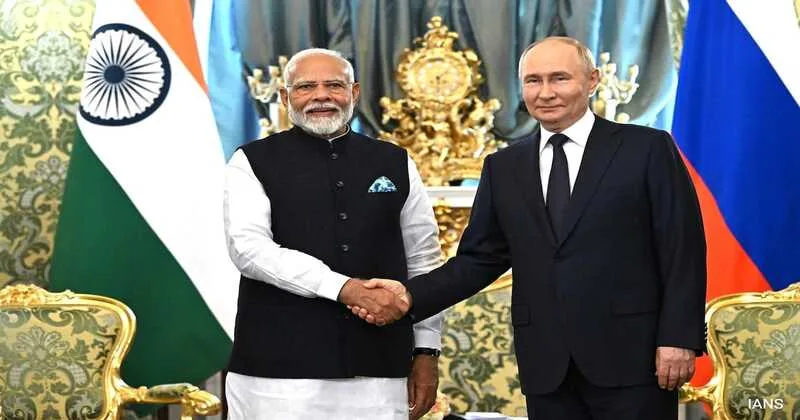
New Delhi /Moscow: India and Russia are moving closer to signing a preliminary agreement on critical minerals cooperation, marking a significant step in New Delhi’s broader strategy to secure long-term access to resources vital for clean energy technologies, advanced manufacturing and industrial growth. According to a Reuters report citing sources familiar with the discussions, the proposed agreement will focus on the exploration, processing and technological cooperation of critical minerals, including lithium and rare earth metals.
The agreement is expected to be signed within the next few months. One source told Reuters that India has already shared a draft proposal with Russian authorities, indicating that negotiations have entered an advanced stage. The move reflects India’s growing urgency to diversify its critical mineral supply chains and reduce strategic dependence on China, which currently dominates global production and processing capacities for several rare earth elements and battery minerals.
India’s strategic push for critical mineral security
The planned cooperation comes at a time when countries across the world are racing to secure access to critical minerals that are essential for electric vehicle batteries, renewable energy systems, semiconductors and high-end industrial manufacturing. India has emerged as one of the major economies aggressively pursuing overseas mineral partnerships to support its clean energy transition and expanding industrial base.
New Delhi has in recent years intensified efforts to reduce its reliance on Chinese supply chains, particularly in sectors linked to energy security and strategic technologies.
In 2023, India officially designated more than 20 minerals as “critical” for the country’s future industrial and energy requirements. To further strengthen domestic capabilities, India has also prepared a 25 billion rupee ($261 million) incentive programme aimed at encouraging private companies to manufacture rare earth magnets and develop processing infrastructure. The initiative is part of a wider national effort to build resilient supply chains and strengthen India’s position in emerging technology sectors.
The Reuters report also noted that India may revisit a lithium exploration project in Mali operated by Russia’s state nuclear corporation Rosatom if the political and security conditions in the West African country improve. India had earlier withdrawn from the project due to security concerns, but renewed cooperation could reopen opportunities for overseas lithium access.
Russia’s resource potential and industrial limitations
For Russia, the agreement represents an opportunity to expand its underdeveloped rare earths sector and deepen economic cooperation with India amid shifting global geopolitical and trade dynamics. Despite possessing substantial reserves, Russia’s domestic production remains extremely limited. According to Russia’s Natural Resources Ministry, the country holds an estimated 28.5 million metric tons of rare earth metals and over 650 million metric tons of rare metals. However, nearly all domestic demand continues to be met through imports.
Russia consumes around 3,000 metric tons of rare earth metals annually but produces only about 50 metric tons, with imports accounting for more than 98% of supply. The country also remains heavily dependent on imports for minerals such as tungsten, molybdenum, zirconium, niobium, tantalum and lithium.
In November last year, Russian President Vladimir Putin directed the government to prepare a roadmap for developing the country’s rare earth metals industry.
The proposed India-Russia partnership therefore reflects a broader global realignment in critical mineral supply chains, with India positioning itself proactively to secure strategic resources necessary for its long-term economic growth, clean energy ambitions and industrial self-reliance.