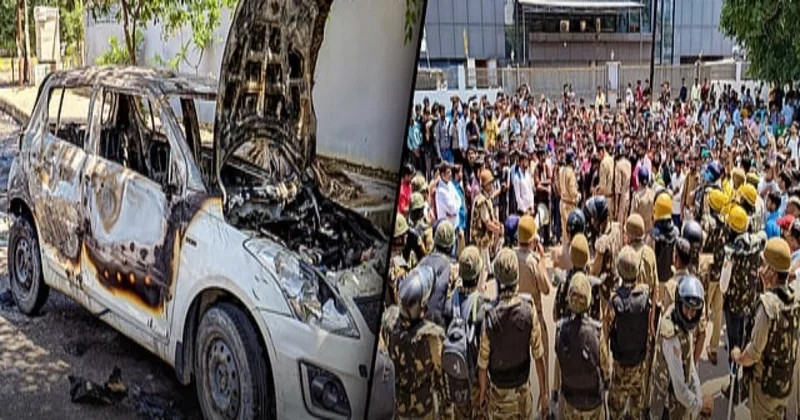
Noida: The industrial hub of Noida witnessed a disturbing episode of violence on April 13, when what began as a labour protest over wage-related issues spiralled into coordinated arson and destruction. Nearly a month-long investigation has since revealed that the violence may not have been spontaneous, but rather the result of training, planning, and possible external instigation aimed at disrupting industrial stability.
A Protest That Escalated into Precision Violence
The protests, concentrated in industrial clusters such as Phase 2 and Sector 63, quickly escalated into chaos. Eyewitness accounts and video evidence showed vehicles being set ablaze within seconds, an act that investigators say requires prior knowledge and preparation.
Ordinarily, setting a vehicle on fire is neither quick nor simple. However, in this case, bikes and other vehicles were ignited in as little as three to five seconds. Investigators noted that perpetrators appeared to know exactly where to tamper, such as opening fuel hoses or applying flammable substances at critical points, to trigger rapid combustion. This level of precision has led authorities to suspect that at least a section of the crowd had been trained in arson techniques.
One of the most sensitive findings in the investigation relates to online provocation during the protests. According to Noida Police, two social media accounts on X (formerly Twitter) played a role in escalating tensions.
Police have stated that these accounts were traced to Pakistan (via VPN usage) and allegedly spread misinformation, including false claims about the deaths of protesters. Such content, if believed, could rapidly inflame emotions.
Targeted Disruption of Industrial Infrastructure
The violence did not appear random. When access to certain chemical factories was blocked, rioters shifted their focus to automobile units and attendance-related manufacturing facilities. This selective targeting has raised concerns that the intent went beyond protest and was aimed at disrupting the production supply chain.
Noida today stands as one of India’s most important manufacturing ecosystems, producing everything from two-wheelers to high-end components such as helicopter parts and electronics. Any disruption here has ripple effects not just locally, but across national and global supply chains.
Investigators believe the attacks were designed to exploit this vulnerability—creating maximum economic impact while projecting instability.
Evidence Suggests Organised Instigation
The Special Investigation Team (SIT) probing the incident has uncovered indications that the violence may have been incited deliberately. Digital forensics teams are examining mobile phones and social media activity of those detained.
According to preliminary findings, certain communication channels may have been used to coordinate actions during the protest. Authorities are also probing the possibility of external involvement, including reports that some online handles linked to the unrest may have been operated from outside India.
While the investigation is ongoing, officials have emphasised that the pattern of violence, speed, coordination, and target selection does not align with a spontaneous outburst.
A Youth-Driven Mobilisation
One striking aspect of the incident is the demographic profile of those involved. Police findings indicate that the average age of participants was around 25 years.
This contrasts sharply with other large-scale protests in India, such as farmer movements, where participants tend to be significantly older, often between 45 and 50 years.
The relatively young age group suggests a different kind of mobilisation—possibly faster, more digitally coordinated, and potentially more susceptible to rapid escalation.
Law Enforcement Response and Ongoing Probe
Authorities have been working to identify and apprehend those responsible for instigating violence. Video footage from multiple locations is being analysed frame-by-frame, and mobile data is being scrutinised to reconstruct the sequence of events and communication networks.
Police have stated that strict action will be taken against individuals found guilty of inciting or participating in the violence. The focus remains not only on those who carried out the acts, but also on uncovering the larger conspiracy—if any—that may have orchestrated the unrest.
Implications for Industrial Growth and Security
The Noida violence has raised serious concerns about the vulnerability of India’s industrial hubs to coordinated disruption. As the country positions itself as a global manufacturing alternative, ensuring stability in key regions, such as Noida, becomes critical.
Such incidents risk undermining investor confidence, slowing production, and affecting supply chains that extend far beyond local boundaries. They also highlight the need for stronger intelligence coordination, digital monitoring, and rapid-response mechanisms to prevent escalation.
The April 13 violence in Noida marks a troubling shift in the nature of protest-related unrest. What initially appeared to be a labour agitation now bears signs of trained execution, targeted disruption, and possible external instigation.
As investigations continue, the incident serves as a reminder that economic centres are not just engines of growth; they can also become focal points for disruption. Ensuring their security will require not only policing on the ground, but also vigilance in the digital and strategic domains where such unrest may be conceived and coordinated.