Guwahati: Assam has seen big political moments before — but few quite like today’s oath taking ceremony of Himanta Biswa Sarma’s cabinet.
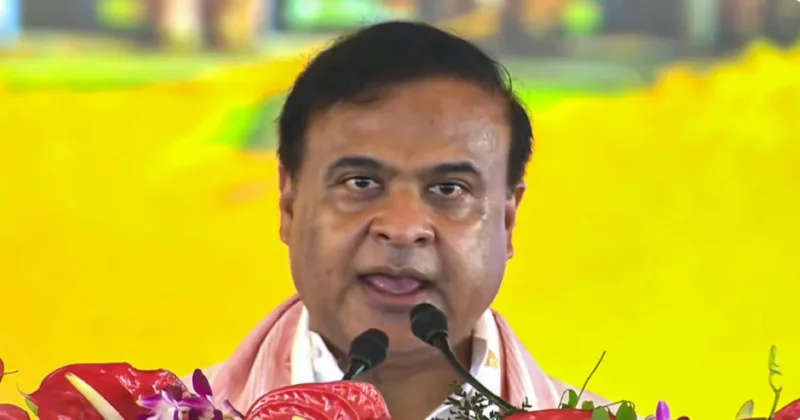
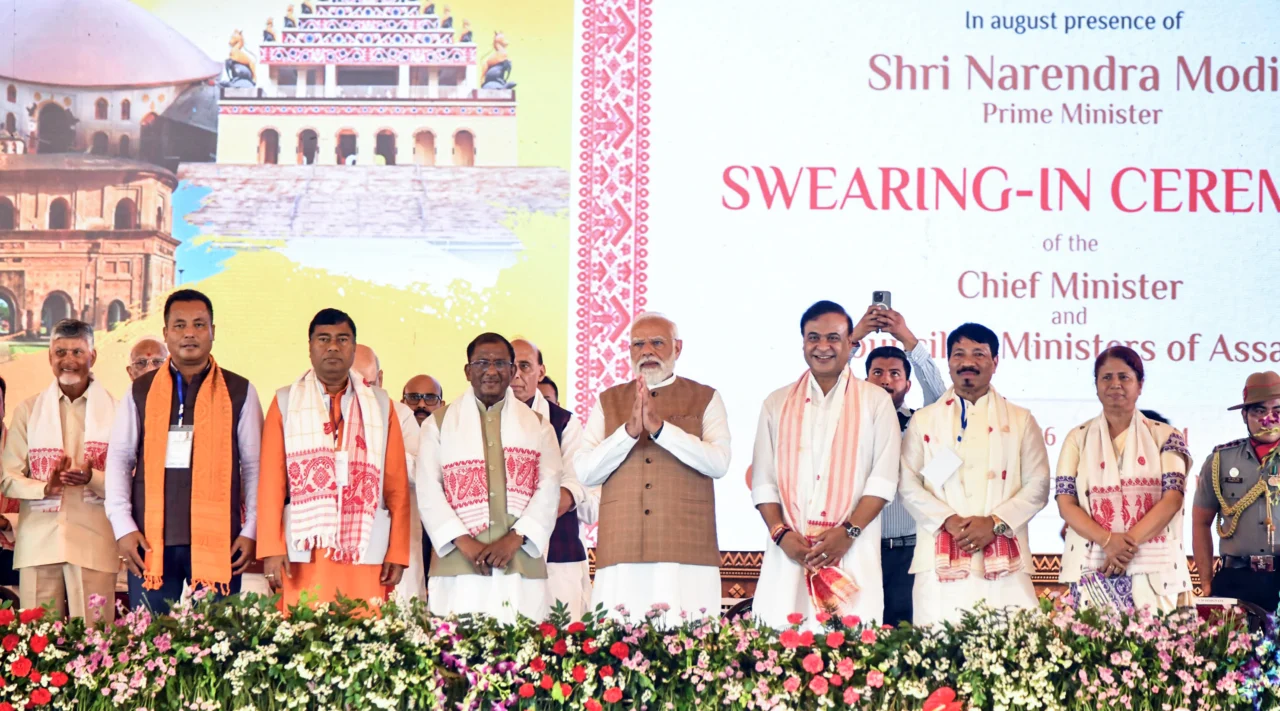
In front of tens of thousands of BJP supporters, Satradhikars, cultural luminaries and a constellation of national political heavyweights, Himanta Biswa Sarma was sworn in as Chief Minister of Assam for a second consecutive term at the Veterinary College Playground in Khanapara. Assam Governor Lakshman Prasad Acharya administered the oath of office and secrecy to the incumbent Chief Minister as the vast ground erupted in cheers.
Prime Minister Narendra Modi attended as the chief guest — his presence alone signalling how central Assam has become to the BJP’s national political story.
Four ministers were sworn in alongside Dr Sarma, one each drawn from the NDA’s alliance partners in a careful balancing act. Senior BJP leaders Rameswar Teli and Ajanta Neog took oath as Cabinet Ministers, while Asom Gana Parishad president Atul Bora and Bodoland People’s Front’s Charan Bodo were also inducted — giving the cabinet an immediate coalition character.
The dignitaries in attendance read like a who’s who of the ruling establishment. Home Minister Amit Shah, Defence Minister Rajnath Singh and Union Ministers Sarbananda Sonowal, Kiren Rijiju, Shivraj Singh Chauhan and Jyotiraditya Scindia were present. So were the Chief Ministers of all seven Northeastern states — Manika Saha of Tripura, Konrad Sangma of Meghalaya, Neiphiu Rio of Nagaland, Pema Khandu of Arunachal Pradesh, Prem Singh Tamang of Sikkim, Lalduhoma of Mizoram and Y. Khemchand Singh of Manipur. From beyond the region came Uttar Pradesh CM Yogi Adityanath, West Bengal CM Suvendu Adhikari, Delhi CM Rekha Gupta, Bihar CM Samrat Chaudhary, Uttarakhand CM Pushkar Singh Dhami, Maharashtra CM Devendra Fadnavis, Andhra Pradesh CM N. Chandrababu Naidu, Goa CM Pramod Sawant, Madhya Pradesh CM Mohan Yadav, Chhattisgarh CM Vishnu Deo Sai, Rajasthan CM Bhajan Lal Sharma, Haryana CM Nayab Singh Saini and Odisha CM Mohan Charan Majhi, among others.
Senior BJP leader and Assam assembly Speaker (designated) Ranjit Das said, “we are now eying the 2031 assembly election and winning it too with a massive mandate. We will work keeping that in mind.”
Altogether, Chief Ministers and Deputy Chief Ministers from 21 BJP and NDA-ruled states and seven Union Ministers made the journey to Guwahati — turning the ceremony into a demonstration of the ruling alliance’s national organisational muscle.
The mandate that made it possible
The scale of Tuesday’s celebration was rooted in the scale of the electoral result. The BJP, for the first time in its history in Assam, secured an outright absolute majority — winning 82 seats on its own, 18 above the halfway mark of 64 in the 126-seat Assembly. Add to that 10 seats each for alliance partners AGP and BPF, and the NDA’s combined tally stood at a commanding 102 seats.
The opposition, by contrast, managed only 24 seats in total. The Congress, under the leadership of state president Gaurav Gogoi, registered what many within the party are privately acknowledging as the worst performance in its Assam political history — winning just 19 seats. Notably, only one Hindu MLA of the Congress party won a seat in this election. The AIUDF, led by Badruddin Ajmal, also suffered significant losses as Muslim voters consolidated towards Congress rather than backing the minority-focused party.
The results, according to political observers, reflected a decisive consolidation of Hindu Assamese, indigenous community, tribal and tea community voters behind the BJP-led alliance — while the united opposition failed to stitch together a broad enough coalition to mount a credible challenge.
Responsibility to match the mandate
The BJP’s sweeping mandate, however, comes loaded with expectations. For CM Sarma, who has governed Assam with an assertive and often headline-grabbing style since 2021, the second term brings an amplified set of responsibilities.
Development delivery, welfare schemes and infrastructure expansion remain on the agenda. But alongside these, the protection of Assamese identity, indigenous culture and heritage from what the ruling party has described as demographic and cultural pressures — particularly concerning Bangladeshi-origin settlers in border districts — is expected to remain a defining political theme of the CM Sarma government’s next five years.
With 102 seats, a unified NDA, and the full backing of the national leadership, Himanta Biswa Sarma begins his second term with more political capital than perhaps any Chief Minister Assam has seen in recent memory. Whether that capital translates into legacy-defining governance is a question the next five years will answer.