The Rashtriya Swayamsevak Sangh (RSS), founded in 1925, is now celebrating its centenary year. Rather than using the occasion merely for self-glorification or organisational display, the RSS has chosen to continue its foundational mission — social awakening, character building, and the protection of Dharma — as the central theme of its centenary activities. At such a moment, attempts to obstruct the RSS or demand its ban have once again surfaced strongly, only to meet with failure. The reason is simple: the work carried out by the RSS is deeply rooted in society itself, and therefore society continues to stand firmly behind it.
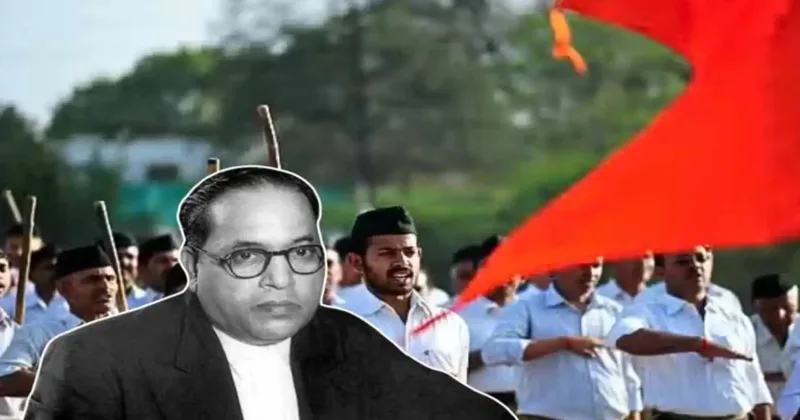
Over the decades, several narratives and strategies have been employed to create a divide between the RSS and society. Even after repeated failures, such attempts have not ceased. One of the most frequently used instruments in this campaign against the RSS has been Dr. B.R. Ambedkar.
A negative narrative was systematically built around the claim that Dr. Ambedkar was a staunch opponent of the RSS and held it in contempt. However, a closer examination of historical records presents a very different picture. Dr. Ambedkar’s visit to an RSS training camp exactly 87 years ago decisively challenges many of these hostile narratives.
On May 121939, Dr.BR Ambedkar visited the RSS Training Camp (OTC) held at the Bhave School grounds in Pune. He was accompanied by advocate Bavu Saheb Ghadkari, Dalit leader and labour leader Balasaheb Salunke, among others. During the visit, Ambedkar was greatly impressed by the discipline, equality, and restraint displayed by the camp participants, who conducted themselves with military precision.
Since Ambedkar’s father had served in the military, and Ambedkar himself had a deep interest in military organisation and discipline, he addressed the trainees much like a commander speaking to soldiers. He personally interacted with and guided the participants.
Based on diary entries recorded by labour leader Balasaheb Salunke — who later became a Member of Parliament representing the Scheduled Castes Federation founded by Ambedkar — the essence of Ambedkar’s speech may be reconstructed as follows:
“My salutations to the youth of this nation.
When I entered this camp, I asked one of the participants, ‘Are there any members of the Scheduled Castes here as trainees?’
He replied, ‘There are no Scheduled Castes here. We are only Indians.’
Even then, out of natural curiosity, I observed the camp carefully and noticed that young men from all castes were mingling freely as one. In that simple reply, the trainee conveyed to me the organisation’s outlook — one that works beyond caste and religion with sincerity and purity of purpose.
The most striking feature of this camp is its discipline. Your conduct, speech, uniform, work culture, activities, and punctuality are all remarkably organised. Looking at all of you reminds me of soldiers. I grew up observing the same discipline and punctuality within the military.
I have had long discussions with the revered Doctorji regarding India’s social order and the question of equality, and I was aware of his work in these areas. But today, for the first time, I am witnessing directly how systematically and disciplined this mission is being carried out.
Truly, the India of my dreams seems to be taking shape here. I now feel confident that this organisation will one day reach every corner of India, spread to every village, and contribute to shaping the nation’s future.
I congratulate Doctorji for this important national mission, and I extend my congratulations to all of you as well.
Bharat Mata Ki Jai.”
(These details were personally recorded in his diary by Balasaheb Salunke himself, who was present during Ambedkar’s visit and later served as a Member of Parliament from Ambedkar’s Scheduled Castes Federation. These diary records were subsequently published by his son Kashyap Salunke in the book “Hamare Saheb”.
In reality, documentary evidence clearly establishes that Dr. Ambedkar held a positive opinion of the RSS. Yet, despite such evidence, efforts to widen the perceived distance between Ambedkar and the RSS have continued unabated.)