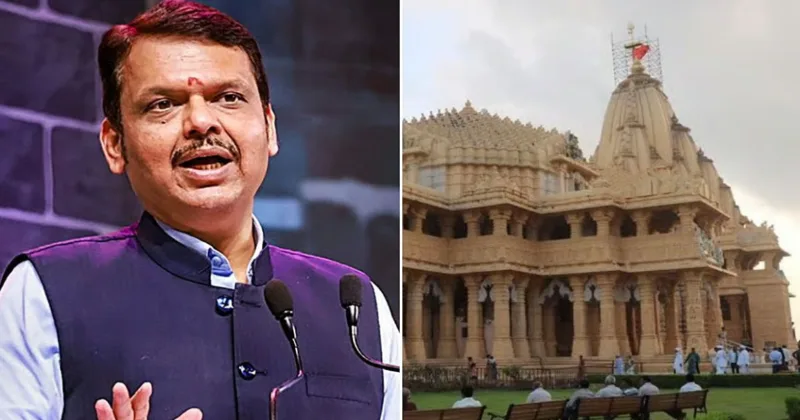
As Prime Minister Narendra Modi visited the Somnath temple on May 11 to mark 75 years since its post-Independence reconstruction, Maharashtra Chief Minister Devendra Fadnavis’ recent writings offer a layered lens to understand the moment, placing Somnath at the intersection of faith, history, and national identity.
A thousand years ago, the first of many attacks on Somnath took place. Those who kept engaging in such attacks believed they could shatter the ethos of our land. But, they were wrong. Thanks to fiercely courageous children of Bharat Mata, Somnath kept getting rebuilt.… pic.twitter.com/dN6qGEN4c9
— Narendra Modi (@narendramodi) May 11, 2026
A Temple Beyond Time
For Fadnavis, Somnath is not just an ancient shrine but “… a living embodiment of India’s unbroken culture and courage,” as he writes in Marathi in his piece in various Maharashtra dailies – an articulation of his reverence to and attachment towards the divine temple.
सोमनाथ आणि महाराष्ट्राचे नाते हे केवळ भूगोलाचे नाही, तर इतिहास, श्रद्धा, स्वाभिमान आणि पुनरुत्थानाच्या अखंड परंपरेचे आहे. पुण्यश्लोक राजमाता अहिल्यादेवी होळकर यांच्या पासून मराठा साम्राज्यापर्यंत अनेकांनी सोमनाथच्या पुनर्बांधणीसाठी दिलेले योगदान हे भारतीय संस्कृतीच्या अढळ… pic.twitter.com/JghYUOmiwQ
— Devendra Fadnavis (@Dev_Fadnavis) May 10, 2026
Somnath, he says, is a living embodiment of India’s unbroken culture and courage. He writes that the temple’s significance goes far beyond devotion, describing it as a site where “A history of invasions, reconstruction, self-respect, governance, and national resurgence…” converges.
This framing shifts the focus from a static monument to a dynamic civilisational marker. Somnath, in his telling, is not frozen in history but constantly renewed through collective memory and action.
From Ruin to Renewal
Mahmud of Ghazni attacked and plunder Somnath in 1025–26 CE. In 1299, forces under Alauddin Khalji (Ulugh Khan and Nusrat Khan) raided Gujarat and targeted Somnath – like it or not – another Islamist invader targeted the great temple. In the late 17th century, the radicalised Mughal (actually Turkik lineage) ruler Aurangzeb is widely recorded as having ordered the temple’s demolition. There were also intervening phases under the Gujarat Sultanate where the site was damaged or its worship curtailed, though details vary by source.
The repeated destruction of Somnath, beginning with the 11th-century invasion by Mahmud of Ghazni, is acknowledged by Fadnavis not as a story of loss but of resilience. He notes that despite multiple invasions, “The lamp of faith at Somnath has never been extinguished…,” emphasising that faith endured even when the structure attacked and viciously destroyed.
He underscores that every phase of reconstruction was an act of assertion. “Reconstruction is not merely about rebuilding a temple, but about re-establishing the self-respect of a culture,” he writes, positioning rebuilding as a conscious reclaiming of identity.
Maharashtra’s Deep Historical Bond
A key dimension of Fadnavis’ articulation is the strong emphasis on Maharashtra’s connection to Somnath. He writes that the relationship is not incidental but rooted in shared history and responsibility. “The relationship between Somnath and Maharashtra is not geographical, but historical and cultural,” he notes.
Invoking Chhatrapati Shivaji Maharaj and the Maratha legacy, he highlights a broader vision where safeguarding sacred spaces was part of a larger civilisational duty. The Marathas, he suggests, saw themselves as protectors of a cultural continuum that extended beyond regional boundaries.
The role of Ahilyabai Holkar – the pious and brave Maratha ruler of Indore and the daughter-in-law of the renowned warrior general Malharrao Holkar – is described with particular reverence. Fadnavis points out that her efforts ensured continuity of worship during turbulent times, reflecting a governance model rooted in faith and cultural preservation. “Ahilyabai Holkar did not merely rebuild, but kept the unbroken tradition of faith alive,” he writes.
A National Project After Independence
Fadnavis situates Somnath’s modern reconstruction within the larger story of India’s emergence as an independent nation. He recalls how Sardar Vallabhbhai Patel took the initiative to rebuild the temple, turning it into a symbol of national self-respect.
He emphasises that the effort was driven by public participation rather than state funding. “This work was accomplished not by the government, but by the people,” he writes, reinforcing the idea that Somnath belongs to the people of India as a whole.
The role of Dr Rajendra Prasad in inaugurating the temple in 1951 is presented as a defining moment.
What we need to elaborate on this point here is that the resporation of the temple of Somnath became reality due to millions of Indians who rallied behind the ethos – including the then President of the country.
Dr Rajendra Prasad, independent India’s first President, was the one who formally inaugurated the reconstructed Somnath Temple in 1951, giving the project both national visibility and civilisational significance. After the temple was rebuilt under the initiative of Sardar Vallabhbhai Patel and driven by K.M. Munshi and the Somnath Trust, it was decided to invite the President to mark the occasion. Dr Rajendra Prasad attended the inauguration ceremony on May 11, 1951, at Prabhas Patan in Gujarat. He performed the ceremonial installation (pran pratishtha) and formally dedicated the temple to the nation.
SOMNATH – FROM RUINS TO RESURRECTION
Pic 1. Ruins of #SomnathTemple, 1899.
Pic 2: Dr. Rajendra Prasad performing Puja at the newly constructed Temple.#SomnathVirasatK75Varsh pic.twitter.com/EAOAT7fZ46— Indian Art (@IndiaArtHistory) May 11, 2026
It is a well-known fact that the then Prime Minister of India, Jawaharlal Nehru was not in favour of the President attending, but Dr Rajendra Prasad chose to attend in his personal capacity, making a principled statement about cultural heritage, framing the moment as a civilisational reaffirmation for independent India. His presence turned the event from a regional reconstruction into a national milestone.
Fadnavis notes that the event signified the alignment of political freedom with cultural resurgence, giving independent India a deeper sense of continuity.
Somnath as a Living Narrative
The Somnath Swabhimaan Parv, marking a thousand years since the first major attack on the temple, is described by Fadnavis as “This is truly a living story of truth.” He argues that the festival is not merely commemorative but reflective, urging society to engage with history as a living force.
8. Somnath Temple, India before and after reconstruction pic.twitter.com/NUqOeZyFCs
— Today In History (@historigins) April 29, 2025
He writes that the story of Somnath continues to inspire because it embodies both (Sangharsh) Struggle and (Punarjanma) Rebirth. “History does not merely tell the past; it shapes the present and shows the direction for the future,” he observes.
Pan-Indian Ethos and Shared Ownership
Perhaps the most striking aspect of Fadnavis’ narrative is his insistence that Somnath transcends regional identity. “Somnath is not just a matter for Gujarat, but for the whole of India,” Chief Minister Devendra Fadnavis states unequivocally.
This idea of shared ownership is central to his argument. The temple, he suggests, is part of a sacred geography that binds the nation emotionally. It reflects a unity that predates modern political boundaries and continues to shape national consciousness.
By linking Somnath to broader initiatives that emphasise cultural heritage and connectivity, Fadnavis aligns the temple with a vision of India where tradition and development coexist.
Faith as Strength, Not Memory Alone
Fadnavis’ writing carries a strong emotional undercurrent, but it is anchored in resolve rather than nostalgia. He presents faith not as a passive sentiment but as an active force that drives renewal.
“Faith is not just an emotion; it is a force,” Fadnavis writes, underscoring that the endurance of Somnath lies in the collective will to rebuild and preserve.
He also cautions against viewing history as a series of defeats. Instead, he frames it as a continuum of resilience where each generation contributes to sustaining civilisational values.
A Message for the Present
In the context of the Prime Minister’s visit and the 75-year milestone of reconstruction, Fadnavis’ reflections acquire added relevance. His writing suggests that Somnath is not just a reminder of what India has endured, but a guide to how it must move forward.
He describes the temple as a point where past, present, and future intersect. “This is not merely a remembrance of history, but an inspiration to move forward with confidence,” he writes.
Enduring Symbol of Civilisational Continuity
Fadnavis ultimately frames Somnath as a testament to an unbroken civilisational thread. It is a place where destruction did not lead to erasure and where faith translated into action across centuries.
In his telling, Somnath stands not just as a monument of stone, but as a living idea. An idea that continues to unite, inspire, and define India.
As the nation marks milestones linked to the temple’s reconstruction, that idea remains central. Somnath endures not because it was protected historically, but because it was rebuilt every time calamity struck.