
In Tamil Nadu’s political theatre, elections have increasingly become contests not of governance, reform, or economic vision — but of who can promise the largest basket of freebies. Into this well-established culture of competitive populism now steps Vijay, whose party, Tamilaga Vettri Kazhagam, has unveiled a manifesto overflowing with cash transfers, subsidies, waivers, and welfare guarantees.
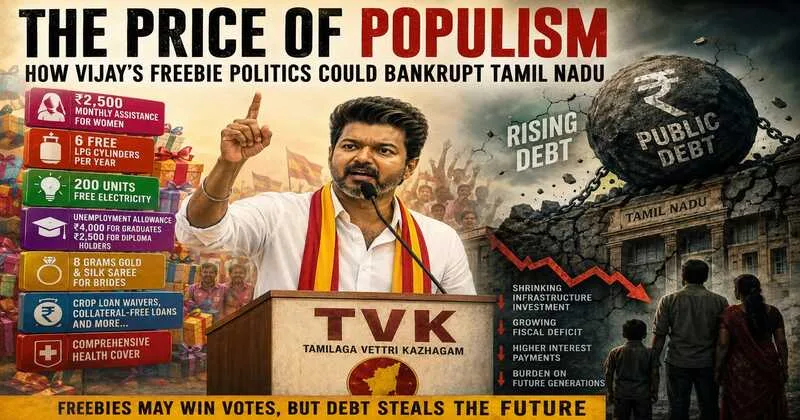
The promises are dazzling in scale: Rs 2,500 monthly assistance for women heads of households, six free LPG cylinders annually, 200 units of free electricity, unemployment allowances, gold assistance for marriages, crop loan waivers, collateral-free loans, and expanded healthcare benefits.
For millions of voters struggling under inflation and economic uncertainty, these announcements sound comforting. Politically, they are designed to create instant emotional appeal. Economically, however, they represent a deeply dangerous trajectory for a state already grappling with mounting debt and shrinking fiscal space.
What TVK presents as “social justice” risks becoming fiscal irresponsibility on an unprecedented scale.
The Dangerous Expansion of Freebie Politics
Tamil Nadu has long been the laboratory of welfare-driven electoral politics. Successive governments led by the Dravida Munnetra Kazhagam and the All India Anna Dravida Munnetra Kazhagam normalised a political culture built around state-sponsored giveaways-televisions, mixers, grinders, laptops, bicycles, and cash assistance schemes.
What began as targeted welfare gradually evolved into a competitive race of populist bidding. TVK has not challenged this model. It has amplified it.
The problem is not welfare itself. A responsible welfare state is essential in a society marked by inequality. Governments must support vulnerable citizens through healthcare, education, food security, and targeted social protection. But there is a critical difference between empowering welfare and fiscally reckless populism. TVK’s manifesto leans heavily toward the latter.
The proposed monthly allowance scheme alone could cost the exchequer tens of thousands of crores every year. Add to this electricity subsidies, LPG support, unemployment doles, pensions, and agricultural waivers, and the cumulative burden becomes staggering.
These are not one-time expenditures. They are recurring liabilities.And Tamil Nadu’s finances are already under severe strain.
A State Drowning in Debt
Tamil Nadu remains one of India’s strongest industrial economies, with a robust manufacturing base, thriving automobile and electronics sectors, and significant tax revenues. Yet despite these strengths, the state’s debt burden has ballooned dramatically over the years.
Public liabilities are approaching alarming levels. Interest payments consume an increasingly large share of government revenue. Borrowings that should ideally finance productive infrastructure are now being diverted toward subsidies, salaries, pensions, and recurring welfare expenditure.
This is the central danger of populist economics: governments begin borrowing not to create assets, but to sustain consumption.
When a state borrows for roads, ports, industrial corridors, logistics networks, or power infrastructure, future economic growth can justify the debt. But borrowing to finance recurring handouts creates no lasting productive capacity. It merely postpones the crisis.
Every election cycle then forces political parties to announce even larger freebies to remain competitive, creating a vicious spiral of debt-financed populism. Ultimately, future generations inherit the burden.
The Cost to Tamil Nadu’s Economic Future
The hidden damage of excessive welfare politics is often invisible in the short term. But over time, it weakens a state’s economic foundations.
As revenue expenditure rises, capital expenditure suffers. Investments in highways, urban infrastructure, industrial parks, water management, transport systems, and energy modernisation begin to shrink. This undermines long-term competitiveness.
Tamil Nadu’s success historically rested on industrialisation, entrepreneurship, and export-oriented growth. It emerged as one of India’s most attractive investment destinations because of relatively strong infrastructure and administrative stability. But investors seek fiscal predictability.
A state increasingly dependent on borrowings to sustain subsidies sends troubling signals to industry. Large deficits raise concerns over future taxation, policy instability, and deteriorating public finances.
Subsidy-heavy regimes also distort economic behaviour. Free electricity weakens power utilities. Loan waivers damage credit discipline. Unemployment allowances without parallel structural reforms risk encouraging dependency rather than productive employment.
Sustainable prosperity cannot be built on permanent political patronage.
Real empowerment comes from quality education, industrial growth, entrepreneurship, skill development, and job creation not endless state-funded consumption.
Cinema Populism Meets Economic Reality
Like M. G. Ramachandran before him, Vijay seeks to convert cinematic charisma into political capital. The emotional appeal is undeniable. His messaging taps into frustration with traditional Dravidian politics while simultaneously borrowing its most electorally successful formula-welfare populism. But Tamil Nadu today faces a far more unforgiving economic environment than it did decades ago.
Global competition is intensifying. Manufacturing investments are increasingly mobile. States compete aggressively for industrial capital. Infrastructure quality, energy reliability, logistics efficiency, and fiscal discipline matter more than ever before.
In such an environment, the politics of uncontrolled freebies becomes not merely unsustainable, but economically self-destructive.
The danger lies not only in fiscal deterioration, but in the normalisation of a political culture where governance is reduced to distribution.
If elections become auctions of taxpayer-funded promises, serious economic policymaking disappears altogether.
Tamil Nadu’s Defining Choice
Tamil Nadu stands at a crossroads between two competing visions. One path continues the cycle of debt-fuelled populism, where political parties mortgage future revenues for immediate electoral gains. The other path prioritises sustainable growth- investment, infrastructure, industrial expansion, innovation, and targeted welfare linked to productivity and empowerment.
The state possesses extraordinary advantages: a skilled workforce, industrial depth, entrepreneurial culture, strong urbanisation, and strategic geographic positioning. But these strengths cannot indefinitely compensate for fiscal indiscipline. There is no such thing as “free” welfare.
Every subsidy carries a cost paid eventually through debt, reduced infrastructure investment, higher taxes, inflationary pressures, or declining economic competitiveness.
Political slogans may win elections. But sound economics determines whether societies prosper or decline. And Tamil Nadu’s future may well depend on whether it chooses populist applause today or economic stability tomorrow.