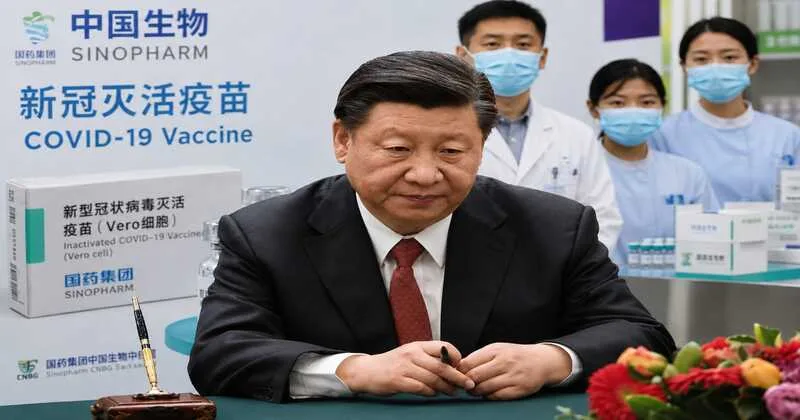
More than three years after China dismantled its strict pandemic controls, concerns surrounding the long-term effects of domestically produced COVID-19 vaccines continue to surface across several provinces, with citizens reporting severe health complications, sudden deaths among younger people, and an apparent lack of response from Chinese authorities.
According to media reports, multiple individuals from different regions of China have described persistent health problems that they believe began after receiving Chinese-made COVID-19 vaccines. Reports of sudden heart attacks, strokes, neurological disorders, unexplained fatigue, memory loss, and chronic chest pain have increasingly circulated online and through local communities, even as public discussion of vaccine-related injuries remains tightly restricted inside China.
Authorities have not acknowledged the existence of any broader vaccine injury crisis. However, growing numbers of citizens have attempted to seek answers, compensation, or medical explanations, only to encounter silence, censorship, or legal pressure. Reports indicating a visible increase in deaths among younger and middle-aged individuals in recent years. According to the report, deaths from heart attacks and strokes among people in their 30s, 40s, and 50s appeared to rise after the mass vaccination campaign. The reports also described widespread complaints involving weakened immunity, hair loss, forgetfulness, allergies, and recurring illness. The pandemic period itself was described as overwhelming, with funeral-related work reportedly increasing sharply during the peak years of China’s COVID-19 crisis.
Reports of severe symptoms and sudden deaths
According to reports published by various media houses, a resident from Liaocheng in Shandong Province stated that her uncle died suddenly from a heart attack in late April despite previously being healthy and showing no warning signs. The reports noted that similar sudden deaths had become increasingly common in the area, particularly among individuals in their 40s and 50s. The same individual reportedly developed chest pain, weakness, forgetfulness, persistent low-grade fevers, sleepiness, and hair loss after receiving a single-dose COVID-19 vaccine that was officially counted as two shots.
Another case involved a man in his 30s from Hechi in Guangxi Province, who experienced severe physical deterioration after receiving three doses of the COVID-19 vaccines. According to the report, he suffered recurring chest tightness, palpitations, shortness of breath, severe headaches, dizziness, blurred vision, and episodes resembling heart attacks and strokes.
The symptoms reportedly became so serious that he repeatedly visited emergency rooms and underwent scans, ultrasounds, and more than a dozen electrocardiograms. Despite extensive testing, doctors reportedly failed to identify a clear cause and informed him that he was suffering from a nervous system disorder with no available treatment. The report stated that his physical condition deteriorated over time, resulting in dramatic weight loss of nearly 50 pounds and the inability to continue working. Once capable of performing long hours of physical labour, he became too weak to maintain employment. The vaccines he received were produced by Shenzhen Kangtai Biological Products.
According to the account, severe symptoms intensified after the second injection, leaving him bedridden. Despite concerns about taking another dose, he was informed that his symptoms were unrelated to vaccination and was administered a third shot. The reports further claimed that his child later developed multiple health problems believed to be linked to vaccination. In addition, several individuals personally known to him died suddenly after receiving COVID-19 vaccines, although specific vaccine brands and timelines for those deaths were not detailed.
Compensation appeals, censorship and criminal charges
According to reports, several Chinese citizens who attempted to publicly raise concerns regarding vaccine injuries faced official obstruction or censorship. On June 18, 2025, Guangdong resident Wang Haiyan and several others who identified themselves as disabled by COVID-19 vaccines went to provincial health authorities seeking compensation. But the officials refused to meet them. Later that evening, the group livestreamed from a reception room to discuss their experiences publicly, but the livestream was quickly shut down.
Another widely discussed case involved Shanxi resident Zhao Yajing, who received two doses of the Sinovac COVID-19 vaccine in May and June 2021. According to Radio Free Asia, she was diagnosed with acute myeloid leukaemia in January 2022. The report stated that Zhao and her husband, Wang Hongyi, repeatedly petitioned Beijing authorities seeking compensation after suspecting a connection between the illness and vaccination. Chinese authorities later charged both individuals with “picking quarrels and provoking trouble,” an offence frequently used against petitioners and dissidents in China.
Wang Hongyi received a six-month prison sentence, while Zhao Yajing was sentenced to two years and nine months in prison.
Rising online attention over sudden deaths
In recent years, reports of sudden deaths involving middle-aged officials, media figures, and public personalities have increasingly drawn public attention across China. Discussions linking these deaths to vaccines have frequently been censored online, with related posts removed from Chinese social media platforms. Chinese state media and government-controlled outlets often described such deaths using vague phrases, including “sudden illness” or “treatment failure,” without releasing detailed medical explanations.
Among the recent deaths receiving public attention was that of Mao Xinyu, 45, chief of the Longba police station under the Zhuxi County Public Security Bureau in Shiyan, Hubei Province. According to the state-owned Legal Daily, he died suddenly on April 20 while working. On April 18, Ye Jun, 43, a director known for the Chinese-language documentary series “Masters in the Forbidden City,” died after medical treatment for an illness failed, according to the state-run China Internet Information Centre.
Another case involved Yi Lian, a 38-year-old artist and alumnus of the China Academy of Art, who died on April 15 after unsuccessful medical treatment for an illness. The death was reported by Jimu News, a Chinese outlet operating under state censorship rules.
On April 10, Yu Hongli, 45, deputy director of the Yongren County Public Security Bureau in Chuxiong Prefecture, Yunnan Province, died after suddenly falling ill during a meeting, according to People’s Public Security News. Additional deaths reported by Chinese media included Wang Zhiwen, Party secretary and director of the Shuocheng branch of the Shuozhou Ecology and Environment Bureau in Shanxi Province, who reportedly died from a sudden illness while working on April 1 at the age of 49. Tang Jian, Party secretary and chairman of Guotong Trust, reportedly died from a sudden heart attack on March 25 at age 55. Wei Hua, an investigative reporter with Henan Radio and Television, reportedly died from a sudden heart attack on March 19 at the age of 45.
As reports of sudden illness and unexplained deaths continue to emerge, public discussion inside China remains heavily controlled, with authorities offering little public transparency regarding possible long-term vaccine complications or broader health trends following the country’s mass COVID-19 vaccination campaign.